
Dietary Pattern and Body Composition Anthropometric Indices Among Biochemistry Undergraduate Students in Katsina; A Cross-Sectional Study
DOI:
https://doi.org/10.33003/fjs-2026-1011-5430Keywords:
Dietary Pattern, Body Composition, Anthropometry, Undergraduate StudentsAbstract
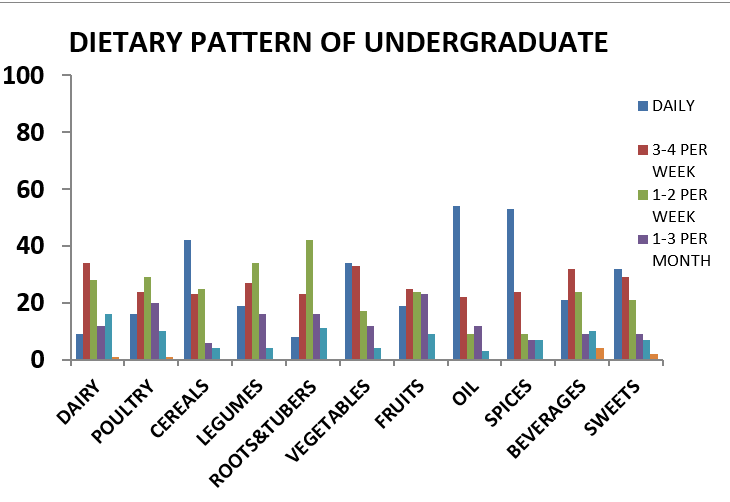
University students often experience changes in dietary habits due to increased independence and exposure to diverse food environments influencing dietary patterns and body composition with potential implications for future health outcomes. This study assessed dietary pattern and body composition anthropometric indices among biochemistry undergraduate students of Federal University Dutsin-Ma, Katsina State. A cross-sectional descriptive study was conducted among 100 biochemistry undergraduate students selected through convenience sampling. Dietary pattern was assessed using modified 11-item food frequency questionnaire covering major food groups. Body mass index (BMI), body fat percentage, muscle composition, visceral fat and resting metabolism were measured using an Omron BF511 body composition monitor. Daily consumption was highest for oil (54%), spices and condiments (53%), cereals (42%), vegetables (34%) and sweets (32%). Dairy products (34%), beverages (32%), and fruits (25%) were predominantly consumed 3–4 times weekly, while roots and tubers (42%), legumes (34%) and poultry (29%) were mostly consumed 1–2 times weekly. Most students (79.0%) had normal BMI, while 13.0%, 6.0%, and 2.0% were underweight, overweight and obese respectively. Males had significantly higher muscle composition (p < 0.001) and resting metabolism (p < 0.001) while females had higher body fat percentage (p < 0.001). Nearly all respondents (99.0%) had normal visceral fat levels. Students demonstrated dietary pattern characterized by frequent consumption of cereals, vegetables, oils, spices, and sweets. Although majority had normal BMI and visceral fat, significant gender differences existed in body composition parameters. Continuous nutrition education is recommended to encourage healthier dietary choices and prevent future nutrition-related disorders.
References
Abubakar, S. M. and Shehu, A. (2022). Body Composition of Women of Reproductive Age in Urban and Rural Settings in Kano State. Journal of Dietitians Association of Nigeria, 13(1):28-34.
Al-Rethaiaa, A.S., Fahmy, A.A. and Al-Shwaiyat, N. M. (2010). Obesity and eating habits among college students in Saudi Arabia: A cross sectional study. Nutrition Journal; 9:39.
Arisa, N., Anaemene, D. and Mekwunye, W. (2020). Assessment of Overweight, Obesity and the Dietary Habits of Undergraduate Students of Lagos State University. European Journal of Nutrition and Food Safety, 12(5): 25-34.
Borel, A. L., Coumes, S., Reche, F., Ruckly, S., Pe´pin, J. L. and Tamisier, R. (2018). Waist, neck circumferences, waist-to-hip ratio: which is the best cardiometabolic risk marker in women with severe obesity? The SOON Cohort. PLoS ONE, 13(11):e0206617.
Dietary Guideline Advisory Committee, (2015). Dietary guidelines advisory committee scientific report: development and major conclusions. Advances in Nutrition, 7(3): 438-444.
FAO (2018). Dietary Assessment: A resource guide to method selection and application in low resource settings. Rome.
Fregene, C. E., Mahmood, S. F. T., Ojji, D. B., Adegboye, A. O. and Ubiaru, M. E. (2025). Intake assessment of saturated fat in palm olein and soya oil for pregnant and lactating women in Nigeria. World Nutrition, 16(2): 95–99. https://doi.org/10.26596/wn.202516295-99
Haq, I., Mariyam, Z., Li, M., Huang, X., Jiang, P., Zeb, F., Wu, X., Feng, Q. and Zhou, M. A, (2018). Comparative study of nutritional status, Knowledge Attitude and Practices (KAP) and dietary intake between International and Chinese Students in Nanjing, China. International Journal of Environmental Research and Public Health; 15:1910.
Hasan, H., Faris, M. A. I. E., Mohamad, M. N., Al Dhaheri, A. S., Hashim, M. Stojanovska, L., Al Daour, R., Rashid, M., El-Farra, L., Alsuwaidi, A., Altawfiq, H., Erwa, Z. and Cheik, I. L. (2021) Consumption, attitudes, and trends of vending machine foods at a university campus: a cross-sectional study. Foods 10, 2122
Idialu, E. E. and Uwameiye, B. E. (2024). Assessment of Dietary Patterns of Undergraduates of Public Universities in Edo and Delta States, Nigeria. Studies in Education, 22(1): 127-137.
Jackson, C. E. and DiPlacido, J. (2020) Vitality as a mediator between diet quality and subjective wellbeing among college students. Journal of Happiness Studies: 21, 1617–1639.
Liang, X. M. D., Xianhua, C. M. D., Jing, L. M. S., Mengdan, Y. M. S. and Yifeng, Y. M. D. (2018). Study on body composition and its correlation with obesity. Medicine, 97(21):1-6.
Liberty, F. K. and Bello, Y. (2021). Analysis of Rainfall and Temperature Trends in Dutsin-Ma Town, Dutsin-Ma Local Government Area, Katsina State, Nigeria. Bima Journal of Science and Technology, 6(2): 189-199.
Middha, B., Strengers, Y., Lewis, T. and Horne, R. E.. (2021) Spatiotemporalities of convenience eating for sustainability outcomes at an inner-urban university. Geographical Research 59, 407–4
Niba, L. L., Atanga, M. B. and Narti, L. K. (2017). A crossanalysis of eating habits and weight status of university students in Cameroun. BMC Nutrition; 3:55
Nola, I. A., Jelinic, J. D., Matanic, D., PucarinCvetkovic, J., Bergman Markovic, B. and Senta, A. (2010). Differences in eating and lifestyle habits between first- and sixth-year medical students from Zagreb. Collegium Antropologicum; 34:1289–1294.
Omage, K., and Omuemu, V. (2018). Assessment of dietary pattern and nutritional status of undergraduate students in a private University in Southern Nigeria. Food Science and Nutrition, 6(7), 1890-1897.
Ram´on-Arbués, E., Granada-L´opez J. M., Martínez-Abadía, B., Echaniz-Serrano, E., Anton-Solanas, I. and Jerue, B. A. (2021). Factors related to diet quality: a cross-sectional study of 1055 University students. Nutrients 13, 3512
Shaw, A., Capetola, T., Lawson, J. T., Henderson-Wilson, C. and Murphy, B. (2018). The cost of sustainability in higher education: staff and student views of a campus food culture. International Journal of Sustainability in Higher Education 19, 376–392.
Solaja, S. O., Bamiro, O. M., Ayeni, M. D. and Mohammed, G. (2025). Fruit and vegetable intake among Nigerian University students: patterns, preferences, and influencing factors. Open Agriculture; 11(1): 1-10.
Woods, A. L., Rice, A. J., Garvican-Lewis, L. A., Wallett, A. M., Lundy, B. and Rogers, M. A. (2018). The effects of intensified training on resting metabolic rate (RMR), body composition and performance in trained cyclists. PLoS ONE, 13(2):e0191644.
Downloads
Published
Issue
Section
Categories
License
Copyright (c) 2026 Amina Shehu, Christian Amuzie, Zainab Muhammad Bonomi, Umar Sabiu Abdullahi, Isyaku Yahaya Maisaje, Salisu Maiwada Abubakar

This work is licensed under a Creative Commons Attribution 4.0 International License.


