
Elemental and Physico-chemical characterization of farm lands in Matazu and Musawa, Katsina State, Nigeria.
DOI:
https://doi.org/10.33003/fjs-2026-10(ANB-K)-5404Keywords:
Physical properties, Chemical properties, Elemental composition, Fertility, Selected soilsAbstract
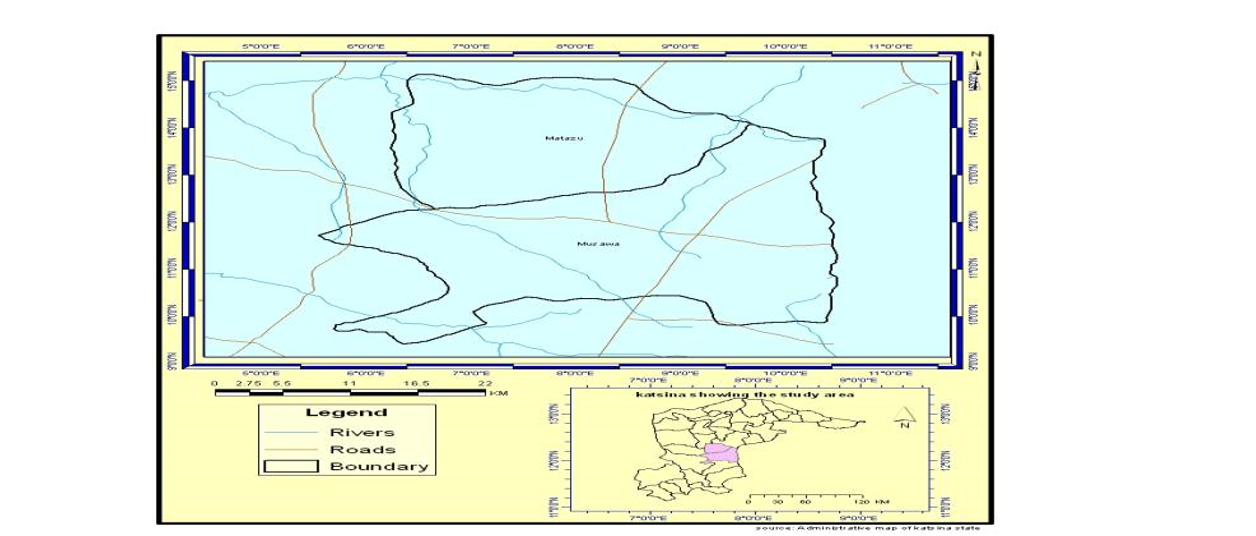
A good knowledge of the variations of soil physico - chemical properties and its elemental composition as it relates to micronutrient status is essential for good land evaluation which is a pre-requisite for effective land use planning. This work was carried out to determine the Elemental and Physico-chemical characterization farm lands in Matazu and Musawa, Katsina State, Nigeria. Field experiments were carried out during the 2020 and 2021 dry seasons and the equipment used to determine the elemental and physico-chemical characterization was Energy Dispersive X-ray Fluorescence (EDXRF). A total of 30 soil composite soil samples were collected from agricultural and non agricultural farm lands and soil erosion areas at 0 – 10 cm soil depth. The results of the study sites were slightly acidic, low to moderate macronutrients. The values for moisture content, porosity, particle density and bulk density were rated as moderate and were considered to favor good aeration, root penetration and free water movement in the soil. The values for the soil pH and available elements (N, P, K, and Cu) indicates the moderate acidity which implied that nutrients are likely to be available for crop uptake and is optimum for the release of plant nutrients and concentration of the available elements is low to moderate which requires the need to apply a fertilizer type for better plant growth, seeds and fruits (reproduction), plant growth of root and stem, leaves and flowers.
References
Akpa, S.I.C., Odeh, I.O.A., Bishop, T.F.A., Hartemink, A.E., Amapu, I.Y. 2016. Total soil organic carbon and carbon sequestration potential in Nigeria. Geoderma 271: 202 - 215.
Anikwe, M.A.N. 2010. Carbon storage in soils of southeastern Nigeria under different management practices. Carbon Balance and Management 5(1): 5.
Ayub, M. and Boyd, C.E. 1994. Comparisonof different methods for measuring organic carbon concentrations in pond bottom soils. J. World Aquacult. Soc. 25: 322-325.
Blair, N., Faulkner, R.D., Till, A.R., Poulton, P.R. 2006. Long-term management impacts on soil C, N and physical fertility. Part I. Broad balk experiment. Soil and Tillage Research 91: 30 - 38.
Carter, M.R. 2002. Soil quality for sustainable land management: organic matter and aggregation interactions that maintain soil functions. Agronomy Journal 94: 38 - 47.
FAO and ITPS. 2015. Status of the World’s Soil Resources (SWSR) – Technical Summary. Food and Agriculture Organization of the United Nations and Intergovernmental Technical Panel on Soils, Rome, Italy.
FAO: Rome, Italy; IIASA: Laxenburg, Austria; ISRIC: Wageningen, the Netherlands; ISSCAS: Nanjing, China; JRC: Ispra, Italy, 2012.
. Learning tool on Nationally Appropriate Mitigation Actions (NAMAs) in the agriculture, forestry and other land use (AFOLU) sector. Rome: FAO.
FAO. 2015a. Revised World Soil Charter. Rome: Food and Agriculture Organization of the
FAO. 2010. The world’s forests 2010. (Available at http://foris.fao.org/static/data/fra2010/ fao forest map 2010.pdf). Accessed 1 March 2017.
FAO. 2012. Peatlands - guidance for climate change mitigation through conservation, rehabilitation and sustainable use. Rome: FAO and Wetlands International.
Gee GW, Orr D., 1994: Particle-size analysis. In Methods of soil analysis Part 4-Physical methods Soil Sci Soc Am Book Ser 5.Edited by: Dane JH, Topp GC.SSSA, 1994 Madison, WI; 2002:255-293
Gelaw, A.M., Singh, B.R., Lal, R. 2014. Soil organic carbon and total nitrogen stocks under different land uses in a semi-arid watershed in Tigray, Northern Ethiopia. Agriculture, Ecosystems and Environment 188: 256 - 263.
Lal, R. 2001. The potential of soil carbon sequestration in forest ecosystems to mitigate the greenhouse effect. In: Soil Carbon Sequestration and the Greenhouse Effect. SSSA Special Publication 57, SSSA, Inc., Madison, WI. USA.
Lal, R. 2004. Soil Carbon Sequestration impacts on global climate change and food security. Soil Science 30: 1623 - 1627.
Lal, R. 2006. Enhancing crop yields in the developing countries through restoration of soil organic carbon pool in agricultural lands. Land Degradation and Development 17: 197 - 209.
Lal, R., Follett, R.F., Stewart, B.A., Kimble, J.M. 2007. Soil carbon sequestration to mitigate climate change and advance food security. Soil Science 172: 943 - 956.
Lal, R., Lehmann, J., O’Donnel, A.G., Parton, W.J., Whitehead, D., Zimmerman, M. 2013. The knowns, known unknowns and unknowns of sequestration of soil organic carbon. Agriculture, Ecosystems and Environment 164: 80 - 99.
Lal, R. 2001. World cropland soils as a source or sink for atmospheric carbon. Advances in Agronomy, 71: 145-191.
Lal, R. 2004. Soil carbon sequestration impacts on global climate change and food security. Soil Science Journal, 304(5677): 1623-1627.
McLeod, S 1973, Studies on wet oxidation procedures for the determination of organic carbon in soils. CSIRO Division of Soils, Notes on Soil Techniques, pp73-79.
Obalum, S.E., Chibuike, G., Peth, S., Ouyang, Y. 2017. Soil organic matter as sole indicator of Soil degradation. Environmental monitoring and assessment 189(4): 176.
Schmidt, M. & Noack, A. 2000. Black carbon in soils and sediments: Analysis, distribution, implications, and current challenges. Global Biogeochemical Cycles, 14(3): 777-793.
Schmidt, M. W. I., Torn, M. S., Abiven, S., Dittmar, T., Guggenberger, G., Janssens, I. A., Kleber, M., Kögel-Knabner, I., Lehmann, J., Manning, D. A. C., Nannipieri, P., Rasse, D. P., Weiner, S. & E. Trumbore, S. E. 2011. Persistence of soil organic matter as an ecosystem property. Nature, 478: 49–56.ls and Carbon Sequestration. Forest Ecology and Management, 220: 242-258
Walkley, A.; Black, I.A. 1934. An examination of Degtjareff method for determining soil organic matter, and proposed modification of the chromic acid tritation method. Soil Science journal 37: p.29-38.
Zinn, Y.L., Guerra, A.R., Silva, C.A., Faria, J.A., Silva, T.A.C. 2014. Soil organic carbon and morphology as affected by pine plantation establishment in Minas Gerais, Brazil. Forest Ecology and Management 318: 261 - 269.
Downloads
Published
Issue
Section
Categories
License
Copyright (c) 2026 Matazu Mohammed Bako, Namadi Abdulrahman Zuru, Bello Suleiman

This work is licensed under a Creative Commons Attribution 4.0 International License.


