
Numerical Optimization of ZnO Electron Transport Layer and Absorber Properties with Temperature Effects in Germanium-Based Perovskite Solar Cells Using SCAPS-1D Simulation
DOI:
https://doi.org/10.33003/fjs-2026-10(ANB-K)-5402Keywords:
Perovskite solar cells, Germanium-based perovskite, SCAPS-1D, Electron transport layer (ZnO, Thermal stability, Lead-free, Inorganic transport layersAbstract
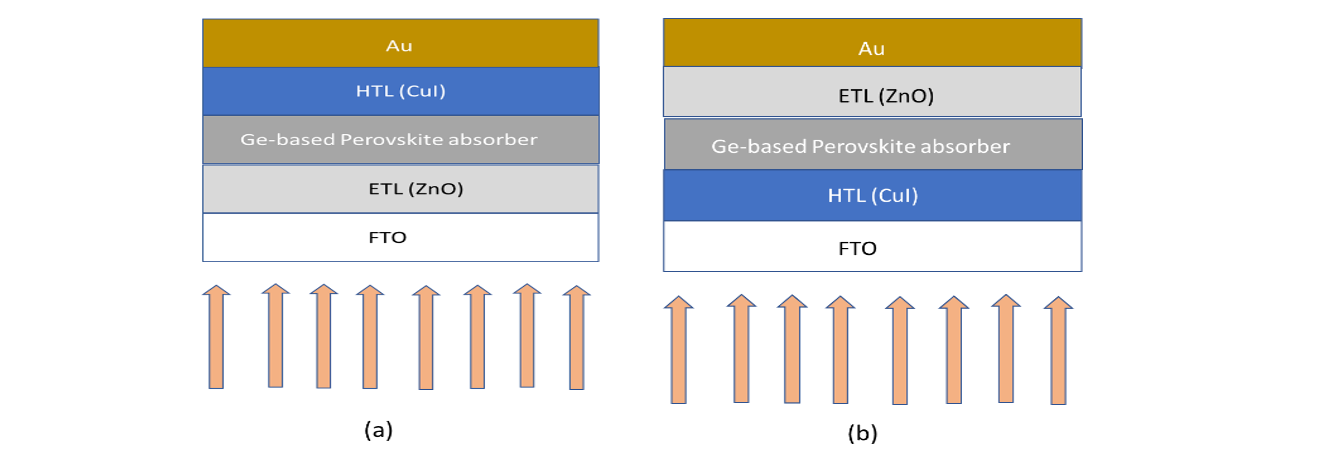
Perovskite solar cells (PSCs) have made significant advances in power conversion efficiency (PCE); however, their commercial viability remains hindered by stability concerns with organic transport layers and the environmental toxicity of lead-based absorbers. This study investigates a lead-free germanium-based perovskite solar cell (CH3NH3GeI3) with inorganic charge transport layers of zinc oxide ZnO and copper iodide CuI as electrons and holes transport layers, respectively, using SCAPS-1D simulation. The device design consists of FTO/ZnO/ CH3NH3GeI3/CuI/Au in a standard n-i-p configuration. Key parameters were extensively optimized, including absorber layer thickness (300-800 nm), absorber layer bandgap (1.2-1.6 eV), ZnO electron transport layer (ETL) thickness (10-400 nm), and ZnO bandgap (2.0-4.0 eV). The results show that an optimal absorber thickness of 500-600 nm and an optimal bandgap of 1.4-1.5 eV produce a maximum PCE of about 24.9%. While differences in ZnO thickness have little effect on open-circuit voltage (Voc) and fill factor (FF), parasitic absorption causes small reductions in short-circuit current density (Jsc) and PCE. Increasing the ZnO bandgap improves device transparency while modestly improving performance. Temperature analysis (290-360 K) shows a considerable decrease in Voc, FF and PCE as temperature increase, whereas Jsc remains almost constant, indicating recombination dominated thermal degradation in Ge-based PSCs. Overall, this study demonstrates that optimizing inorganic transport layers and absorber layer can significantly increase the efficiency and stability of lead-free PSCs, providing valuable insights for creating environmentally friendly and thermally robust solar systems.
References
Adeniji, S., Oyewole, O., Koech, R., Oyewole, D., Cromwell, J., Ahmed, R., Oyelade, O., Sanni, D., Orisekeh, K., Bello, A., & Soboyejo, W. (2021). Failure Mechanisms of Stretchable Perovskite Light-Emitting Devices under Monotonic and Cyclic Deformations. Macromolecular Materials and Engineering, 306(11). https://doi.org/10.1002/mame.202100435
Akpaneno, F. A., Sanni, D. M., & Salim, M. A. (2024). Theoretical Study of Inorganic Charge Transport Layer of Perovskite Solar Cells Using Scaps Software. Physical Science International Journal, 28(4), 57–63. https://doi.org/10.9734/psij/2024/v28i4837
Asif, P., Chetia, A., Saikia, D., & Sahu, S. (2025). A comprehensive theoretical investigation of lead-free mixed antimony-bismuth halide double perovskite (Cs₂AgBi₀.₇₅Sb₀.₂₅Br₆) solar cell using SCAPS-1D. Discover Electronics, 2(1). https://doi.org/10.1007/s44291-025-00085-8
Atem, M. Al, & Makableh, Y. (2025). Towards Sustainable Perovskite Solar Cells : Lead-Free High Efficiency Designs with Tin and Germanium. Eng MDPI, 6(38).
Green, M. A., Ho-Baillie, A., & Snaith, H. J. (2014). The emergence of perovskite solar cells. Nature Photonics, 8(7), 506–514. https://doi.org/10.1038/nphoton.2014.134
Hao, F., Stoumpos, C., & D. Cao, R. Chang, M. K. (2014). Lead-Free Solid-State Organic-Inorganic Halide Perovskite Solar Cells. Nature Photonics, 8, 489–494. https://doi.org/10.1038/nphoton.2014.82
Jenny Nelson. (2003). The Physics of Solar Cells. Imperial College Press, London. https://doi.org/10.1142/p276
Kim, H. S., Lee, C. R., Im, J. H., Lee, K. B., Moehl, T., Marchioro, A., Moon, S. J., Humphry-Baker, R., Yum, J. H., Moser, J. E., Grätzel, M., & Park, N. G. (2012). Lead iodide perovskite sensitized all-solid-state submicron thin film mesoscopic solar cell with efficiency exceeding 9%. Scientific Reports, 2, 1–7. https://doi.org/10.1038/srep00591
Koech, R. K., Ichwani, R., Oyewole, D. O., Kigozi, M., Amune, D., Sanni, D. M., Adeniji, S. A., Oyewole, O. K., Bello, A., Ntsoenzok, E., & Soboyejo, W. O. (2021). Tin oxide modified titanium dioxide as electron transport layer in formamidinium-rich perovskite solar cells. Energies, 14(23), 1–13. https://doi.org/10.3390/en14237870
Krishnamoorthy, T., Ding, H., Yan, C., Leong, W. L., Baikie, T., Zhang, Z., Sherburne, M., Li, S., Asta, M., & Nripan Mathews and Subodh G. Mhaisalkar. (2015). Lead-free germanium iodide perovskite materials for photovoltaic applications. Journal of Materials Chemistry A, 3(47), 23829–23832. https://doi.org/org/10.1039/C5TA05741H
Lee, M. M., Teuscher, J., Miyasaka, T., Murakami, T. N., & Snaith, and H. J. (2012). Efficient Hybrid Solar Cells Based on Meso-Superstructured Organometal Halide Perovskites. Science, 338(6107), . 643-647. https://doi.org/10.1126/science.122860
Liu, M., Johnston, M. B., & Snaith, H. J. (2013). Efficient planar heterojunction perovskite solar cells by vapour deposition. Nature, 501(7467), 395–398. https://doi.org/10.1038/nature12509
Mortadi, A., El Hafidi, E., Nasrellah, H., Monkade, M., & El Moznine, R. (2024). Analysis and optimization of lead-free perovskite solar cells: investigating performance and electrical characteristics. Materials for Renewable and Sustainable Energy, 13(2), 219–232. https://doi.org/10.1007/s40243-024-00260-z
National Renewable Energy Laboratory (NREL). (2025). Best research-cell efficiency chart.
Obi, U. C., Sanni, D. M., & Bello, A. (2021). Effect of Absorber Layer Thickness on the Performance of Bismuth-Based Perovskite Solar Cells. Semiconductors, 55(12), 922–927. https://doi.org/10.1134/S1063782621040114
Sanni, D. M., Chen, Y., Yerramilli, A. S., Ntsoenzok, E., Asare, J., Adeniji, S. A., Oyelade, O. V., Fashina, A. A., & Alford, T. L. (2019). An approach to optimize pre-annealing aging and anneal conditions to improve photovoltaic performance of perovskite solar cells. Materials for Renewable and Sustainable Energy, 8(1), 1–10. https://doi.org/10.1007/s40243-018-0139-3
Sanni, D. M., Joseph, E., Aminu, M., & Adamu. (2020). The importance of Film Thickness on the Photovoltaic Performance of Perovskite Solar Cells. Fudma Journal of Sciences, 4(1), 600–606.
Sanni, D. M., Yerramilli, A. S., Ntsoenzok, E., Adeniji, S. A., Oyelade, O. V., Koech, R. K., Fashina, A. A., & Alford, T. L. (2021). Impact of precursor concentration on the properties of perovskite solar cells obtained from the dehydrated lead acetate precursors. Journal of Vacuum Science & Technology A: Vacuum, Surfaces, and Films, 39(3). https://doi.org/10.1116/6.0000714
Shockley, W., & Queisser, H. J. (1961). Detailed Balance Limit of Efficiency of p‐n Junction Solar Cells. Journal of Applied Physics, 33(3), 510–519. https://doi.org/org/10.1063/1.1736034
Stranks, S. D., Eperon, G. E., Grancini, G., Menelaou, C., & Snaith, H. J. (2013). Electron-Hole Diffusion Lengths Exceeding Trihalide Perovskite Absorber. Science, 342(October), 341–344. https://doi.org/10.1126/science.1243982
Wolf, S. De, Holovsky, J., Moon, S.-J., Löper, P., Niesen, B., Ledinsky, M., Haug, F.-J., Yum, J.-H., & Ballif, C. (2014). Organometallic Halide Perovskites: Sharp Optical Absorption Edge and Its Relation to Photovoltaic Performance. The Journal of Physical Chemistry Letters, 5(6), 1035–1039. https://doi.org/org/10.1021/jz500279b
Wolfgang Tress. (2017). Perovskite Solar Cells on the Way to Their Radiative Efficiency Limit – Insights Into a Success Story of High Open-Circuit Voltage and Low Recombination. Advanced Energy Materials, 7(14), 1602358. https://doi.org/org/10.1002/aenm.201602358Digital Object Identifier (DOI)
Xing, G., Mathews, N., Lim, S. S., Lam, Y. M., Mhaisalkar, S., & Sum, T. C. (2013). Long-Range Balanced Electron- and Hole-Transport Lengths in Organic-Inorganic CH 3 NH 3 PbI 3. 6960(October), 498–500.
Downloads
Published
Issue
Section
Categories
License
Copyright (c) 2026 Dahiru M. Sanni, Hadiza H. Ndanusa, Hamza Abubakar

This work is licensed under a Creative Commons Attribution 4.0 International License.


