
Phytochemical characterization and antioxidant analysis of essential oils isolated from Cymbopogon citratus
DOI:
https://doi.org/10.33003/fjs-2026-1011-5386Keywords:
cymbopogon citratus, essential oil, medicinal plants, antioxidant, phytochemicalAbstract
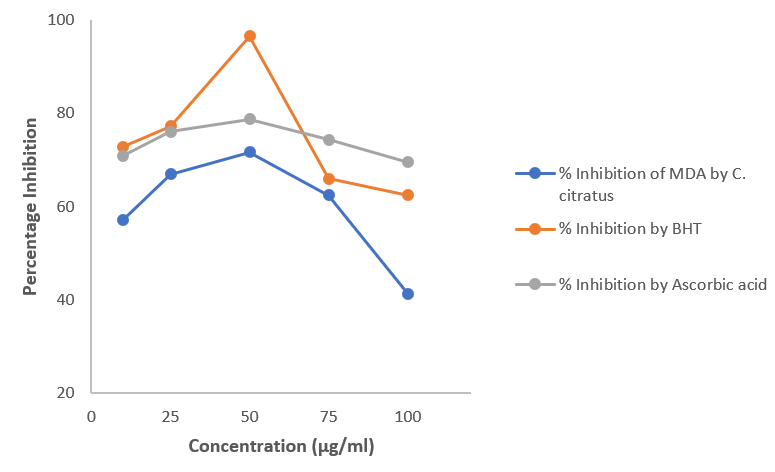
The drive for novel phytocompounds of distinct bioactivities for treating diverse disease conditions has necessitated research into various indigenous medicinal plants for promising drug candidates of immense therapeutic efficacies. This study therefore investigated the phytochemical composition and antioxidant activity of essential oils isolated from Cymbopogon citratus in contributing bioactive phytochemicals for drug discovery and development. Standard methods of Association of Official Analytical Chemists were employed to characterize phytochemicals while MDA inhibition and reducing assays were used to assess antioxidant capacity. Results revealed the oils contained phytochemicals in appreciable amounts: alkaloids (10.00%), terpenoids (3.00%), phenols (0.22%), phytates (0.85%), tannins (0.17%), flavonoids (0.02%), and saponins (0.03%). Antioxidant assays demonstrated the essential oils inhibited lipid peroxidation and increased reduced glutathione levels in a dose-dependent manner. Maximum MDA inhibition and GSH elevation were observed at moderate concentrations (25–50 µg/ml), while activity declined at very low and high doses, suggesting reduced efficiency or possible pro-oxidant effects. Compared with standards, C. citratus essential oil exhibited lower potency but showed significant antioxidant capacity. These findings indicate that the plant essential oil contains appreciable amounts of phytochemicals and is a potential natural antioxidant source that may serve as a complementary therapeutic agent in oxidative stress-related conditions.
References
Aćimović, M., Čabarkapa, I., Cvetković, M., Stanković, J., Kiprovski, B. and Gvozdenac, S. (2019). Cymbopogon citratus (DC.) Staph: Chemical composition, antimicrobial and antioxidant activities, use in medicinal and cosmetic purpose. Journal of Agronomy, Technology and Engineering Management, 2(6):344–360.
Association of Official Analytical Chemists (AOAC) (1995). Official Methods of Analysis (16th edition). AOAC International, Washington D.C.
Avoseh, N. O., Oyedeji, A. O. and Oyedeji, O. O. (2023). Therapeutic significance of Cymbopogon citratus essential oil: Phytochemical profile and synergistic effects. Plants, 14(9):1341.
Bailly, C. (2020). Targets and pathways involved in the antitumor activity of citral and its stereo-isomers. European Journal of Pharmacology, 871: 172945.
Balusamy, S. R., Perumalsamy, H., Veerappan, K., Huq, M. A., Rajeshkumar, S., Lakshmi, T. and Kim, Y. J. (2020). Citral induced apoptosis through modulation of key genes involved in fatty acid biosynthesis in human prostate cancer cells: In silico and in vitro study. BioMed Research International, 2020(1): 6040727.
Barros, L., Ferreira, M.J., Queiros, B., Ferreira, I.C.F.R., and Baptista, P. (2007). Total phenols, ascorbic acid, β carotene and lycopene in portuguese wild edible mushrooms and their antioxidant activities. Food Chemistry, 103(2): 413-419.
Buege, J.A. and Aust, S.D. (1978). Microsomal lipid peroxidation. Methods in Enzymology, 52: 302-310.
Chouhan, K. B. S., Mukherjee, S., Mahato, K., Sinha, A., & Mandal, V. (2023). An integrated holistic approach to unveil the key operational learnings of solvent-free microwave extraction of essential oil: An effort to dig deep—The case of lemongrass. Trends in Analytical Chemistry 165:117131.
Halliwell, B. and Gutteridge, J.M.C. (2007). Free radicals in Biology and medicine 94th edition). Oxford University Press.
Harborne, J.B. (1998). Phytochemical Methods: A Guide to Modern Technoques of Plant Analysis (3rd edition). Springer Netherlands.
Hartatie, E. S., Prihartini, I., Widodo, W. and Wahyudi, A. (2019). Bioactive compounds of lemongrass (Cymbopogon citratus) essential oil from different parts of the plant and distillation methods as natural antioxidant in broiler meat. IOP Conference Series: Materials Science and Engineering, 532:012018.
Indumathi, C., G. Durgadevi, S. Nithyavani. and P.K. Gayathri (2014). Estimation of terpenoid content and its antimicrobial property in Enicostemma litorrale. International. Journal of ChemTech. Research, 6 (9): 4264 – 4267.
Islam, T., Chowdhury, M. A. and Rahman, M. A. (2024). Essential oils in cancer therapy: Insights into mechanisms and therapeutic potential. Antioxidants, 13(1):20.
Kusumawati, I. and Indrayanto, G. (2013). Natural antioxidants in cosmetics. Studies in Natural Products Chemistry, 40: 485–505.
Le Rhun, E., Devos, P., Bourg, V., Darlix, A., Lorgis, V., Ahle, G., Boone, M., Taillandier, L., Curtit, E., Gras, L., Lebrun Frenay, C., Gramatzki, D., Ramirez, C., Simon, N., & Weller, M. (2019). Complementary and alternative medicine use in glioma patients in France. Journal of Neuro-Oncology, 145, 487–499.
Lin, X., Rafique, A., Fayyaz, T., Bashir, W., Luqman, M., Zahid, F. M. and Zhou, K. (2020). Appraisal of Cymbopogon citratus (lemon grass) for antibacterial activity against uropathogens. Pakistan Veterinary Journal, 41(1):122–126.
Luang-In, V., Saengha, W., Karirat, T., Senakun, C. and Siriamornpun, S. (2024). Phytochemical profile of Cymbopogon citratus (DC.) Stapf lemongrass essential oil from northeastern Thailand and its antioxidant and antimicrobial attributes and cytotoxic effects on HT-29 human colorectal adenocarcinoma cells. Foods, 13(18):2928.
Madi, Y., Meselhy, M. R., El-Kashoury, E. A. and Choucry, M. A. (2022). Morphological and Anatomical Characterization of Cymbopogon citratus (DC.) Stapf Cultivated in Egypt. Bulletin of Faculty of Pharmacy Cairo University, 60(1):56–69.
Majewska, E., Kozłowska, M., Gruczyńska-Śekowska, E., Kowalska, D. and Tarnowska, K. (2019). Lemongrass (Cymbopogon citratus) essential oil: Extraction, composition, bioactivity and uses for food preservation—A review. Polish Journal of Food and Nutrition Sciences, 69(4):327–341.
Maksimović, T., Minda, D., Șoica, C., Mioc, A., Mioc, M., Colibășanu, D., Lukinich-Gruia, A. T., Pricop, M.-A., Jianu, C. and Gogulescu, A. (2025). Anticancer potential of Cymbopogon citratus L. essential oil: In vitro and in silico insights into mitochondrial dysfunction and cytotoxicity in cancer cells. Plants, 14(9): 1341.
Marrelli, M. (2021). Medicinal Plants. Plants, 10(7), 1355.
Nagata T, Satou T, Hayashi S, Satyal P, Watanabe M, Riggs B, Saida Y. (2024). Citral in lemon myrtle, lemongrass, litsea, and melissa essential oils suppress the growth and invasion of breast cancer cells. BMC Complement Med Ther. 24(1):211.
Ohkawa, H., Ohishi, N., and Yagi, K. (1979). Assay for lipid peroxides in animal tissues by thiobarbituric acid reaction. Analytical Biochemistry, 95(2): 351-358.
Patwardhan, B., Vaidya, A., Chorghade, M. and Joshi, S. (2008). Reverse pharmacology and systems approaches for drug discovery and development. Curr. Bioact. Compd. 4, 201–212.
Sotler, R., Poljšak, B., Dahmane, R., Jukić, T., Pavan Jukić, D., Rotim, C., Trebše, P. and Starc, A. (2019). Prooxidant activities of antioxidants and their impact on health. Acta Clinica Croatica, 58(4):726–736.
Sousa, R., Figueirinha, A., Batista, M. T. and Pina, M. E. (2021). Formulation effects in the antioxidant activity of extract from the leaves of Cymbopogon citratus (DC) Stapf. Molecules, 26(15):1–15.
Viktorová, J., Stupák, M., Řehořová, K., Dobiasová, S., Hoang, L., Hajšlová, J., Thanh, T. V., Tri, L. V., Tuan, N. V. and Ruml, T. (2020). Lemongrass essential oil does not modulate cancer cells multidrug resistance by citral - its dominant and strongly antimicrobial compound. Foods, 9(5):585.
Yin, H., Zhang, X. and Zhang, Y. (2021). Natural compounds in essential oils: A focus on anticancer activities. Antioxidants, 11(1):20.
Young, K.A. and Greeves, K.A. (1999). Phytate: Impact on Environment and Human Nutrition. Food and Nutrition Bulletin, 20(4): 426-433.
Downloads
Published
Issue
Section
Categories
License
Copyright (c) 2026 Uchechukwu Chibuzo Ogbodo, Anuli Chiagozie Ogu, Emmanuel Israel Nsedu, Chidiebere Malachy Chigbo, Ijeoma Cynthia Anyaoku

This work is licensed under a Creative Commons Attribution 4.0 International License.


