
Radiological Hazards of Natural Radionuclides in Building Materials in Katsina State, Nigeria: A Systematic Review
DOI:
https://doi.org/10.33003/fjs-2026-10(ANB-K)-5374Keywords:
Building Materials, Gamma-Ray Spectroscopy, Natural Radioactivity, Radiological Hazards, Katsina StateAbstract
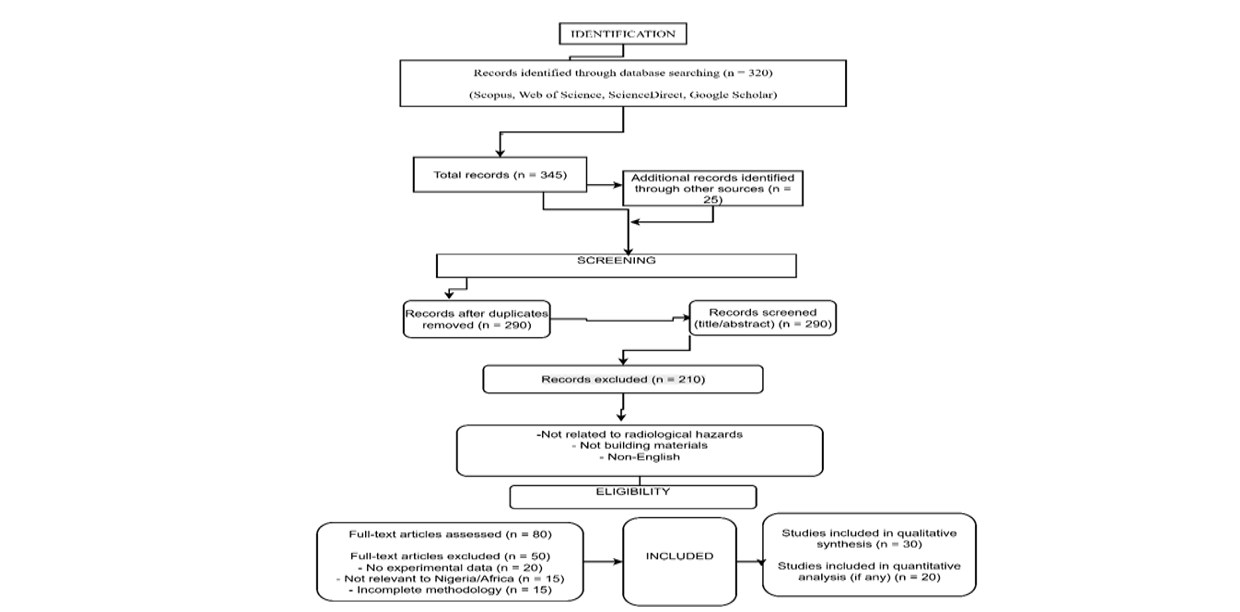
Trace amounts of radioactive elements are naturally present in building materials and may contribute to human exposure to ionizing radiation. This systematic review evaluates the concentrations of naturally occurring radionuclides including 226Ra, 232Th, 40K commonly used construction materials in Katsina State, Nigeria, and comparable geological environments. This systematic review was conducted following the Preferred Reporting Items for Systematic Reviews and Meta-Analyses (PRISMA) framework. A total of 345 records were initially identified from major scientific databases and institutional reports published between 2010 and 2025. After screening and eligibility assessment, 30 relevant studies were included for qualitative synthesis, while 20 studies containing detailed radiological parameters were selected for comparative analysis. Only peer-reviewed studies reporting activity concentrations of radionuclides and radiological hazard indices in building materials, particularly within Nigeria and similar geolo
gical environments, were included in the review. Reported activity concentration values ranged from 4.41–93.00 Bq/kg for 226Ra, 16.71–320.00 Bq/kg for 232Th, and 68.03–673.00 Bq/kg for 40K across reviewed studies. Most evaluated radiological hazard indices, including radium equivalent activity and external hazard index, remained below internationally recommended safety limits. Gamma-ray spectroscopy and X-Ray Diffraction (XRD) were the major analytical methods employed. However, regional variations linked to geological formations, inadequate monitoring facilities, weak regulatory implementation, and limited integration of mineralogical analysis remain significant challenges in Nigeria. The review highlights the importance of continuous radiological monitoring, improved regulatory control, and standardized assessment procedures to ensure the safe and sustainable use of building materials.
References
Abbasi, A. (2013). Environmental Radiation in High Exposure Building Materials. (July).
Abdel Gawad, A. E., Hanfi, M. Y., Tawfik, M. N., Alqahtani, M. S., & Mira, H. I. (2024). Assessment of radioactivity levels and radiation hazards in building materials in Egypt. Nuclear Engineering and Technology, 56(2), 707–714. https://doi.org/10.1016/j.net.2023.11.006
Abraham. A., N., Fazli Ismail, A., & Samat, S. (2019). ASSESSMENT OF NATURALLY OCCURRING RADIONUCLIDES IN MALAYSIA’S BUILDING MATERIALS. Radiation Protection Dosimetry, 186(4), 520–523. https://doi.org/10.1093/rpd/ncz125
Chougule, A., & Kumar Jain, G. (2024). Radiation Hazards, Protection, and Cultivating a Radiologically Safe Environment for Nurses. Journal of Medical and Clinical Nursing Studies, 2(4), 1–5. https://doi.org/10.61440/jmcns.2024.v2.58
Estokova, A., Singovszka, E., & Vertal, M. (2022). Investigation of Building Materials’ Radioactivity in a Historical Building — A Case Study. 1–18.
Gambo, N., & N, Baba- Kutigi A.N, H. A. & M. M. (2015). INVESTIGATING THE CONCENTRATION OF 226 Ra IN CONCRETE BLOCK AS RAW MATERIALS FOR BUILDING IN KATSINA STATE. International Journal of Latest Research in Engineering and Technology (IJLRET) ISSN: 2454-5031(Online) Www.Ijlret.Comǁ Volume 1 Issue 6ǁNovember 2015 ǁ PP 36-42, 1(6), 36–42.
Garba, N. N., Rabi’u, N., Aliyu, A. S. ad, Kankara, U. M., Vatsa, A. M., Isma’ila, A., & Bello, S. (2023). Evaluation of radiological risk associated with local building materials commonly used in Northwestern Nigeria. Heliyon, 9(5), e15791. https://doi.org/10.1016/j.heliyon.2023.e15791
Grzywa-Celinska, A., Krusinski, A., Mazur, J., Szewczyk, K., & Kozak, K. (2020). Radon — The Element of Risk. The Impact of Radon. Toxics, 8(120), 1–20.
Ilemona C. Okeme , Thomas B. Scott , Peter G. Martin, Y. S., & Olaluwoye, T. I. O. and M. O. (2022). Assessment of the Mode of Occurrence and Radiological Impact of Radionuclides in Nigerian Gamma-Ray Spectroscopy.
Kocsis, E., Tóth-Bodrogi, E., Peka, A., Adelikhah, M., & Kovács, T. (2021). Radiological impact assessment of different building material additives. Journal of Radioanalytical and Nuclear Chemistry, 330(3), 1517–1526. https://doi.org/10.1007/s10967-021-07897-4
Ladan, S. C., Mustapha, I. M., Hassan, A., Aliyu, M. S., & Rahmat, S. (2022). Assessment of Radioactivity Concentration Level in Soil Samples of some Gold Mining Areas of Shiroro, Niger State, Nigeria. Journal of Radiation and Nuclear Applications, 7(2), 1–6. https://doi.org/10.18576/jrna/070201
Legasu, M. L., & Chaubey, A. K. (2022). Determination of dose derived from building materials and radiological health related effects from the indoor environment of Dessie city, Wollo, Ethiopia. Heliyon, 8(3), e09066. https://doi.org/10.1016/j.heliyon.2022.e09066
Muhammad, A. N., Ismail, A. F., & Garba, N. N. (2024). Natural radioactivity in food crops and soil and estimation of the concomitant dose from tin mining areas in Nigeria. Journal of Taibah University for Science, 18(1). https://doi.org/10.1080/16583655.2024.2366507
Nation, U., Committee, S., & Radiation, A. (2024). UNSCEAR 2024 Report: I.
Ogunobi, S., Abdulkareem, A., & Ayodele, A. (2023). Radiological Impact Assessment of Natural Radioactivity of Ceramic Wares and Decorations in Abeokuta, Nigeria. The Journals of the Nigerian Association of Mathematical Physics, 65(October 2022), 1–10.
Oladotun, A. O., McKay, R. R., Sunday, J. E., Usikalu, M. R., Embong, Z., & Saeed, A. (2021). Evaluation of Radiological Health Risk Associated with Indian Tiles Available in Nigerian Markets. Advances in Science, Technology and Engineering Systems Journal, 6(3), 271–276. https://doi.org/10.25046/aj060330
Popov, D. (2026). Inhalation and Ingestion of Radioactive Nuclides : Mechanisms of Internal Contamination, Radio toxicity, and Medical Management. Biokinetics and Organ-Specific Targeting of Radionuclides after Respiratory and Gastrointestinal Entry. (Vol. 137). https://doi.org/10.13140/RG.2.2.36756.56963
Downloads
Published
Issue
Section
Categories
License
Copyright (c) 2026 Nura Gambo, Dahiru Dahuwa

This work is licensed under a Creative Commons Attribution 4.0 International License.


