
Heavy Metals Concentration and Health Risks Assessment of Drinking Water Sources from Jibia Town, Katsina State, Nigeria
DOI:
https://doi.org/10.33003/fjs-2026-10(ANB-K)-5372Keywords:
Heavy Metals, Health Risk Assessment, Drinking Water, JibiaAbstract
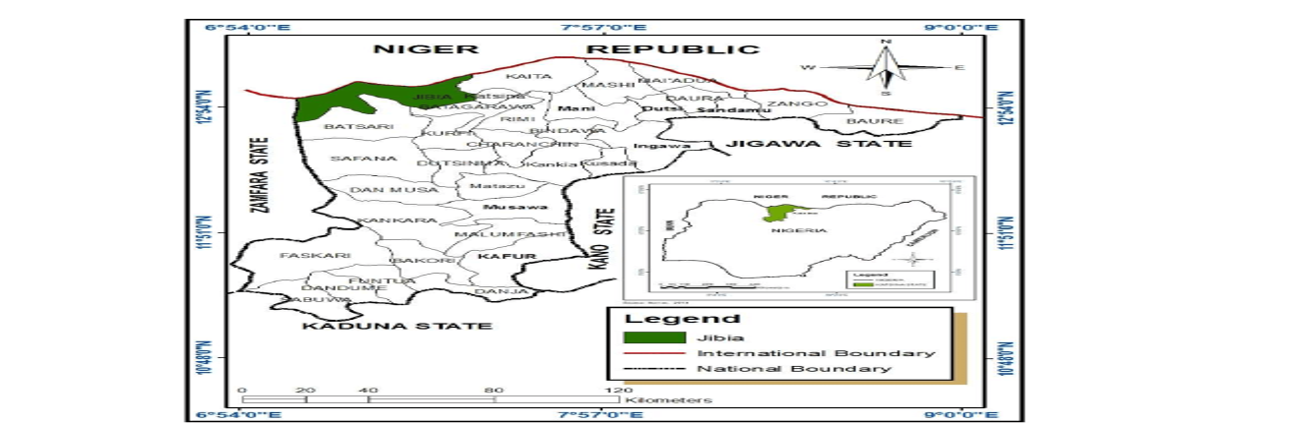
The domestic and agricultural application of chemicals made from heavy metals has led to their contamination of our environments, raising concerns over their potential effects on human health and the environment. People that consume high levels of heavy metals risk acute and chronic toxicity, intestinal damage, anemia, and cancer. This study aimed to analyzed the concentrations of the heavy metals (As, Cd, Cr, Co, Pb) and assess human exposure risks via drinking water pathway from Jibia Town, Katsina State. Twenty samples were collected from Jibia, Kagadama, and Magama Communities and analyzed using Flame Atomic Absorption Spectrometer. The overall mean concentrations of the heavy metals for the entire study area were 0.0066 mg/L, 0.0029 mg/L, 0.0287 mg/L, 0.0500 mg/L and 0.0073 mg/L for As, Cd, Cr, Co and Pb, respectively. These values were all recorded to be within the permissible limits set by WHO for the quality of drinking water. The hazard indices were 0.430 and 0.123 for adult and children, respectively. These values are less than USEPA (2011) limit of 1.000 as threshold value. Similarly, the excess lifetime cancer risks revealed that the non-carcinogenic and carcinogenic risks respectively in the drinking water sources in both adults and children were 4.05×10⁻⁵ (4 people/ hundred thousand may be affected) for adult and 6.12×10⁻⁵ (6 people/hundred thousand may be affected) for children. These values are within the WHO limit. Conclusively, within the restrictions of the study, the current level of heavy metals does not suggest significant non-carcinogenic and carcinogenic health risks.
References
Adeyemi, O.; O. Oloyede, and A. Oladiji. (2007). Physicochemical and microbial characteristics of Leachate contaminated ground water. Asian J. Biochem., 2(5): 343-348.
Ahmad N, Jaafar MS, Nasir T, and Rafique M. (2018). Determination of radon concentration and heavy metals (Ni, Pb, Cd, As, Cr) in drinking and irrigated water samples from Kulim, Malaysia. International Journal of Radiation Research Vol. 16 No. 4. 341 – 349.
Alexandra S (2017). How people die from pollution around the World. The lancet commission on pollution and health journal.
Azmi M, Junidah R, Mariam AS, Safiah M, Fatimah S and Nori‐mah A (2009) Body mass index (BMI) of adults: Findings of the Malaysian Adult Nutrition Survey (MANS). Malaysian Journal of Nutrition 15
Bello S (2019). Assessment of health hazards associated with environmental radioactivity and heavy metals contamination around Shanono and Bagwai gold mines, Kano State. Ph. D. dissertation in radiation biophysics, Department of Physics, Faculty of Physical Sciences, Ahmadu Bello University, Zaria.
Chang LW, Magos L and Suzuki T (1996).Toxicology of metals. Boca Raton. Fl, USA: Crc (Press release):
Chee Y, Roseline YW, Siti SB (2008). Weight status and dietary intake among female Children and adolescents aged 6-17 years in a welfare home, Kuala Lumpur. Malaysian Journal of Nutrition, 14: 79-89
Chunyuan S, Wenji Z, Qianzhong Z, Xue Y, Xiaoxia Z, Jiayin Z and Ming L (2016). Spatial distribution, sources apportionment and health risk of metals in topsoil in Beijing, China. International journal of environmental study and public health. 2016 Jul; 13(7): 727.
DEA (2010). The framework for the management of contaminated land. Department of Environmental Affairs South Africa 2010. International journal of environmental Study and public health.
Entesar HE, Soliman HA and Abo-Elmad M. (2019) Measurement of radon levels in water and the associated health hazards in Jazan, Saudi Arabia. Journal of radiation research and applied science. 2019, Vol.12 No.1 31-36
Gevorgyan, GA, Ghazaryan, KA, Movsesyan, HS, Zhamharyan and HG (2017). Human health risk assessment of heavy metal pollution in soils around Kapan mining area, Armenia. Electronic journal of natural sciences. 2(29): 29-33.
IARC (1987) IARC monographs on the evaluation of carcinogenic risks to humans. Supplement 7. Volumes 1–42. Lyons, France: International Agency for Study on Cancer (IARC). Overall evaluation of carcinogenicity: An updating of monographs; pp. 230–232.
Kamunda C, Mathuthu M and Madhuku M (2017) Health risk assessment of heavy metals in soils from Witwatersrand gold mining basin, South Africa. International journal of environmental study and Public Health, 13(7): 663.
Mohammad AF, Hadiza TA and Benedine A (2020) Predictive modeling of desertification in Jibia local government area of Katsina State. The Egyptian journal of remote sensing and space sciences.23 (363 – 370)
Mustapha N (2017) Radioactivity measurement and heavy metal assessment of soil and water from sugarcane farm in Jibia, Katsina State. Department of Physics Ahmadu Bello University, Zaria, Nigeria.
Naveedullah ZH, Chunna Y, Hui S, Dechoa D, Chaofeng S, Liping L and Yingxu C (2014). Concentration and human health risk assessment of selected heavy metals in surface water of the siling reservoir watershed in Zhejiang Province, China. Journal Environmental Studies Vol. 23 No. 3 (2014), 801 – 811.
NPC (2010) Population and housing census 2006. National Population Commission, Federal Republic of Nigeria.
NPC (2016). National Population Commission of Nigeria, National Bureau of Statistics (web) Federal Republic of Nigeria.
Nwankwo L.I. (2013). Study of Natural Radioactivity of Ground water in Sango-Ilorin. Nigeria. Journal of Physical Science and Application, 2 (8): 289-295.
Oludare HA, Oluwafunmilayo OO and Opeyemi OT (2019). Spatial distribution and health risk assessment of soil pollution by heavy metals in Ijebu-Ode, Nigeria. Journal of Health and Pollution, 9(22): 190601.
Olukanni, D. O. and Kokumo, K. O. (2013) Efficiency Assessment of a Constructed Wetland Using Eichhornia Crassipes for Wastewater Treatment. American Journal of Engineering Research (AJER), 2 (12): 450-454
Orosun MM, Tchokossa P, Nkwankwo LI, Lawal TO, Bello SA and Ige SO (2016). Assessment of heavy metals pollution in drinking water due to milling and smelting activities in Ajaokuta, Nigeria. Nigerian Journal of Technological Development. Vol. 13 No.1 pp. 31-39
Oyewumi AS, James GK, Jega IM, Olojo OO, Shar JT, Onuoha H, Salami VT, Mustafa S, Shehu I, Waziri AN, Mahmood MM and Salman KS (2019). Assessing groundwater quality in Katsina State, Nigeria.SSRG International Journal of Geoinformatics and Geological Science (SSRG-IJGGS) – Volume 6 Issue 2–May – Aug 2019
Paul BT, Clement GY, Anita KP and Dwayne JS (2012). Heavy metals toxicity and the environment: Nih-Rcmi centre for environmental health college of science, engineering and technology, Jackson State University, 1400 Lynch Street, Box 18750, Jackson, Ms 39217, USA.
Poh BK, Niege BK, Haslinda MDS, Shanita SN, Wong JE and Budin SB (2013). Nutritional status and dietary intakes of Children aged 6 months to 12 years: findings of the Nutrition Survey of Malaysian Children (SEANUTS Malaysia). British Journal of Nutrition, 110: S21-S35.
Priti S and Biswajit P (2016). Assessment of heavy metal pollution in water resources and their impacts: a review. Journal of Basic and Applied Engineering Research; Volume 3, Issue 8, Pp. 671-675
Tuzen M. and Soylak M (2006). Evaluation of metal levels of Drinking waters from the Tokat-Black Sea region of Turkey. Polish Journal of Environmental Science. Vol. 15 No. 6 pp. 915 – 919.
Ukibe SN, Ukibe NR, Ikeako LC, Okpogba AN, Obi-Okaro AC, and Nwankwo PC (2016). Heavy metals contamination of drinking water in Anambra State, Southern Nigeria. European Journal of Scientific Study, Vol. 139 No. 2 pp. 104-108.
USEPA (1986). National secondary drinking water regulations; Final Rule. US Environmental Protection Agency Federal Regulation 44(140): 42195 (July 19, 1979).
USEPA (1988). Types of information collected and considered when performing the risk assessment. U.S. Environmental Protection Agency, Risk assessment guidelines and information directory, Government Institute, Rockville, MD.
USEPA (1989). Risk assessment guidance for super fund.US Environmental Protection Agencies human health evaluation manual, Part A, vol. 1. Washington, DC: Office of emergency and remedial response.
USEPA (1992). Types of drinking water contaminants. Contaminant Candidate List (CCL) and regulatory determination. United States Environmental Protection Agency. Washington, D.C.
USEPA (2002b). A review of the reference dose and reference concentration processes. EPA/630/P02/002F, Environmental Protection Agency USA.
USEPA (2004). Risk assessment guidance for superfund volume I. Human health evaluation manual (Part E, supplemental guidance for dermal contact risk assessment). Environmental Protection Agency, USA.
USEPA (2011). Recommended use of bw3/4 as the default method in derivation of the oral reference dose. Environmental Protection Agency, office of the science advisor, USA.
Vetrimurugan E, Brindha K and Elango L (2017). Human Exposure Risk Assessment Due to Heavy Metals in Groundwater by Pollution Index and Multivariate Statistical Method. A case study from South Africa.
Walpole SC, Prieto MD, Edwards P, Cleland J, Stevens G and Roberts I (2012). The weight of nations: an estimation of adult human biomass. BMC Public Health 12:439. 12 (1): 439.
WHO (1993).Guidelines for Drinking Water Quality Vol.1 (2nd Edition).World Health Organization Report.
WHO (1998). Global fresh water quality assessment. Report of World Health Organisation.
WHO (2000). Water sampling and analysis: World Health Organization Report.
WHO (2008). Guidelines for drinking-water quality.Fourth edition incorporating the first and second addenda Volume 1 Recommendations. WHO Geneva, 2008.
WHO (2020) Ten (10) chemicals of public health concern Source: World Health Organization International Programme on Chemical Safety.
Wood JM (1974) Biological cycles for toxic elements in the environment. Science, 183: 1049-1052
Downloads
Published
Issue
Section
Categories
License
Copyright (c) 2026 Salisu Khaleed, Gaddafi, Sulaiman Bello

This work is licensed under a Creative Commons Attribution 4.0 International License.


