
Analysis of Drought Impacts and Adaptation Strategies Of Smallholder Crop Farmers In Southern Kaduna, NigeriaAnalysis of Drought Impacts and Adaptation Strategies Of Smallholder Crop Farmers In Southern Kaduna, Nigeria
DOI:
https://doi.org/10.33003/fjs-2026-1009-5368Keywords:
Drought, Smallholder farmers, Adaptation strategies, Crop yield loss, Food security, Southern Kaduna, Nigeria, Climate change resilience, Indigenous coping mechanisms, Irrigation infrastructure, Farmer cooperatives, Crop insurance, Climate-resilient seedsAbstract
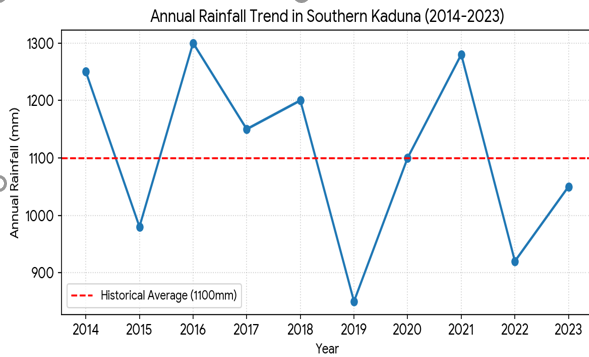
This study examines drought impacts and adaptation strategies among smallholder crop farmers in Southern Kaduna, Nigeria. The region, a major producer of ginger, maize, sorghum, and soybean, has experienced increasingly erratic rainfall over the past decade. Data were collected from 400 farmers across four Local Government Areas (Zangon Kataf, Kachia, Jema'a, and Kagarko) using structured questionnaires, focus group discussions, and key informant interviews, alongside historical meteorological data (2014–2023) from the Nigerian Meteorological Agency. Results show severe drought spells significantly reduced crop yields: maize and ginger fell by 44% and 36%, sorghum and soybean by 31% and 28%. These losses pushed 67% of surveyed households below the poverty line during drought years, with estimated annual economic losses of ₦12.4 billion across the four LGAs. Farmers adopted various coping mechanisms, including altering planting dates (82%), using early-maturing varieties (78%), crop diversification (65%), mulching (58%), and soil and water conservation (45%). However, capital-intensive adaptations like irrigation remained low (35%) due to financial constraints and poor institutional support. Social networks and cooperatives (52%) played significant roles in facilitating adaptation. The study concludes that indigenous strategies are insufficient to buffer severe drought shocks. It recommends increased government investment in small-scale irrigation, improved access to climate-resilient seeds, timely weather information dissemination, crop insurance schemes, and strengthened farmer cooperatives to enhance resilience against climate change
References
Adebooye, O. C., Ajayi, S. A., & Baidu, J. (2020). Drought impacts and adaptation strategies among cereal farmers in northern Nigeria. African Journal of Agricultural Research, 15(8), 1124–1136. https://doi.org/10.5897/AJAR2020.14892
Ayanlade, A., & Jegede, M. O. (2016). Climate change and crop yield in southwestern Nigeria. Theoretical and Applied Climatology, 124(3), 901–910. https://doi.org/10.1007/s00704-015-1460-4
Deressa, T. T., Hassan, R. M., Ringler, C., Alemu, T., & Yesuf, M. (2009). Determinants of farmers' choice of adaptation methods to climate change in the Nile Basin of Ethiopia. Global Environmental Change, 19(2), 248–255. https://doi.org/10.1016/j.gloenvcha.2009.01.002
DFID. (1999). Sustainable Livelihoods Guidance Sheets. Department for International Development, London.
Doss, C. (2014). Collecting sex-disaggregated data to improve development policies. World Bank Research Observer, 29(2), 214–238. https://doi.org/10.1093/wbro/lku005
Ellis, F. (2000). Rural Livelihoods and Diversity in Developing Countries. Oxford University Press, Oxford.
Fadairo, O. S., Adewumi, M. O., & Ogundari, I. A. (2023). Determinants of irrigation adoption among smallholder farmers in Oyo State, Nigeria. Journal of Rural Development, 42(1), 78–95.
FAO. (2023). The Impact of Disasters and Crises on Agriculture and Food Security: 2023 Edition. Food and Agriculture Organization of the United Nations, Rome.
Hansen, J. W., Vaughan, C., Kagabo, D. M., Dinku, T., Carr, E. R., & Körner, J. (2019). Climate services can benefit poor farmers in Africa. Nature Climate Change, 9(10), 787–790. https://doi.org/10.1038/s41558-019-0585-z
IPCC. (2021). Climate Change 2021: Impacts, Adaptation, and Vulnerability. Contribution of Working Group II to the Sixth Assessment Report. Cambridge University Press, Cambridge.
Kaduna State Ministry of Agriculture. (2022). Agricultural Yield Data and Farmer Demographics Report, 2014–2022. Kaduna State Government.
Lobell, D. B., Bänziger, M., Magorokosho, C., & Vivek, B. (2011). Nonlinear heat effects on African maize as evidenced by historical yield trials. Nature Climate Change, 1(1), 42–45. https://doi.org/10.1038/nclimate1043
Morton, J. F. (2007). The impact of climate change on smallholder and subsistence agriculture. Proceedings of the National Academy of Sciences, 104(50), 19680–19685. https://doi.org/10.1073/pnas.0701855104
Mortimore, M., & Adams, W. M. (2001). Farmer adaptation, change and "crisis" in the Sahel. Global Environmental Change, 11(1), 49–57. https://doi.org/10.1016/S0959-3780(00)00048-X
Niang, I., Ruppel, O. C., Abdrabo, M. A., Essel, A., Lennard, C., Padgham, J., & Urquhart, P. (2014). Africa. In: Climate Change 2014: Impacts, Adaptation, and Vulnerability (pp. 1199–1265). Cambridge University Press.
Nigerian Meteorological Agency (NiMet). (2024). Annual Climate Review for Northern Nigeria, 2014–2023. NiMet Publication No. 2024/03.
Nwankwo, C. D., Ibrahim, A. M., & Suleiman, R. (2022). Adaptation strategies of sorghum farmers to climate variability in Borno State, Nigeria. Sokoto Journal of the Social Sciences, 12(2), 45–58.
Odjugo, P. A. (2010). General overview of climate change impacts in Nigeria. Journal of Human Ecology, 29(1), 47–55. https://doi.org/10.1080/09709274.2010.11906243
Ojo, T. O., Li, E., & Fu, L. (2021). Maize farmers' perception of and adaptation to drought in Kano State, Nigeria. Environment, Development and Sustainability, 23, 4321–4341. https://doi.org/10.1007/s10668-020-00756-5
Okwuowulu, P. A., Ofoh, M. C., & Ogbuji, R. O. (2015). Water requirement and productivity of ginger (Zingiber officinale Roscoe) in the humid tropics. Journal of Agricultural Science, 7(3), 234–245. https://doi.org/10.5539/jas.v7n3p234
Onyeneke, R. U., Madukwe, D. K., & Ugwumba, C. O. A. (2020). Adaptation of rice farmers to climate change in Anambra State, Nigeria. Journal of Agricultural Extension, 24(1), 45–58.
Place, F. (2009). Land tenure and agricultural productivity in Africa: A comparative analysis of the economics literature and recent policy strategies and reforms. World Development, 37(8), 1326–1336. https://doi.org/10.1016/j.worlddev.2008.08.020
Wilhite, D. A., & Glantz, M. H. (1985). Understanding the drought phenomenon: The role of definitions. Water International, 10(3), 111–120. https://doi.org/10.1080/02508068508686328
World Meteorological Organization (WMO). (2021). WMO Guidelines on the Definition and Monitoring of Extreme Weather and Climate Events. WMO-No. 1234. Geneva.
Downloads
Published
Issue
Section
Categories
License
Copyright (c) 2026 Akinrinshola Dare, Donatus Obiajulu Onwuegbunam, Samson Maikano, Olusegun William Bolaji, Samson Owunebe Okechalu

This work is licensed under a Creative Commons Attribution 4.0 International License.


