
Quantitative Investigation of Groundwater Contamination at the Afaka Open Dumpsite, Kaduna State, Nigeria: An Integrated Geophysical, Hydrochemical, and Numerical Modeling Approach
DOI:
https://doi.org/10.33003/fjs-2026-1009-5366Keywords:
Open dumpsite, Groundwater contamination, Leachate plume, Electrical resistivity tomography, MODFLOW, MT3DMS, Kaduna, Nigeria, Heavy metals, Risk assessmentAbstract
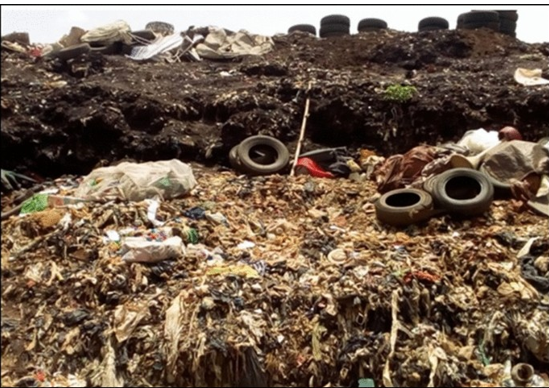
Open dumpsites without protective liners are a massive groundwater pollution problem across the developing world. This study quantifies exactly how the Afaka dumpsite in Kaduna State, Nigeria, is destroying the local water supply. The research team used Vertical Electrical Sounding at ten stations and 2D Electrical Resistivity Tomography along four 200-meter profiles to map groundwater contamination. They also ran numerical models with MODFLOW for groundwater flow and MT3DMS for solute transport. The geophysical data revealed a clear low-resistivity zone (under 25 Ωm) running from 1.2 meters down to 18 meters below the surface. That means toxic leachate has punched straight through the lateritic topsoil and fully saturated the weathered basement aquifer underneath. Water tests from three boreholes backed this up. Wells closest to the dumpsite showed Total Dissolved Solids hitting 1,840 mg/L and Electrical Conductivity at 2,450 μS/cm—more than triple the WHO limits. Heavy metal contamination was severe: Lead at 0.120 mg/L (12× the WHO limit) and Cadmium at 0.015 mg/L (5× the limit).The transient numerical simulations calibrated well, with an RMSE of 0.42 m and R² of 0.98. The models show the contaminant mass spreading steadily down-gradient. Over a 20-year projection, the >250 mg/L isochlor plume will migrate 1.25 kilometers from the dumpsite putting domestic wells directly in harm's way. To protect public health, this was recommended: capping the dumpsite with an impermeable barrier immediately; installing a pump-and-treat well network to intercept the plume; and banning groundwater pumping within a 500-meter radius.
References
Akinwumiju, J.O., Oloruntola, M.O., & Akinola, O.O. (2021). 2D inversion of electrical resistivity investigation of contaminant plume around a dumpsite near Onitsha expressway in southeastern Nigeria. Scientific Reports, 11, 10128.
Carla F., Onyanta A., Anosike E. I., Zahra K. (2023). Groundwater quality in the vicinity of a dumpsite in Lagos metropolis, Nigeria. Elsevier Journal of Geography and Sustainability Volume 4, Issue 4, December 2023, Pages 379-390. https://doi.org/10.1016/j.geosus.2023.09.005
Edwards, L. S. (1977). A modified pseudosection for resistivity and IP. Geophysics, 42(5), 1020–1036.
Gelhar, L.W., Welty, C., & Rehfeldt, K.R. (1992). A critical review of data on field-scale dispersion in aquifers. Water Resources Research, 28(7), 1955-1974.
Guideline Geo. (2026). Electrical Resistivity and Induced Polarization. The Terrameter LS supports VES, 2D ERT, and 3D surveys for groundwater and landfill contaminant mapping.
Kjeldsen, P., Barlaz, M.A., Rooker, A.P., Baun, A., Ledin, A., & Christensen, T.H. (2002). Present and long-term composition of MSW landfill leachate: a review. Critical Reviews in Environmental Science and Technology, 32(4), 297-336.
Loke, M. H., & Barker, R. D. (1996). Rapid least-squares inversion of apparent resistivity pseudosections by a quasi-Newton method. Geophysical Prospecting, 44(1), 131–152..
Mor, S., Ravindra, K., Dahiya, R.P., & Chandra, A. (2006). Leachate characterization and assessment of groundwater pollution near municipal solid waste landfill site. Environmental Monitoring and Assessment, 118(1-3), 435-456.
Telford, W. M., Geldart, L. P., & Sheriff, R. E. (1990). Applied Geophysics (2nd ed.). Cambridge University Press. (For ρa = K·ΔV/I and Schlumberger array geometry)
Chukwudi C. Ezeh and Shukwunweizu M. A. Maike, (2022). Using vertical electrical sounding and 2D resistivity tomography to investigate Osogbo central waste dumpsite, Osun State, Nigeria. Academic Journals. Article Number - 1EF9CF170314 Vol.18(1), pp. 25-37 , January 2023 https://doi.org/10.5897/IJPS2022.5020
Akintunde O. A. (2025). Delineation Effect of Subsurface Leachate Plume Contamination on the Groundwater using Geo-Electrical and Geo-Chemical Techniques: Case Study of Epe Dumpsite, Temu-Orisha, Epe, Lagos State, Nigeria. The Transactions of the Nigerian Association of Mathematical Physics, 21, 93-109. https://doi.org/10.60787/tnamp.v21.481
Downloads
Published
Issue
Section
Categories
License
Copyright (c) 2026 Akinrinshola Dare, Donatus Obiajulu Onwuegbunam, Samson Maikano, Olusegun William Bolaji, Samson Owunebe Okechalu

This work is licensed under a Creative Commons Attribution 4.0 International License.


