
A Systematic Review of Dynamic Disease Phenotyping in Plant Pathology
DOI:
https://doi.org/10.33003/fjs-2026-1012-5349Keywords:
AUDPC, dynamic phenotyping, high-throughput phenotyping, genomic prediction, DSI, functional data analysis, Systematic ReviewAbstract
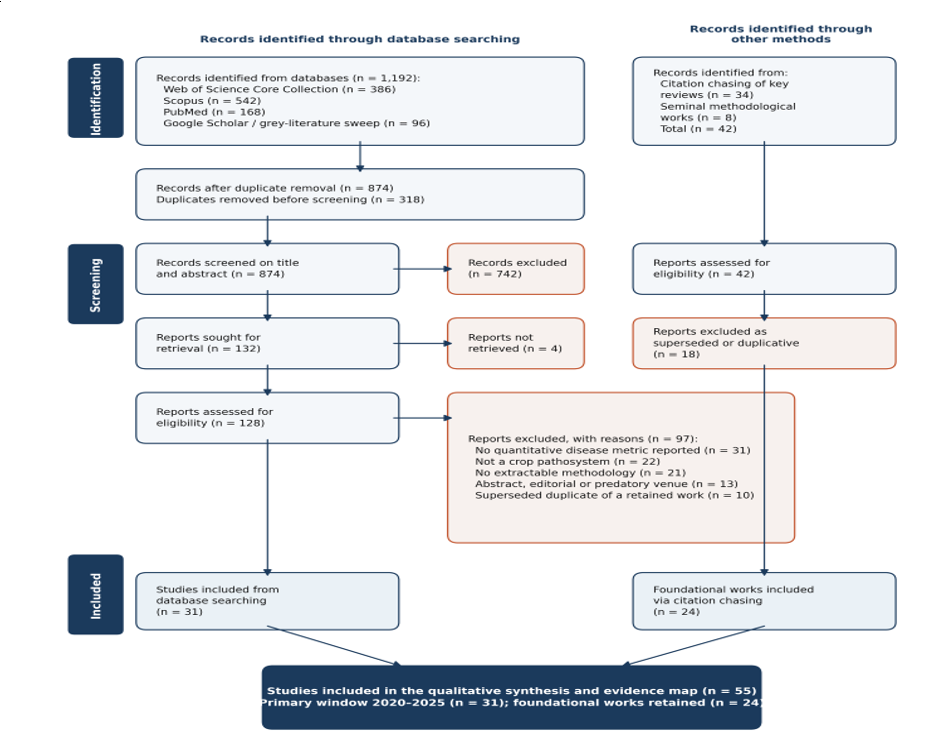
Plant disease phenotyping underpins resistance breeding, epidemiology and crop-loss management, yet it remains a recognised bottleneck. This review asked whether the two metrics that dominate the discipline, the disease severity index (DSI) and the area under the disease progress curve (AUDPC), adequately represent disease as a temporally unfolding process, and what the evidence says about dynamic alternatives. Reporting followed PRISMA 2020 and the Synthesis Without Meta-analysis (SWiM) guideline. Web of Science Core Collection, Scopus, PubMed and a Google Scholar grey-literature sweep were searched for records published between January 2020 and December 2025, retrieving 1,192 records; 874 remained after de-duplication, 128 full texts were assessed and 31 studies met the eligibility criteria. Citation chasing added 24 foundational works, giving 55 included studies. Records were dual-screened (Cohen's kappa = 0.86), appraised with an adapted Mixed Methods Appraisal Tool, and synthesised using vote counting by direction of effect, an evidence map and structured cross-study comparison; meta-analysis was inappropriate because outcomes were not commensurable. Thirty studies (54.5%) represented disease at a single assessment and eight (14.5%) collapsed the epidemic into one integrated area, whereas only twelve (21.8%) retained the full trajectory. Across six outcome domains, all 29 study-level comparisons favoured the temporally richer method and none reported a null or negative result, an asymmetry indicating probable reporting bias. Certainty was high for visual-assessment findings, moderate for sensing and dynamic modelling, and low for field-realised genetic gain. The phenotyping bottleneck has migrated from data acquisition to data representation.
References
Adak, A., Murray, S. C., & Anderson, S. L. (2024). Deciphering temporal growth patterns in maize: Integrative modeling of phenotype dynamics and underlying genomic variations. New Phytologist, 242(4), 1486-1503. https://doi.org/10.1111/nph.19575.
Adi, B. A., & Sani, Y. E. (2025). Genetic diversity and characterization of common bacterial blight resistance in common bean (Phaseolus vulgaris L.) In northern Nigeria using genome-wide association studies. FUDMA Journal of Sciences, 9(2), 285-289. https://doi.org/10.33003/fjs-2025-0902-3368
Akhtar, M. S., Zafar, Z., Nawaz, R., & Fraz, M. M. (2024). Unlocking plant secrets: A systematic review of 3D imaging in plant phenotyping techniques. Computers and Electronics in Agriculture, 222, 109033. https://doi.org/10.1016/j.compag.2024.109033
Alves, K. S., & Del Ponte, E. M. (2021). Analysis and simulation of plant disease progress curves in R: Introducing the epifitter package. Phytopathology Research, 3, 22. https://doi.org/10.1186/s42483-021-00098-7
Araus, J. L., & Cairns, J. E. (2014). Field high-throughput phenotyping: The new crop breeding frontier. Trends in Plant Science, 19(1), 52-61. https://doi.org/10.1016/j.tplants.2013.09.008
Baba, T., Momen, M., Campbell, M. T., Walia, H., & Morota, G. (2020). Multi-trait random regression models increase genomic prediction accuracy for a temporal physiological trait derived from high-throughput phenotyping. PLOS ONE, 15(2), e0228118. https://doi.org/10.1371/journal.pone.0228118
Barbedo, J. G. A. (2019). Plant disease identification from individual lesions and spots using deep learning. Biosystems Engineering, 180, 96-107. https://doi.org/10.1016/j.biosystemseng.2019.02.002
Bock, C. H., Barbedo, J. G. A., Del Ponte, E. M., Bohnenkamp, D., & Mahlein, A.-K. (2020). from visual estimates to fully automated sensor-based measurements of plant disease severity: Status and challenges for improving accuracy. Phytopathology Research, 2, 9. https://doi.org/10.1186/s42483-020-00049-8
Bock, C. H., Hotchkiss, M. W., & Wood, B. W. (2016). Assessing disease severity: Accuracy and reliability of rater estimates in relation to number of diagrams in a standard area diagram set. Plant Pathology, 65(2), 261-272. https://doi.org/10.1111/ppa.12403
Bock, C. H., Poole, G. H., Parker, P. E., & Gottwald, T. R. (2010). Plant disease severity estimated visually, by digital photography and image analysis, and by hyperspectral imaging. Critical Reviews in Plant Sciences, 29(2), 59-107. https://doi.org/10.1080/07352681003617285
Campbell, C. L., & Madden, L. V. (1990). Introduction to plant disease epidemiology. John Wiley & Sons.
Campbell, M., McKenzie, J. E., Sowden, A., Katikireddi, S. V., Brennan, S. E., Ellis, S., Hartmann-Boyce, J., Ryan, R., Shepperd, S., Thomas, J., Welch, V., & Thomson, H. (2020). Synthesis without meta-analysis (SWiM) in systematic reviews: Reporting guideline. BMJ, 368, l6890. https://doi.org/10.1136/bmj.l6890
Campbell, M., Walia, H., & Morota, G. (2018). Utilizing random regression models for genomic prediction of a longitudinal trait derived from high-throughput phenotyping. Plant Direct, 2(9), e00080. https://doi.org/10.1002/pld3.80
Chaloner, T. M., Gurr, S. J., & Bebber, D. P. (2021). Plant pathogen infection risk tracks global crop yields under climate change. Nature Climate Change, 11(8), 710-715. https://doi.org/10.1038/s41558-021-01104-8
Chiang, K.-S., & Bock, C. H. (2022). Understanding the ramifications of quantitative ordinal scales on accuracy of estimates of disease severity and data analysis in plant pathology. Tropical Plant Pathology, 47(1), 58-73. https://doi.org/10.1007/s40858-021-00446-0
Chiang, K.-S., Liu, H.-I., & Bock, C. H. (2017). A discussion on disease severity index values. Part I: Warning on inherent errors and suggestions to maximise accuracy. Annals of Applied Biology, 171(2), 139-154. https://doi.org/10.1111/aab.12362
Cobb, J. N., DeClerck, G., Greenberg, A., Clark, R., & McCouch, S. (2013). Next-generation phenotyping: Requirements and strategies for enhancing our understanding of genotype-phenotype relationships and its relevance to crop improvement. Theoretical and Applied Genetics, 126(4), 867-887. https://doi.org/10.1007/s00122-013-2066-0
Cohen, J. (1960). A coefficient of agreement for nominal scales. Educational and Psychological Measurement, 20(1), 37-46. https://doi.org/10.1177/001316446002000104
Costa-Neto, G., Fritsche-Neto, R., & Crossa, J. (2021). Nonlinear kernels, dominance, and envirotyping data increase the accuracy of genome-based prediction in multi-environment trials. Heredity, 126(1), 92-106. https://doi.org/10.1038/s41437-020-00353-1
Cunniffe, N. J., Koskella, B., Metcalf, C. J. E., Parnell, S., Gottwald, T. R., & Gilligan, C. A. (2015). Thirteen challenges in modelling plant diseases. Epidemics, 10, 6-10. https://doi.org/10.1016/j.epidem.2014.06.002
Del Ponte, E. M., Pethybridge, S. J., Bock, C. H., Michereff, S. J., Machado, F. J., & Spolti, P. (2017). Standard area diagrams for aiding severity estimation: Scientometrics, pathosystems, and methodological trends in the last 25 years. Phytopathology, 107(10), 1161-1174. https://doi.org/10.1094/PHYTO-02-17-0069-FI
Franceschi, V. T., Alves, K. S., Mazaro, S. M., Godoy, C. V., Duarte, H. S. S., & Del Ponte, E. M. (2020). A new standard area diagram set for assessment of severity of soybean rust improves accuracy of estimates and optimizes resource use. Plant Pathology, 69(3), 495-505. https://doi.org/10.1111/ppa.13148
Furbank, R. T., & Tester, M. (2011). Phenomics: Technologies to relieve the phenotyping bottleneck. Trends in Plant Science, 16(12), 635-644. https://doi.org/10.1016/j.tplants.2011.09.005
Ghosal, S., Blystone, D., Singh, A. K., Ganapathysubramanian, B., Singh, A., & Sarkar, S. (2018). An explainable deep machine vision framework for plant stress phenotyping. Proceedings of the National Academy of Sciences, 115(18), 4613-4618. https://doi.org/10.1073/pnas.1716999115
Gilioli, G., Simonetto, A., Colturato, M., Bazarra, N., Fernandez, J. R., Naso, M. G., Bosco, D., & Bodino, N. (2023). An eco-epidemiological model supporting rational disease management of Xylella fastidiosa: An application to the outbreak in Apulia (Italy). Ecological Modelling, 476, 110226. https://doi.org/10.1016/j.ecolmodel.2022.110226
Gill, T., Gill, S. K., Saini, D. K., Chopra, Y., de Koff, J. P., & Sandhu, K. S. (2022). A comprehensive review of high throughput phenotyping and machine learning for plant stress phenotyping. Phenomics, 2(3), 156-183. https://doi.org/10.1007/s43657-022-00048-z
Gimenez-Romero, A., Moralejo, E., & Matias, M. A. (2023). A compartmental model for Xylella fastidiosa diseases with explicit vector seasonal dynamics. Phytopathology, 113(9), 1686-1696. https://doi.org/10.1094/PHYTO-09-22-0356-R
Haddaway, N. R., Page, M. J., Pritchard, C. C., & McGuinness, L. A. (2022). PRISMA2020: An R package and Shiny app for producing PRISMA 2020-compliant flow diagrams, with interactivity for optimised digital transparency and open synthesis. Campbell Systematic Reviews, 18(2), e1230. https://doi.org/10.1002/cl2.1230
Hebert, T. T. (1982). The rationale for the Horsfall-Barratt plant disease assessment scale. Phytopathology, 72(10), 1269. https://doi.org/10.1094/Phyto-72-1269
Heidarian Dehkordi, R., El Jarroudi, M., Kouadio, L., Meersmans, J., & Beyer, M. (2020). Monitoring wheat leaf rust and stripe rust in winter wheat using high-resolution UAV-based red-green-blue imagery. Remote Sensing, 12(22), 3696. https://doi.org/10.3390/rs12223696
Hickey, L. T., Hafeez, A. N., Robinson, H., Jackson, S. A., Leal-Bertioli, S. C. M., Tester, M., Gao, C., Godwin, I. D., Hayes, B. J., & Wulff, B. B. H. (2019). Breeding crops to feed 10 billion. Nature Biotechnology, 37(7), 744-754. https://doi.org/10.1038/s41587-019-0152-9
Hilton, A., Wang, X., Jo, Y. K., Conner, P., Randall, J., Chatwin, W., & Bock, C. (2024). Standard area diagrams for pecan leaf scab: Effect of rater experience, location, and leaf size on reliability and accuracy of visual estimates. Plant Disease, 108(6), 1820-1832. https://doi.org/10.1094/PDIS-09-23-1947-RE
Hong, Q. N., Fabregues, S., Bartlett, G., Boardman, F., Cargo, M., Dagenais, P., Gagnon, M.-P., Griffiths, F., Nicolau, B., O'Cathain, A., Rousseau, M.-C., Vedel, I., & Pluye, P. (2018). The Mixed Methods Appraisal Tool (MMAT) version 2018 for information professionals and researchers. Education for Information, 34(4), 285-291. https://doi.org/10.3233/EFI-180221
Horsfall, J. G., & Barratt, R. W. (1945). An improved grading system for measuring plant diseases. Phytopathology, 35, 655.
Horsfall, J. G., & Heuberger, J. W. (1942). Measuring magnitude of a defoliation disease of tomatoes. Phytopathology, 32, 226-232.
Jeger, M. J., & Viljanen-Rollinson, S. L. H. (2001). The use of the area under the disease-progress curve (AUDPC) to assess quantitative disease resistance in crop cultivars. Theoretical and Applied Genetics, 102(1), 32-40. https://doi.org/10.1007/s001220051615
Jin, X., Zarco-Tejada, P. J., Schmidhalter, U., Reynolds, M. P., Hawkesford, M. J., Varshney, R. K., Yang, T., Nie, C., Li, Z., Ming, B., Xiao, Y., Xie, Y., & Li, S. (2021). High-throughput estimation of crop traits: A review of ground and aerial phenotyping platforms. IEEE Geoscience and Remote Sensing Magazine, 9(1), 200-231. https://doi.org/10.1109/MGRS.2020.2998816
Knoch, D., Abbadi, A., Grandke, F., Meyer, R. C., Samans, B., Werner, C. R., Snowdon, R. J., & Altmann, T. (2020). Strong temporal dynamics of QTL action on plant growth progression revealed through high-throughput phenotyping in canola. Plant Biotechnology Journal, 18(1), 68-82. https://doi.org/10.1111/pbi.13171
Kuswidiyanto, L. W., Noh, H.-H., & Han, X. (2022). Plant disease diagnosis using deep learning based on aerial hyperspectral images: A review. Remote Sensing, 14(23), 6031. https://doi.org/10.3390/rs14236031
Landis, J. R., & Koch, G. G. (1977). The measurement of observer agreement for categorical data. Biometrics, 33(1), 159-174. https://doi.org/10.2307/2529310
Lewin, S., Booth, A., Glenton, C., Munthe-Kaas, H., Rashidian, A., Wainwright, M., Bohren, M. A., Tuncalp, O., Colvin, C. J., Garside, R., Carlsen, B., Langlois, E. V., & Noyes, J. (2018). Applying GRADE-CERQual to qualitative evidence synthesis findings: Introduction to the series. Implementation Science, 13(Suppl 1), 2. https://doi.org/10.1186/s13012-017-0688-3
Lin, L. I. (1989). A concordance correlation coefficient to evaluate reproducibility. Biometrics, 45(1), 255-268. https://doi.org/10.2307/2532051
Madden, L. V., Hughes, G., & van den Bosch, F. (2007). The study of plant disease epidemics. American Phytopathological Society.
Mahlein, A.-K. (2016). Plant disease detection by imaging sensors: Parallels and specific demands for precision agriculture and plant phenotyping. Plant Disease, 100(2), 241-251. https://doi.org/10.1094/PDIS-03-15-0340-FE
Mahlein, A.-K., Kuska, M. T., Behmann, J., Polder, G., & Walter, A. (2018). Hyperspectral sensors and imaging technologies in phytopathology: State of the art. Annual Review of Phytopathology, 56, 535-558. https://doi.org/10.1146/annurev-phyto-080417-050100
McGee, R. J., Coyne, C. J., Cheng, P., Vandemark, G. J., & Porter, L. D. (2025). Breeding for quantitative disease resistance: Case studies, emerging approaches, and exploiting pathogen variation. Crop Science, 65(1), e70202. https://doi.org/10.1002/csc2.70202
Merrick, L. F., Burke, A. B., Chen, X., & Carter, A. H. (2021). Breeding with major and minor genes: Genomic selection for quantitative disease resistance. Frontiers in Plant Science, 12, 713667. https://doi.org/10.3389/fpls.2021.713667
Momen, M., Campbell, M. T., Walia, H., & Morota, G. (2019). Predicting longitudinal traits derived from high-throughput phenomics in contrasting environments using genomic Legendre polynomials and B-splines. G3: Genes, Genomes, Genetics, 9(10), 3369-3380. https://doi.org/10.1534/g3.119.400346
Moreira, F. F., Oliveira, H. R., Volenec, J. J., Rainey, K. M., & Brito, L. F. (2020). Integrating high-throughput phenotyping and statistical genomic methods to genetically improve longitudinal traits in crops. Frontiers in Plant Science, 11, 681. https://doi.org/10.3389/fpls.2020.00681
Murphy, K. M., Ludwig, E., Gutierrez, J., & Gehan, M. A. (2024). Deep learning in image-based plant phenotyping. Annual Review of Plant Biology, 75, 771-795. https://doi.org/10.1146/annurev-arplant-070523-042828
Ojwang', A. M. E., Ruiz Barlett, V., Cobre, A. F., Ojiambo, P. S., & Gent, D. H. (2021). A general framework for spatio-temporal modeling of epidemics with multiple epicenters: Application to an aerially dispersed plant pathogen. Frontiers in Applied Mathematics and Statistics, 7, 721352. https://doi.org/10.3389/fams.2021.721352
Ouzzani, M., Hammady, H., Fedorowicz, Z., & Elmagarmid, A. (2016). Rayyan: A web and mobile app for systematic reviews. Systematic Reviews, 5, 210. https://doi.org/10.1186/s13643-016-0384-4
Page, M. J., McKenzie, J. E., Bossuyt, P. M., Boutron, I., Hoffmann, T. C., Mulrow, C. D., Shamseer, L., Tetzlaff, J. M., Akl, E. A., Brennan, S. E., Chou, R., Glanville, J., Grimshaw, J. M., Hrobjartsson, A., Lalu, M. M., Li, T., Loder, E. W., Mayo-Wilson, E., McDonald, S., ... Moher, D. (2021). The PRISMA 2020 statement: An updated guideline for reporting systematic reviews. BMJ, 372, n71. https://doi.org/10.1136/bmj.n71
Pethybridge, S. J., & Nelson, S. C. (2015). Leaf Doctor: A new portable application for quantifying plant disease severity. Plant Disease, 99(10), 1310-1316. https://doi.org/10.1094/PDIS-03-15-0319-RE
Qu, J., Morota, G., & Cheng, H. (2022). A Bayesian random regression method using mixture priors for genome-enabled analysis of time-series high-throughput phenotyping data. The Plant Genome, 15(3), e20228. https://doi.org/10.1002/tpg2.20228
Ristaino, J. B., Anderson, P. K., Bebber, D. P., Brauman, K. A., Cunniffe, N. J., Fedoroff, N. V., Finegold, C., Garrett, K. A., Gilligan, C. A., Jones, C. M., Martin, M. D., MacDonald, G. K., Neenan, P., Records, A., Schmale, D. G., Tateosian, L., & Wei, Q. (2021). The persistent threat of emerging plant disease pandemics to global food security. Proceedings of the National Academy of Sciences, 118(23), e2022239118. https://doi.org/10.1073/pnas.2022239118
Sandhu, K. S., Merrick, L. F., Sankaran, S., Zhang, Z., & Carter, A. H. (2022). Prospectus of genomic selection and phenomics in cereal, legume and oilseed breeding programs. Frontiers in Genetics, 12, 829131. https://doi.org/10.3389/fgene.2021.829131
Savary, S., Willocquet, L., Pethybridge, S. J., Esker, P., McRoberts, N., & Nelson, A. (2019). The global burden of pathogens and pests on major food crops. Nature Ecology & Evolution, 3(3), 430-439. https://doi.org/10.1038/s41559-018-0793-y
Shahi, T. B., Xu, C.-Y., Neupane, A., & Guo, W. (2023). Recent advances in crop disease detection using UAV and deep learning techniques. Remote Sensing, 15(9), 2450. https://doi.org/10.3390/rs15092450
Shaner, G., & Finney, R. E. (1977). The effect of nitrogen fertilization on the expression of slow-mildewing resistance in Knox wheat. Phytopathology, 67, 1051-1056. https://doi.org/10.1094/Phyto-67-1051
Shoaib, M., Sadeghi-Niaraki, A., Ali, F., Hussain, I., & Khalid, S. (2025). Leveraging deep learning for plant disease and pest detection: A comprehensive review and future directions. Frontiers in Plant Science, 16, 1538163. https://doi.org/10.3389/fpls.2025.1538163
Simko, I., & Piepho, H.-P. (2012). The area under the disease progress stairs: Calculation, advantage, and application. Phytopathology, 102(4), 381-389. https://doi.org/10.1094/PHYTO-07-11-0216
Singh, A. K., Ganapathysubramanian, B., Sarkar, S., & Singh, A. (2018). Deep learning for plant stress phenotyping: Trends and future perspectives. Trends in Plant Science, 23(10), 883-898. https://doi.org/10.1016/j.tplants.2018.07.004
Song, P., Wang, J., Guo, X., Yang, W., & Zhao, C. (2021). High-throughput phenotyping: Breaking through the bottleneck in future crop breeding. The Crop Journal, 9(3), 633-645. https://doi.org/10.1016/j.cj.2021.03.015
Upadhyaya, J., Bayer, P. E., Tirnaz, S., Edwards, D., & Batley, J. (2024). Genomics-based plant disease resistance prediction using machine learning. Plant Pathology, 73(8), 2069-2084. https://doi.org/10.1111/ppa.13988
Van der Plank, J. E. (1963). Plant diseases: Epidemics and control. Academic Press.
Varshney, R. K., Bohra, A., Roorkiwal, M., Barmukh, R., Cowling, W. A., Chitikineni, A., Lam, H.-M., Hickey, L. T., Croser, J. S., Bayer, P. E., Edwards, D., Crossa, J., Weckwerth, W., Millar, A. H., Kumar, A., Bevan, M. W., & Siddique, K. H. M. (2021). Fast-forward breeding for a food-secure world. Trends in Genetics, 37(12), 1124-1136. https://doi.org/10.1016/j.tig.2021.08.002
Visakh, R. L., Anand, S. S., Nair, R. A., & Soman, S. (2024). Precision phenotyping in crop science: From plant traits to gene discovery for climate-smart agriculture. Plant Breeding, 143(6), 749-774. https://doi.org/10.1111/pbr.13228
Wu, R., & Lin, M. (2006). Functional mapping: How to map and study the genetic architecture of dynamic complex traits. Nature Reviews Genetics, 7(3), 229-237. https://doi.org/10.1038/nrg1804
Xu, Y., Zhang, X., Li, H., Zheng, H., Zhang, J., Olsen, M. S., Varshney, R. K., Prasanna, B. M., & Qian, Q. (2022). Smart breeding driven by big data, artificial intelligence, and integrated genomic-enviromic prediction. Molecular Plant, 15(11), 1664-1695. https://doi.org/10.1016/j.molp.2022.09.001
Yang, W., Feng, H., Zhang, X., Zhang, J., Doonan, J. H., Batchelor, W. D., Xiong, L., & Yan, J. (2020). Crop phenomics and high-throughput phenotyping: Past decades, current challenges, and future perspectives. Molecular Plant, 13(2), 187-214. https://doi.org/10.1016/j.molp.2020.01.008
Zakieh, M., Alemu, A., Henriksson, T., Pareek, N., Singh, P. K., & Chawade, A. (2023). Exploring GWAS and genomic prediction to improve Septoria tritici blotch resistance in wheat. Scientific Reports, 13, 15651. https://doi.org/10.1038/s41598-023-42856-x
Downloads
Published
Issue
Section
Categories
License
Copyright (c) 2026 Yusha'u El-Sunais, Alexender Adi Bem, Daniel D Musa

This work is licensed under a Creative Commons Attribution 4.0 International License.


