
Determinants of Indigenous Organic Farming Practices Adoption among Cassava Farmers in Kwara State, Nigeria
DOI:
https://doi.org/10.33003/fjs-2026-1011-5326Keywords:
Indigenous Knowledge, Cassava, Organic Farming, Adoption, Kwara StateAbstract
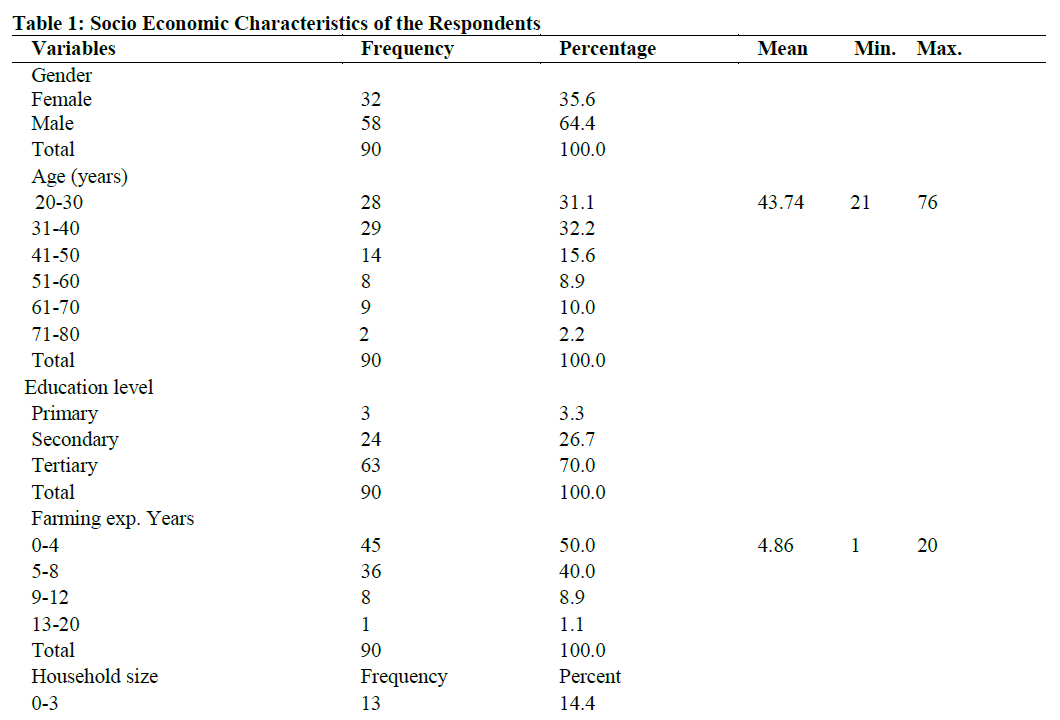
This study examined the determinants of indigenous organic farming practices adoption among cassava farmers in Kwara State, Nigeria. Multistage sampling procedure was used to select 90 cassava farmers from Kwara State Agricultural Development Programme (KWADP) Zone C. Data were collected using structured questionnaires and analyzed using descriptive statistics and binary logistic regression. The results showed that 64.4% of the respondents were male, while 63.3% were within the economically active age range of 20–40 years. About 70.0% of the farmers had tertiary education, and 57.8% had household sizes of between 4–6 persons. Institutional characteristics revealed that 68.9% of the respondents were members of farmers’ associations, and majority of them 83.3% had access to extension services, most of them 71.1% had access to credit for farming activities. The logistic regression results indicated that education level (β = 0.683, p < 0.05), farming experience (β = 0.686, p < 0.05), access to extension services (β = 2.739, p < 0.01), access to credit (β = 2.645, p < 0.05), and membership of farmers’ associations (β = 1.231, p < 0.05) significantly influenced adoption of indigenous organic farming practices. Access to extension services increased the likelihood of adoption by over fifteen times. The study concludes that institutional support and farmers’ capacity-building are critical to enhancing indigenous organic farming adoption among cassava farmers. Strengthening extension delivery, improving credit access, and promoting farmers’ organizations are recommended to scale up sustainable cassava production in the study area.
References
Adebayo, O. O., Oladele, O. I., & Yusuf, S. A. (2020). Determinants of sustainable farming practices among smallholder farmers in Nigeria. Journal of Agricultural Extension, 24(2), 45–58.
Adebayo, O. O., Oladele, O. I., & Yusuf, S. A. (2020). Determinants of sustainable farming practices among smallholder farmers in Nigeria. Journal of Agricultural Extension, 24(2), 45–58.
Adeoye, I. B., Omotayo, A. O., & Olatunji, G. B. (2017). Socio-economic factors influencing adoption of organic farming practices in Nigeria. African Journal of Agricultural Research, 12(8), 623–631.
Adeoye, I. B., Omotayo, A. O., & Olatunji, G. B. (2017). Socio-economic factors influencing adoption of organic farming practices in Nigeria. African Journal of Agricultural Research, 12(8), 623–631.
Ajzen, I. (2005). Attitudes, personality and behavior (2nd ed.). Open University Press.
FAO. (2022). FAOSTAT statistical database. Food and Agriculture Organization of the United Nations.
IFOAM. (2021). The world of organic agriculture: Statistics and emerging trends. IFOAM Organics International.
Oladele, O. I., & Somorin, A. A. (2021). Extension service delivery and adoption of sustainable agricultural practices in Nigeria. Nigerian Journal of Rural Sociology, 21(1), 33–44.
Oni, O. A., Salman, K. K., & Idowu, A. O. (2020). Gender roles in cassava production and processing in Nigeria. Journal of Gender, Agriculture and Food Security, 5(1), 1–15.
Rogers, E. M. (2003). Diffusion of innovations (5th ed.). Free Press.
Tadesse, G., & Lemma, Z. (2020). Factors influencing adoption of organic farming practices in Sub-Saharan Africa. Sustainability, 12(3), 1023.
Downloads
Published
Issue
Section
Categories
License
Copyright (c) 2026 Habeebullahi Abdulgafar, Aliyu Isah, Garba Ado

This work is licensed under a Creative Commons Attribution 4.0 International License.


