
A Predictive Analytics Model for Early Detection and Prevention of Student Dropout in Federal College of Education, Gidan Madi
DOI:
https://doi.org/10.33003/fjs-2026-1011-5293Keywords:
Machine Learning (ML), Deep Learning (DL), Student Dropout Prediction (SDP), Predictive Analytics (PA), Educational Data Mining (EDM)Abstract
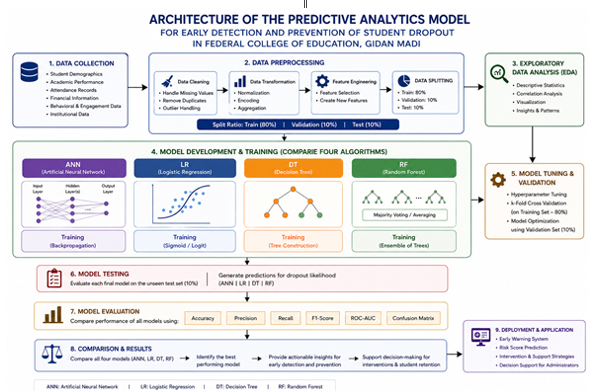
The increasing rate of student dropout in Nigerian tertiary institutions, particularly Colleges of Education, remains a significant threat to national human capital development. At Federal College of Education, Gidan Madi, dropout cases have been persistently linked to poor academic performance, socio-economic challenges, and inadequate institutional support structures. These issues not only result in personal and societal losses but also undermine the performance indicators of the institution, affecting funding opportunities, graduation rates, and academic reputation. Machine learning and deep learning techniques have been widely applied to analyzing student data; however, many existing studies rely on large datasets and computationally intensive models, limiting their applicability in data-constrained environments. This research proposes the development and evaluation of logistic regression (LR), Decision Tree (DT), Random Forest repressor (RF) and Artificial Neural Network (ANN) models for predicting student academic performance using a relatively small dataset. A dataset comprising of 250 student records was used for the experiment. The results show that the RF model achieved the highest accuracy of 92.00%, followed by LR with 90.00%. Both RF and LR consistently outperformed the ANN and DT models. The ANN model achieved an accuracy of 88.00%, while the DT model recorded the lowest accuracy of 84.00%.
References
Adefemi, K. O., & Mutanga, M. B. (2025a). A Robust Hybrid CNN – LSTM Model for Predicting Student Academic Performance.
Adefemi, K. O., & Mutanga, M. B. (2025b). Hybrid Deep Learning Models for Predicting Student Academic Performance. (Dl), 10–20.
Ahmed, E. (2024). Student Performance Prediction Using Machine Learning Algorithms. 2024. https://doi.org/10.1155/2024/4067721
Ahmed, W., Wani, M. A., Plawiak, P., Meshoul, S., Mahmoud, A., & Hammad, M. (2025). Machine learning-based academic performance prediction with explainability for enhanced decision-making in educational institutions. 1–21.
Alsumaidaie, M. S. I., Nafea, A. A., Jalal, R. D., & Al-ani, M. M. (2024). Intelligent System for Student Performance Prediction Using Machine Learning. 21(12), 3877–3891.
Augustine, G., Alfarwan, A. M., Aouifi, H. El, & Gaftandzhieva, S. (2025). Predicting student academic performance using Bi-LSTM : a deep learning framework with SHAP-based interpretability and statistical validation. (June), 1–18. https://doi.org/10.3389/feduc.2025.1581247
Bello, A., Ajibade, I., Wonuola, I., & Ekweli, D. (2025). Developing a predictive model for student academic performance using machine learning techniques.
Diekuu, J., Mekala, M. S., Abonie, U. S., & Isaacs, J. (2025). Predicting student next-term performance in degree programs using AI-based approach : a case study from Ghana. Cogent Education, 12(1). https://doi.org/10.1080/2331186X.2025.2481000
Hajoui, A. El, Alaoui, O. Y., Kharki, O. El, Wahbi, M., & Boulaassal, H. (2025). A Student Performance Prediction Using RNNs Models with variety of optimization Techniques in Deep Learning. 15(6), 1289–1301. https://doi.org/10.18178/ijiet.2025.15.6.2331
Id, J. W., & Yu, Y. (2025). Machine learning approach to student performance prediction of online learning. 1–15. https://doi.org/10.1371/journal.pone.0299018
Kuş, M. (2025). A meta-analysis of the impact of technology related factors on students ’ academic performance. (February). https://doi.org/10.3389/fpsyg.2025.1524645
Li, Y., & Lu, B. (2025). Intelligent educational systems based on adaptive learning algorithms and multimodal behavior modeling. 1–21. https://doi.org/10.7717/peerj-cs.3157
Lin, Y., Chen, H., Xia, W., Lin, F., Wang, Z., Liu, Y., & Lin, F. (2025). A Comprehensive Survey on Deep Learning Techniques in Educational Data Mining. Data Science and Engineering, 10(4), 564–590. https://doi.org/10.1007/s41019-025-00303-z
Mohsen, M., Khoudier, E., Hany, R., Abdelnaby, M., Eldamnhoury, Z. M., Raafat, S., Abouzeid, A., El-monayer, G. K., Enan, N. M., El-ghamry, A., Fouad, K., & Moawad, I. (2023). Prediction of student performance using machine learning techniques. 2023 5th Novel Intelligent and Leading Emerging Sciences Conference (NILES), 333–338.
https://doi.org/10.1109/NILES59815.2023.10296766
Muresan, A., Cardei, M., & Cardei, I. (2026). Predicting Student Success with Heterogeneous Graph Deep Learning and Machine Learning Models.
Sandeepa, A. G. R. (2025). Evaluation of Machine Learning Models in Student Academic Performance Prediction.
Downloads
Published
Issue
Section
Categories
License
Copyright (c) 2026 Muhammad Bodinga Jibril, M. Sarkin Kudu Shehu, Muhammad Bodinga Muhammad

This work is licensed under a Creative Commons Attribution 4.0 International License.


