
Assessment of Herbicide Residue Levels and Physicochemical Properties of Soils in Maize and Sorghum Farms from Ardo Kola, Jalingo, And Yorro Local Government Areas of Taraba State, Nigeria
DOI:
https://doi.org/10.33003/fjs-2026-1013-5253Keywords:
Glyphosate, Herbicide residues, Maize, Sorghum, Physicochemical parameters, GC-MS, Taraba State, Food safetyAbstract
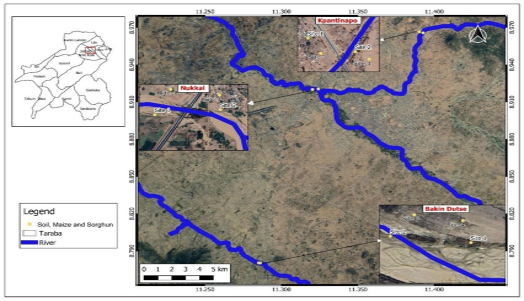
This study assessed the levels of selective and non-selective herbicide residues (Atrazine, 2,4-Dichlorophenol, Glyphosate, and Paraforce) in maize and sorghum obtained from farms in Ardo Kola, Jalingo, and Yorro Local Government Areas of Taraba State, Nigeria. Key physicochemical properties of the corresponding soils, including pH, total organic carbon (TOC), total organic matter (TOM), cation exchange capacity (CEC), and particle size distribution, were also evaluated to determine their influence on herbicide retention and mobility. Twelve maize and sorghum samples and twelve soil samples were collected using composite sampling techniques. Herbicide residues were extracted, purified, and quantified using Gas Chromatography–Mass Spectrometry (GC-MS), while soil physicochemical parameters were determined using standard analytical methods. Glyphosate was the only herbicide detected in all study locations, with concentrations ranging from 10.82 to 48.04 mg/kg, exceeding the FAO/WHO Codex Alimentarius Maximum Residue Limits (0.1–0.5 mg/kg) for cereal grains. Atrazine, Paraforce, and 2,4-Dichlorophenol were below detectable limits in all samples. Residue levels were highest in maize from Bakin Dutse (Ardo Kola), followed by Kpantinapo (Yorro) and Nukkai (Jalingo), indicating widespread use of glyphosate-based herbicides. Soil analysis showed slightly acidic to neutral pH (6.15–7.35), low TOC (0.02–1.22%), moderate CEC (2.86–5.14 cmol/kg), and predominantly sandy textures, conditions that favour glyphosate mobility and crop uptake. The findings raise concerns about excessive herbicide application, poor adherence to recommended pre-harvest intervals, and potential dietary exposure to glyphosate. Strengthened regulatory enforcement, farmer education, and integrated weed management practices are recommended to enhance food safety and environmental quality in Taraba State.
References
Adeyemi, O. A., Bello, R. S., & Yakubu, M. T. (2022). Cereal production and food security in northern Nigeria: Trends, drivers, and policy implications. Journal of Agricultural Economics and Rural Development, 8(2), 45–61.
Aliyu, M., Garba, S., & Usman, H. (2023). Soil physicochemical controls on pesticide retention in Guinea Savannah agroecosystems. Environmental Monitoring and Assessment, 195(4), 512. https://doi.org/10.1007/s10661-023-11128-6
Bai, S. H., & Ogbazghi, W. (2021). Glyphosate uptake and translocation in cereal crops: A comparative review. Crop Protection, 145, 105616. https://doi.org/10.1016/j.cropro.2021.105616
Benbrook, C. M., Perry, M. J., Belpoggi, F., Landrigan, P. J., Perro, M., Mandrioli, D., Antoniou, M. N., Winchester, P., & Mesnage, R. (2021). Commentary: Novel strategies and new tools to curtail the health effects of pesticides. Environmental Health, 20(1), 87. https://doi.org/10.1186/s12940-021-00773-4
Catrinck, T. C. P. G., Dias, A., Aguiar, M. C. S., Silvério, F. O., Fidêncio, P. H., & Pinho, G. P. (2021). A simple and efficient method for derivatization of glyphosate and AMPA using 9-fluorenylmethyl chloroformate and spectrophotometric analysis. Journal of the Brazilian Chemical Society, 32(7), 1356–1363.
Costas-Ferreira, C., Durán, R., & Faro, L. R. F. (2022). Toxic effects of glyphosate on the nervous system: A systematic review. International Journal of Molecular Sciences, 23(9), 4605. https://doi.org/10.3390/ijms23094605
EFSA (European Food Safety Authority). (2023). Peer review of the pesticide risk assessment of the active substance glyphosate. EFSA Journal, 21(7), e08164.
Estefan, G., Sommer, R., & Ryan, J. (2020). Methods of soil, plant, and water analysis: A manual for the West Asia and North Africa region (3rd ed.). ICARDA.
Eze, C. N., Okeke, B. C., & Nwankwo, I. U. (2023). Pesticide residues in Nigerian staple crops: A meta-analytic review (2010–2022). Science of the Total Environment, 868, 161589. https://doi.org/10.1016/j.scitotenv.2023.161589
FAO. (2023). FAOSTAT: Food and agriculture data crop production and consumption statistics. Food and Agriculture Organization of the United Nations. https://www.fao.org/faostat
IARC (International Agency for Research on Cancer). (2021). Glyphosate. IARC monographs on the identification of carcinogenic hazards to humans, Vol. 112. World Health Organization.
Mamy, L., Patureau, D., Barriuso, E., Bedos, C., Bessac, F., Louchart, X., Martin-Laurent, F., Miege, C., & Benoit, P. (2022). Prediction of the fate of organic compounds in the environment: A review of multimedia and soil models. Critical Reviews in Environmental Science and Technology, 52(5), 833–875.
Mesnage, R., Teixeira, M., Mandrioli, D., Falcioni, L., Ducarmon, Q. R., Zwittink, R. D., Mazzacuva, F., Caldwell, A., Halket, J., Amiel, C., Panoff, J.-M., Belpoggi, F., & Antoniou, M. N. (2023). Use of shotgun metagenomics and metabolomics to evaluate the impact of glyphosate or Roundup on the gut microbiome. Environmental Health Perspectives, 131(1), 017005.
Nwankwo, U., & Eze, P. C. (2024). Patterns of herbicide use and farmer awareness in north-eastern Nigeria. African Journal of Agricultural Research, 19(3), 211–225.
Okada, E., Costa, J. L., & Bedmar, F. (2021). Adsorption and mobility of glyphosate in different soils under no-till and conventional tillage. Geoderma, 385, 114874. https://doi.org/10.1016/j.geoderma.2020.114874
Okorie, C. U., Adekunle, A. A., & Bello, M. (2021). Survey of pesticide use among smallholder farmers in Nigeria: Implications for food safety. Heliyon, 7(11), e08366.
Peillex, C., & Pelletier, M. (2020). The impact and toxicity of glyphosate and glyphosate-based herbicides on health and immunity. Journal of Immunotoxicology, 17(1), 163–174.
Sani, A. M., Ibrahim, Y., & Aliyu, S. (2024). Off-label pesticide application practices among cereal farmers in north-eastern Nigeria. Journal of Environmental Health Science and Engineering, 22(1), 33–47.
Sidoli, P., Baran, N., & Angulo-Jaramillo, R. (2022). Glyphosate and AMPA fate in agricultural soils: Recent advances. Environmental Science and Pollution Research, 29(15), 21287–21312.
US-EPA. (2020). Test methods for evaluating solid waste, physical/chemical methods (SW-846). United States Environmental Protection Agency.
US-EPA. (2022). Glyphosate: Interim registration review decision. Office of Pesticide Programs, United States Environmental Protection Agency.
WHO. (2022). Public health impact of chemicals: Knowns and unknowns. World Health Organization.
Downloads
Published
Issue
Section
Categories
License
Copyright (c) 2026 Amira Ibrahim Abba, Ernest Isaac, Eunice Adebowale Medjor; Weltime Odeguonor Medjor

This work is licensed under a Creative Commons Attribution 4.0 International License.


