
Mathematics Polya's Model for Analysing Insecurity Disruption and Sensitising Senior Secondary School Students in Niger State, Nigeria
DOI:
https://doi.org/10.33003/fjs-2026-1015-5242Keywords:
Analysis, Disruption, Insecurity, Mathematics, Polya's Model, SensitisationAbstract
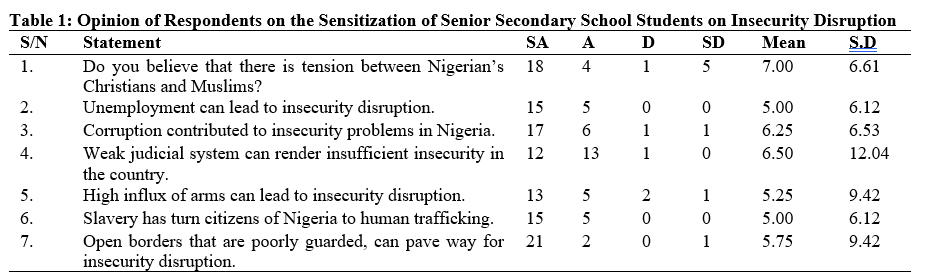
Education plays a vital role in sensitising communities about insecurity disruptions, particularly in regions recently devastated by banditry attacks that have claimed the lives of innocent rural men, women, and children. Insecurity has emerged as a major challenge confronting the Nigerian government, with activities of the Islamic sect (Boko Haram) and banditry groups leading to significant loss of lives and properties, especially in Northern Nigeria. These activities include bombings, suicide attacks, sporadic shootings of unarmed citizens, burning of police stations and churches, and kidnapping of school children and women. This study employed Polya's problem-solving model to analyse and sensitise senior secondary school students on insecurity disruption. The research adopted a descriptive survey design of the correlational type. The population comprised senior secondary school students in Minna Metropolis, Niger State, from which 300 students (200 male, 100 female) were randomly selected. Data were collected using the Senior Secondary School Insecurity Disruption Questionnaire (SSSIDQ), which was validated through expert review, with reliability established via the test-retest method yielding a coefficient of 0.98. Four research questions were answered using mean and standard deviation, while the hypotheses were tested using Pearson Product-Moment Correlation Coefficient (PPMC). Results revealed a significant difference in using Mathematics Polya's Model to sensitise senior secondary school students on insecurity disruption (df = 385, r = 0.98, p < 0.05).
References
Back, J. (2014). Creative Approaches to Mathematics across the Curriculum.
McGrew, T. (1988). “Security and Order” in Smith, M., Smith, S. & White, B. (eds.) British Foreign Policy: Tradition, Change and Transformation, London: Allen and Unwin Ltd.
McSweeny, B. (1999) and Dike, B. (2010). Security, Identity and Interests: A Sociology of International Relations. London: Cambridge University Press.
Nwagbosa, C. (2012). “Security Challenges and Economy of the Nigerian State (2007-2011)”, American International Journal of Contemporary Research, Vol. 2, No. 6; pp. 244-258.
Nwolise, O.B.C., (2006). “National Security and Sustainable Democracy” in Ojo, E.O. (Ed.). Challenges of Sustainable Democracy in Nigeria. Nigeria, Ibadan: John Archer Publishers.
Omede, A.J. (2011). “Nigeria: Analyzing the Security Challenges of the Goodluck Jonathan Administration.” Canadian Social Science, Vol. 7, No. 5 2011, pp. 90-102.
Onifade, C.A. & Imhonopi, D. (2012). Towards National Integration in Nigeria: Jumping the Hurdles. A Paper presented at the 28th National Conference of the Social Studies Association of Nigeria, Themed: The Unending Question of National Unity in Nigeria – In whose interest. Institute of Education, OAU, Osun, November 26-29, 2012.
Downloads
Published
Issue
Section
Categories
License
Copyright (c) 2026 Haruna Babakpan, Shehu Batagi, Ndaba David, Isah Ndama, Halima Adamu

This work is licensed under a Creative Commons Attribution 4.0 International License.