
A DISCRETE-TIME ECONOMIC ORDER QUANTITY MODEL FOR AMELIORATING ITEMS WITH CONSTANT DEMAND AND LINEAR HOLDING COSTS
DOI:
https://doi.org/10.33003/fjs-2026-1001-3913Keywords:
Economic Order Quantity, Ameliorating items, Constant Demand, Linear Holding Cost, Discrete timeAbstract
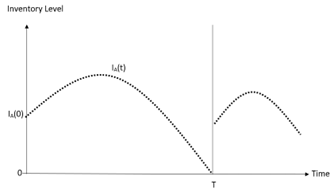
This paper presents the development of a discrete time economic order quantity model with constant demand and linear holding cost for ameliorating items where shortages are not allowed and this is a generalization of GWANDA (2018) In the study, the items are assumed to undergo immediate amelioration upon arrival in stock. The purpose is to determine the optimal ordering quantity and replenishment cycle so as to minimize the total variable cost. It is a generalization of an analysis of ameliorating items under constant demand by taking time to be discrete and holding cost linear. A mathematical expression representing the instantaneous inventory level at an arbitrary time t with the cycle period T, are solved utilizing a difference equation subject to initial and boundary conditions. Numerical example has been demonstrated to validate the model and sensitivity analysis conducted to determine the impact of parameter variations.
References
Ahmed, F., and Vempala, S. (2019) An EOQ model with amelioration of defective items under linear pricing schehe and supply uncertainty. Journal of the Indian Institude of Science. 100(3), 458-471.
Alzzawi, K. A. and Majid, M. H. (2019) An EOQ MODEL with amelioration of defective items under price negotiation and inflation. International Journal of Production Economics, 211, 135-143.
Biswajit, M., Asoke, K. B. and Manoranjan, M. (2003). Inventory system of ameliorating items whose demand rate is dependent on price Computers and industrial engineering. 45, 443-456.
Dave, U. and Jaswal, M. C. (1980). A discrete in time probabilistic ordering policy for deteriorating items. Decision Science, 11, 110-120.
Dave, U.(1985). On a discrete in time deterministic inventory policy for deteriorating items with time proportional demand. Optimization. 16. 449-461.
Fathy, M. e. and Xiaolei, Z. (2020) An optimal inventory model for ameliorating items with maximum rate of amelioration and shortages with variable rate. International Journal of Production Economics. 231, 1-15.
Fathy, M. E., Xiaolei, Z. and Jie, Z. (2017), Deterministic inventory model for ameliorating items with fuzzy demand under inflation and time dependent selling price. International Journal of production Economics. 41, 89-108.
Fathy, M.E. and Riaz, A. A. (2014) An ordering policy for ameliorating items with power demand, inventory level dependent selling price and trade credit. International Journal of Production Economics. 160, (2) 716-723.
Gobinda, C. P., Satyajit, S. and Pravat, K. S. (2013). Note on inventory model for ameliorating items with time dependent second order demand rate. Scientific Journal of Logistics.9, 43-49.
Gwanda, I. Y. (2019) An ordering policy for both ameliorating and deteriorating items with exponential deterioration increasing demand and trended time holding cost. Global Scientific Journals. 7 (1), 427-443.
Gwanda, I.Y. (2018) An ordering policy for ameliorating items with time dependent demand and trended holding cost. Global Scientific Journals. 6 (12), 126-145.
Han-Wen, T., Shu-Cheng, L. and Peterson, J. (2017). Improvement for Amelioration Model with Weibull Distribution. Mathematical Problems in Engineering .2017, 8946547-894555.
Hwang, H. S. (1997). An inventory policy for items with Weibull amelioration. Computers and industrial engineering. 33, 3-4.
Hwang, H. S. (1999). Inventory models for both ameliorating and deteriorating items. Computers and industrial engineering. 37, 257-260.
Hwang, H. S. (2004). A stochastic set-covering location model for both ameliorating and deteriorating items. Computers and industrial engineering. 46, 313-319.
Kandpal, D. H. and Tinani, K. S. (2013). A Stochastic inventory policy for ameliorating items under supplier’s trade credit. International Journal of Engineering and Management Sciences. 4 (2) 203-211.
Khan, M. U. A., Alam, R. and Islam, M. S. (2020) An EOQ model with amelioration of defective items under uncertain demand and service level with nonlinear amelioration cost. Computers and Industrial Engineering, 154, 104-125.
Khoumsi, D. and Skouri, R. (2022) Inventory models with amelioration effect and different demands patterns. International Journal of Production Economics. 240, 124-137.
Luo, Y., Zhan, C., Ma, Y., Liu, Y., and Xu, F. (2020) An EOQ model with amelioration of defective items under a multi-step delivery scheme with price negotiation. International Journal of Resources, Conservation and Recycling. 152, 105-121.
Srichandan, M, Misra, U. K.,Minakshi, M. and Barik, S. (2012). Inventory policy with Weibull amelioration under the influence of inflation and time value for money. Journal of Computer and Mathematical Science. 3, 167-176.
Yahaya, A. Dayyabu, H. and Kabiru, M.A. (2019). Ordering policy for ameliorating inventory with linear demand rate and unconstrained retailer’s capital. Abacus (Mathematical Science Series). 44 (1), 346-351.
Yakubu, M.I. and Sani, B. (2015), Ordering policy for deteriorating items that exhibit delay in deterioration with discrete time. Journal of the Nigerian Association of Mathematical Physics, 31, 241- 250.
Yazici, G., Soysal, G. and Ozdemir, F. (2019). An economic order quantity model with amelioration of defective items under uncertain demand and supply with two suppliers. International Journal of Production Research, 57(15), 4592-4606.
Downloads
Published
Issue
Section
Categories
License
Copyright (c) 2026 Halima Adamu, Mariyat Isah Yakubu

This work is licensed under a Creative Commons Attribution 4.0 International License.


