
FTIR-BASED CHEMICAL INTERACTION STUDY OF RICE HUSK ASH MODIFIED AGBABU NATURAL BITUMEN
DOI:
https://doi.org/10.33003/fjs-2026-1007-5235Keywords:
Bitumen, Rice Husk Ash, OxidationAbstract
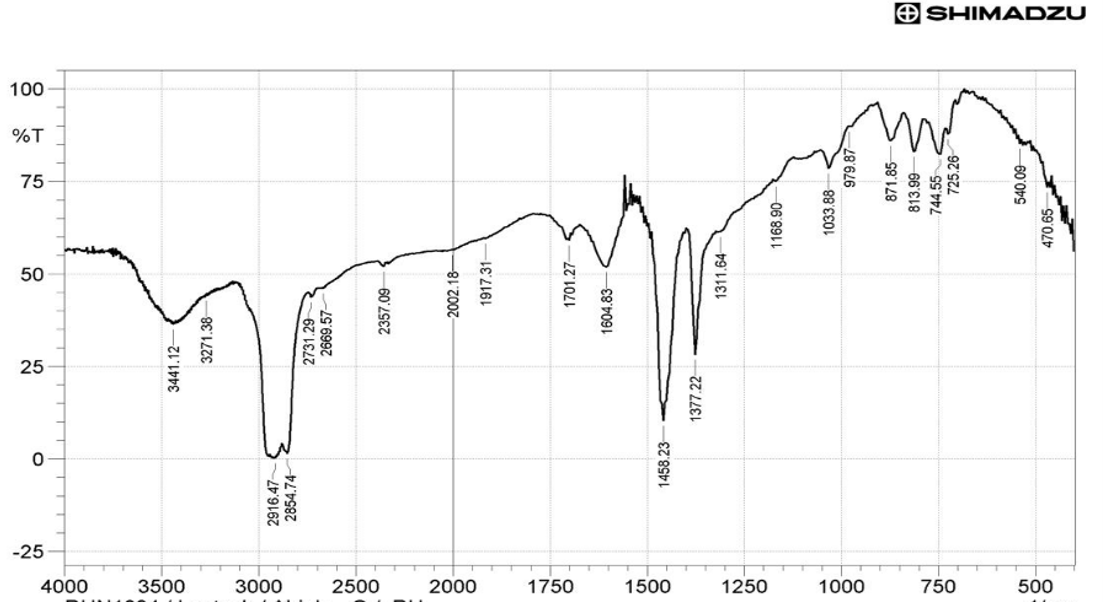
Bitumen is a mixture of hydrocarbons widely used as a binder in road pavements but has certain limitations, including oxidative failure and various surface defects. These challenges led to the modification of Agbabu Natural Bitumen (ANB) using rice husk ash (RHA), with the expected result that it might mitigate the adverse effects of conventional bitumen. The raw ANB was modified in a stainless reactor using the rice husk ash at five different proportions maintaining a temperature of 100-110 ̊C. The modified bitumen was analyzed using Fourier Transform Infrared (FTIR) spectroscopy. The carbonyl peaks are reduced to 1701cm-1 while the aliphatic contents are retained both in the raw and modified ANB and the aromatics and sulfoxide peaks are stable. The peaks at 3448.84cm-1, 2854.74 cm-1, 1716.7cm-1, 1608.69cm-1, 1377.22cm-1, 1033.88cm-1corresponds to O-H stretching of alcohol, C-H stretching of alkane, C=O stretching of carbonyls, C=C stretching of aromatics rings, C-H bending of methyl groups and S=O stretching of sulfoxide respectively. The silicates peaks were also observed at 420.5cm-1, 466.79cm-1, 570.95cm-1, and 582.52cm-1. The interaction of ANB with RHA showed that the silicate components present in RHA can serve as potential antioxidants for improving the performance of ANB in pavements.
References
Bakare, H. O., & Olabemiwo, O. M. (2017). Efficacy of Polyphosphoric Acid in Reducing the Degree of Thermal Aging of Agbabu Natural Bitumen. Covenant Journal of Physical and Life Sciences, 4(2), 1-17.
Barzegari S., 2019. Application of Bio-Binders as Sustainable Alternative to Conventional Asphalt Binders. (Doctoral dissertation, The Pennsylvania State University).
Iliya Y., Adam Z., (2011), Attenuated total reflection (ATR) fourier Transform infrared (FTIR) spectroscopy of oxidized polymer-modified bitumen, Appl. Spectrosc. 765–770.
Abo-Shanab Z.L., Ragab A.A. and Naguib H.M., 2021. Improved dynamic mechanical properties of sustainable bio-modified asphalt using agriculture waste. International Journal of Pavement Engineering 22(7): 905-911.
Petersen J.C., P.M. Harnsberger (1998), Asphalt Aging: a dual oxidation mechanism and its interrelationships with asphalt composition and oxidative age hardening, in: Transportation Research Record 1638, TRB, National Research Council, Washington, D.C, 1998a, pp. 47–55.
Olabemiwo O.M., Esan A.O, H.O. Bakare, F.O. Agunbiade (2019), Polymer modified natural bitumen thermal aging resistance studies, Int. J. Pavement Eng. 20 (10): 1207–1215.
Xue Y., Wu S., Cai J., Zhou M. and Zha J., 2014. Effects of two biomass ashes on asphalt binder: Dynamic shear rheological characteristic analysis. Construction and Building Materials 56: 7-15.
Nivitha M.R., Prasad E. and Krishnan J.M., 2016. Ageing in modified bitumen using FTIR spectroscopy. International Journal of Pavement Engineering, 17:565-577.
Kumar P. and Khan M.T., 2013. Evaluation of physical properties of sulphur modified bitumen and its resistance to ageing. Elixir Chem Eng A, 55:3104-13107.
Zhang H., Zhu C., Yu J., Shi C. and Zhang D., 2015. Influence of surface modification on physical and ultraviolet aging resistance of bitumen containing inorganic nanoparticles. Construction and Building Materials 98: 735-740.
Penki R. and Rout S.K., 2021. Next-generation bitumen: a review on challenges and recent developments in bio-bitumen preparation and usage. Biomass Conversion and Biorefinery, 1-18.
Shankaregowda (2014). Porous Asphalt Design for Cold Climate Use. International Journal of Emerging Trends in Science and Technology, 1(6), 867–874. ISSN 2348-9480.
Downloads
Published
Issue
Section
Categories
License
Copyright (c) 2026 Babawale Emmanuel Abiola, Omotayo Tawakalit Jayeola, Akintomiwa Olumide Esan, Aminat Adebisi Adetayo-Balogun, Monsurat Olabisi A. Shittu, Blessing Abiola Ibiejemite

This work is licensed under a Creative Commons Attribution 4.0 International License.


