
Effect of Copper Suplementation on Biogas Yield from Co-Digestion of Cattle Dung and Jatropha Curcas Fruit Coat
DOI:
https://doi.org/10.33003/fjs-2026-1011-5194Keywords:
anaerobic digestion, co-digestion, biogas yield, copper supplementation, cattle dung, Jatropha curcasAbstract
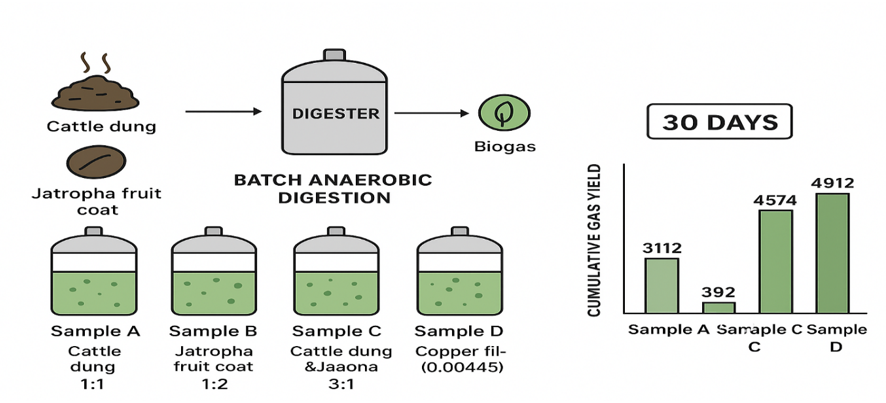
Limited understanding exists regarding the role of copper as a trace additive in cattle dung–Jatropha curcas fruit coat (CD–JFC) co-digestion systems, particularly under ambient mesophilic conditions. This study therefore aimed to evaluate the effect of low-dose copper supplementation on biogas yield during batch anaerobic co-digestion of CD and JFC. Experiments were conducted in 2 L laboratory-scale digesters operated over 30 days at 25–35°C, comparing mono-digestion, co-digestion, and co-digestion with copper addition (4.45 g). Co-digestion improved cumulative biogas yield by approximately 47% relative to cattle dung mono-digestion, confirming enhanced substrate synergy. The inclusion of copper resulted in a further ~7.4% increase compared to co-digestion without copper. While this suggests a stimulatory effect, the relatively small absolute gain indicates that the influence of copper under the tested conditions is modest. Typical batch digestion behavior, including lag, active production, and stabilization phases, was observed; however, no direct process monitoring or yield normalization was performed, limiting mechanistic interpretation and cross-study comparability. Consequently, copper supplementation in this context should be interpreted as appearing to enhance biogas yield rather than providing definitive performance improvement. Given the laboratory-scale setup and short hydraulic retention time, further research is required to optimize copper dosage, evaluate long-term process stability, and assess potential environmental implications associated with metal accumulation in digestate.
References
Alawi Sulaiman, Mohd Rafein Zakaria, Mohd Ali Hassan and Yoshihito Shirai, 2009. Co-Digestion of palm oil mill effluent and Refined Glycerin wash water for chemical oxygen demand removal and Methane Production. American Journal of Environmental sciences. 5(5)
Al-Masri, M. R. (2001). Change in biogas production due to different ratios of some animal and Agricultural wastes. Bioresources Technology. 77: 97-100.
An D, Wang T, Zhou Q, Wang C, Yang Q, Xu B, Zhang Q. Effects of total solids content on performance of sludge mesophilic anaerobic digestion and dewaterability of digested sludge. Waste Management (New York, N.Y.), 2017, 62(1): 188–193.
Andati, W., Braza, D., and Mageto, M. (2019). Biogas Production from Biomas Kitchen Waste Laced with Cow Dung in a modified Laboratory-Scale Anaerobic Digester. East African Journal mof Health and Science, 1(2), 52-61
Das A. and Mondal C. 2016. Biogas production from Co-digestion of Substrates: A Review. International Research Journal of Environment sciences. Vol. 5(1). P. 49-57
El-mashad, H. M. and Zhang R. (2010). Biogas production from Co-Digestion of Dairy manure and Food waste. Bioresource Technology, 101, 4021-4028. Retrieved: https://doi.org/10.1016/j.biortec.2010.01.027.
Ernestas Zaleckas, Egle Sendžikienė and Rūta Čiutelytė, 2012. Evaluation of Heavy Metals Influence on Biogas Production. Environmental Research, Engineering and Management, no 4(62), p. 14-20.
Irini Angelidaki and L. Ellegaard, 2003. Codigestion of manure and Organic Wastes in Centralized Biogas Plants: Status and Trends. Applied biochemistry and Biotechnology 109 (1-3). P. 95-105.
J. Mata – Alvarez, S. Macé, P. Llarés. 2000. Anaerobic digestion of organic solid wastes. And overview of research achievements and perspective (review paper). Bioresource technology 74 (2000) 3-16.
Kougias P G, Treu L, Campanaro S, Zhu X, Angelidaki I. Dynamic functional characterization and phylogenetic changes due to Long Chain Fatty Acids pulses in biogas reactors. Scientific Reports, 2016, 6(1): 28810.
Lam, M.K., and Lee, K.T. (2011). Review and Sustainable Bio-energies Production from Palm Oil Mill Effluent (POME): win-win strategies towards better Environmental protection. Biotechnology Advances, 29:124-141
M. S. Dhanya and H. C. Joshi, 2009. Biogas potentiality of agro-waste jatropha fruit coat.
M.K. Jameel, M.A. Mustafa, H.S. Ahmed, A.j. Mohammed, H. Ghazy, M.N. Shakir, A.M. Lawas, S.k. Mohammed, A.H. Idan, Z.H. Mahmoud, H. Sayadi, E. Kianfar, Biogas: Production, properties, applications, economic and challenges: A review, Results in Chemistry (2024), doi: https://doi.org/10.1016/ j. rechem.2024.101549.
Michael H. Gerardi. 2003. The Microbiology of Anaerobic Digesters. Print ISBN: 9780471206934, DOI: 10.1002/0471468967.
N. Y. Godi, L. B. Zhengwuvi, Salihu Adulkadir and P. Kamtu. 2013. Effect of Cow Dung on Biogas Production. Journal of Mechanical Engineering Research. vol. 5(1), 1-4.
Nijauna, B. T. 2002) biogas Technology. New Age International (P) ltd. Publisher. New Delhi, India 110112.
Ofoefule, A. U., Uzodinma, E. O and Onnukwuli, O. D (2009a), comparative study of the effect of different pretreatment methods on biogas yields from water hyacinth (Eichhornia crassipes), International Journal of physical science. 4(8); 535-539.
Ofosu, M.A. 2009. Anaerobic digestion of shea waste for energy deneration (doctoral dissertation, university of cape coast).
P. Demetriades. 2008. Thermal pretreatment of cellulose rich biomass for biogas production (master thesis, Swedish university of agricultural sciences). ISSN 1101-8151.
Peng G., Tian G., Liu J., Bao Q., Zang L. 2011. Removal of heavy metals from sewage sludge with a combination of bioleaching and electrokinetic remediation technology. Desalination, 271(1-3), pp 100-104.
Poh, P. E., Chong, M.F. (2009). Development of Anaerobic Digestion Methods for Palm Oil Mill Effluent (POME) Treatment, Bioresources technology, 100: 1-9.
Solomon, K. R., and Lora, E.E.S. (2009). Estimate of the electric energy generating potential for different sources of biogas in Brazil. Biomass and Bio Energy, 33: 1101-1107
Tian Z, Zhang Y, Li Y, Chi Y, Yang M. Rapid establishment of thermophilic anaerobic microbial community during the one-step startup of thermophilic anaerobic digestion from a mesophilic digester. Water Research, 2015, 69(1): 9–19.)
Ukpai, P. A. and Nnabuchi, M.N. 2012. Comparative study of biogas production from cow dung, cow pea and cassava peeling using 45 liters biogas digester. Advances in Applied Science Research, 3(3): 1864-1868.
Umar Hayatu Sidik, Firdausi Bin Razali, Sharifah Rafidah Wan Alwi and Fadimtu Maigari, 2013). Biogas production through co-digestion of palm oil mill effluent with cow manure. Nigerian Journal of Basic applied Science, vol. 21(1). P. 79-84.
Yang, Y., Tsukhara, K., Yagishita, T., Sawayama, S. (2004). Performance of a Fixed-bed reactor packed with carbon felt during anaerobic Digestion of Cellulose. Bioresources Technology, 94(2): 197-201.
Downloads
Published
Issue
Section
Categories
License
Copyright (c) 2026 Victor Elisha Ugoma, Stephen Igbinoba, Kingsley Imanze

This work is licensed under a Creative Commons Attribution 4.0 International License.


