
EFFECT OF GINGER (Zingiber officinale) ON NAPROXEN INDUCED-LIVER DAMAGE IN WISTAR RATS
DOI:
https://doi.org/10.33003/fjs-2026-1006-5175Keywords:
Liver enzymes, Naproven, Zingiber officinale, Alkaline PhosphataseAbstract
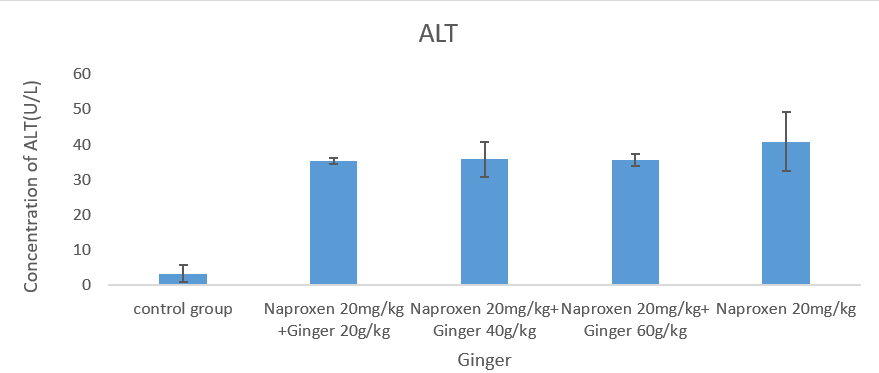
The potential effect of Zingiber officinale on naproxen induced liver damage was evaluated. Twenty-Five male Wistar rats were grouped into five groups of 5 rats each. Liver damage was induced by oral administration of Naproxen 20mg/kg body weight and ginger supplements for 14 days. Group I served as the positive control group; while ginger supplement was included in the diet of group II, III and IV at graded concentration of 20mg/kg, 40mg/kg and 60mg/kg of animal feed and naproxen. Group V received only 20mg/kg of naproxen for 14 days. At the end of the period of administration, the rats were euthanized and their blood was collected and used to determine the levels of Aspartate Transferase, Alanine Aminotransferase, Alkaline Phosphate, direct bilirubin, total protein, albumin, and lactate dehydrogenase. The result obtained revealed a significant increase in serum Aspartate Transaminase in all the groups treated with the various fractions of ginger and the naproxen group as compared to the normal control group. There was also a significant increase in total protein in groups 3,4 and 5 compared to the control group and there was a significance decrease in serum alkaline phosphatase in all groups treated with the ginger. The study also revealed an increased in serum albumin. In conclusion, ginger supplement in diet ameliorates naproxen induced liver damage. It is therefore recommended that ginger should be supplemented in the diets due to its beneficial effects and the abuse of non-steroidal anti-inflammatory drugs should be avoided.
References
Aderibigbe, O. R. (2015). Prevalence, Knowledge And Usage Of Herbal Dietary Supplements
Among Workers In Agricultural Research Institutes In Ibadan, Nigeria (Doctoral dissertation).
Allen SE (2002).The liver: Anatomy, Physiology, Disease and Treatment. North Eastern University Press, USA.
Bessone, F. (2010). Non-steroidal anti-inflammatory drugs: What is the actual risk of liver
damage?. World journal of gastroenterology, 16(45): 5651.
Erci, B. (2012). Medical herbalism and frequency of use. A compendium of essays on alternative
therapy, 173.
Gupta, S., Verma, D., Tufchi, N., Kamboj, A., Bachheti, A., Bachheti, R. K., & Husen, A. (2021).
Food, fodder and fuelwoods from forest. In Non-Timber Forest Products: Food, Healthcare and Industrial Applications (pp. 383-425). Cham: Springer International Publishing.
Jolad SD, Lantz RC, Solyom AM, Chen GJ, Bates RB, Timmermann BN (2004). Fresh organically grown ginger (Zingiber officinale): Composition and effects on LPS-induced PGE2 production. Phytochemistry. ;65:1937–5
Kankanamalage, T. N. M., Dharmadasa, R. M., Abeysinghe, D. C., & Wijesekara, R. G. S. (2014).
A survey on medicinal materials used in traditional systems of medicine in Sri Lanka. Journal of Ethnopharmacology, 155(1), 679-691.
Lee, E. L., Richards, N., Harrison, J., & Barnes, J. (2022). Prevalence of use of traditional,
complementary and alternative medicine by the general population: a systematic review of national studies published from 2010 to 2019. Drug safety, 45(7), 713-735.
Ozougwu, J. C. (2017). Physiology of the liver. International Journal of Research in Pharmacy
and Biosciences, 4(8), 13-24.
Park EJ, Pizzuto JM (2002). Botanicals in cancer chemoprevention. Cancer Metast Rev. ;21:231–55.
Shah, K., Gupta, J. K., Chauhan, N. S., Upmanyu, N., Shrivastava, S. K., & Mishra, P. (2017).
Prodrugs of NSAIDs: A review. The open medicinal chemistry journal, 11, 146.
Shukla Y, Prasad S, Tripathi C, Singh M, George J, Kalra N (2007). In vitro and in vivo modulation of testosterone mediated alterations in apoptosis related proteins by [6]-gingerol. MolNutr Food Res. 51:1492–502.
Shukla Y, Singh M (2007). Cancer preventive properties of ginger: A brief review. Food ChemToxicol.; 45:683–90.
Sriuttha P., Sirichanchuen B., Permsuwan U (2018). Hepatotoxicity of nonsteroidal anti-inflammatory drugs: a systematic review of randomized controlled trials. Int.J.Hepatol.2018:1-13.
Sukasem C, Katsila T, Tempark T, Patrinos GP, Chantratita W (2018). Drug-Induced Stevens-Johnson Syndrome and Toxic Epidermal Necrolysis Call for Optimum Patient Stratification and Theranostics via Pharmacogenomics. HumGenet.31; 19:329-353.
Thomson M, Al-Qattan KK, Al-Sawan SM, Alnaqeeb MA, Khann I, Ali M(2002). The use of ginger(Zingiber officinale Rosc.) as a potential anti-inflammatory and anti-thrombotic agent. Prostaglandin..2002;67(6):475-8.
Van Lerberghe, W. (2008). The world health report 2008: primary health care: now more than
ever. World Health Organization.
Wachtel-Galor, S., & Benzie, I. F. (2012). Herbal medicine: an introduction to its history, usage,
regulation, current trends, and research needs.
World Health Organization, 2. (2001). Legal status of traditional medicine and
complementary/alternative medicine: a worldwide review (No. WHO/EDM/TRM/2001.2). World Health Organization.
World Health Organization. (2009). The use of herbal medicines in primary health care (No. SEA-
HSD-322). WHO Regional Office for South-East Asia.
Downloads
Published
Issue
Section
Categories
License
Copyright (c) 2026 Mahan Josiah Mallo, Uchechi Amarachi Nwankwo, Joseph Emberga Toryila, Victor Inyila Eje, Abiodun Joel Oladejo, Angela Member Danborno

This work is licensed under a Creative Commons Attribution 4.0 International License.


