
ENVIRONMENTAL PREDICTORS OF UNDER-FIVE IMMUNIZATION UTILIZATION AMONG WOMEN OF CHILDBEARING AGE IN PLATEAU NORTH SENATORIAL DISTRICT OF PLATEAU STATE, NIGERIA.
DOI:
https://doi.org/10.33003/fjs-2025-0912-4477Keywords:
Environmental factors, immunization, Wo/men of childbearing age, Under-five, utilizationAbstract
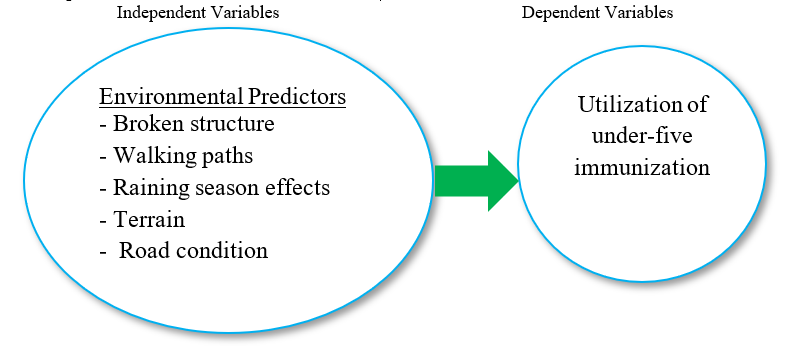
Immunization remains a cornerstone of child survival strategies globally. Environmental barriers often limit mothers’ access to vaccination services such as poor road infrastructure continue to hinder the accessibility of immunization services in many low-resource settings. In the study area, there are still gaps for under-five immunization service. Despite studies to attain full immunization and enhance the immunization programmes. It is important to understand the underlying environmental predictors to fill the existing gaps using the following objective: to investigate the environmental predictors affecting under-five immunization utilization among women of childbearing age and to assess the association between environmental predictors and childhood immunization status.in study area. A cross-sectional study was conducted among 400 women of childbearing age (15-49 years) selected using a multistage random sampling technique. Data were collected through structured questionnaires and in-depth interview (IDI). The data collected were analyzed descriptively, while inferential employed multiple linear regression analysis to examine relationships between independent and dependent variables of under-five immunization utilization among women of childbearing age in the study area. Broken structure statistically significant (p = 0.008); descriptively, with 66.5% “deteriorated road” and 37.50% having the highest number of respondents and non-immunized respectively, of under-five more likely affecting utilization of childhood immunization in the study area. Also, raining season effects is significant (p = 0.005), and descriptively, having highest (82%) number of respondents “not attempting” to immunized their children during raining season” with 43.00% immunized against 39.00% of non-immunized under-five in the study area.
References
Climate Change in Nigeria: Impacts and Responses PreventionWeb,” (2019). https://www.preventionweb.net/publication/climate-change-nigeria-impacts-and-responses.
Dougherty, L., Adediran, M., Akinola, A., Usman, A., & Balogun, M. (2024). An evaluation of a multi-partner approach to increase routine immunization coverage in six northern Nigerian states. BMC Health Services Research.
Ekezie, W., Igein, B., Varughese, J., Butt, A., Ukoha Kalu, B. O., Ikhile, I., & Bosah, G. (2024). Vaccination communication strategies and uptake in Africa: A systematic review. Vaccines, 12(12), 1333.
Galadima, A. N., Zulkefli, N. A. M., Md Said, S., & Ahmad, N. (2021). Factors influencing childhood immunisation uptake in Africa: A systematic review. BMC Public Health
Gavi. (2024). Global immunization in 2023: 7 things you need to know. Gavi: The Vaccine Alliance.
Global Volcanism Program. (2021). Smithsonian Institution. Jos Plateau Retrieved 2021-06-24
Igbiri, S. (2024). Impact of climate-induced flooding on childhood vaccination in two Nigerian states: A retrospective analysis of DHIS2 data. [Link] immunizationagenda2030.org
Jimoh, A. U., Filani, O., & Omoya, S. (2024). Enablers and barriers to integrating COVID-19 vaccination into routine immunization in Ekiti State, Nigeria. Human Resources for Health, 22, Article 217. https://doi.org/10.1186/s12982-024-00217-7
Joseph, N. K., Macharia, P. M., Ouma, P. O., Mumo, E., Jalang'o, R., Wagacha, P. W., & Okiro, E. A. (2020). Spatial access inequities and childhood immunisation uptake in Kenya. BMC Public Health, 20, 1407. https://doi.org/10.1186/s12889-020-09486-8 journal article
Lima, J. A. de., Neta, A. A., Assis, S. M. C., Rodrigues, B. de O., & Ribeiro, H. (2025). Access to Vaccines in Floodplains and Hard-to-Reach Areas of the Brazilian Amazon: The Contribution of Street-Level Bureaucrats and the Use of Social Technologies. International Journal of Environmental Research and Public Health, 22(5), 680.
Malande, O. O., Munube, D., Afaayo, R. N., Annet, K., Bodo, B., Bakainaga, A., Ayebare, E., Njunwamukama, S., Mworozi, E. A., & Musyoki, A. M. (2019). Barriers to effective uptake and provision of immunization in a rural district in Uganda. PLoS ONE, 14(2), e0212270. https://doi.org/10.1371/journal.pone.0212270
Muhammad, L. G., Maigoro, A. M., & Usman, U. S. (2025). Determinants of completion of routine immunization among children in rural areas of Jigawa State, Nigeria. Magna Scientia Advanced Research and Reviews, 13(2), 37–46.
Ngwa, Moise Chi, Wondimagegnehu Alemu, Ifeanyi Okudo, Collins Owili, Uzoma Ugochukwu, Peter Clement, Isabelle Devaux, et al., (2020). “The Reactive Vaccination Campaign against Cholera Emergency in Camps for Internally Displaced Persons, Borno, Nigeria, 2017: A Two-Stage Cluster Survey.” BMJ Global Health 5, no. 6: e002431.
Okon, E.M., B.M. Falana, S.O. Solaja, S.O. Yakubu, O.O. Alabi, B.T. Okikiola, T.E. Awe, et al., (2021). “Systematic Review of Climate Change Impact Research in Nigeria: Implication for Sustainable Development.” Heliyon 7,
Olagunju, T. E., S. O. Adewoye, A. O. Adewoye, and O. A. Opasola (2021):. “Climate Change Impacts on Environment: Human Displacement and Social Conflicts in Nigeria.” IOP Conference Series: Earth and Environmental Science 655, no. 1012072.
Oluwatimilehin, I. A., Joseph O. A., Tolulope A. O., Mojisola H. O., and Godwin A.. (2022). “Assessment of the Impact of Climate Change on the Occurrences of Malaria, Pneumonia, Meningitis, and Cholera in Lokoja City, Nigeria.” Regional Sustainability 3.
Raimi, M. O., Odubo T. V., and Omidiji A. O. (2021). “Creating the Healthiest Nation: Climate Change and Environmental Health Impacts in Nigeria: A Narrative Review.” SSRN Scholarly Paper.
Reuters. (2024). Rising conflicts globally slowed childhood vaccination rate in 2023, UN says. Reuters News. https://www.reuters.com/world/rising-conflicts-globally-slowed-childhood-vaccination-rate-2023-un-says-2024-07-15/
Vasilov, C. (2025). Rain, Roads and Health: A Spatial Investigation of How Accessibility Influences Health-Seeking Behavior in Rural Liberia. Lund University, Department of Human Geography.
WHO Africa. (2024, April). Regional immunization update: Zero-dose and under-vaccinated children remain a challenge. Retrieved from https://www.afro.who.int
World Health Organization (WHO). (2024). Immunization coverage. https://www.who.int/news-room/fact-sheets/detail/immunization-coverage
World Health Organization. (2022). “Child Mortality (under 5 Years) Fact Sheet,” https://www.who.int/news-room/fact-sheets/detail/levels-and-trends-in-child-under-5-mortality.
World Health Organization. (WHO) (2022). Vaccines and Immunization. Available from: https://www.who.int/ health-topics/vaccines-and-immunization#tab=tab_1.Gavi, the Vaccine Alliance. (2024).
World Health Organization/UNICEF. (2022). Estimates of National Immunization Coverage (WUENIC). WHO Immunization Data Portal. https://immunizationdata.-
Zulu, M., Banda, T., & Mwale, C. (2022). Determinants of Childhood Immunisation in Nangoma Constituency. International Journal of Health Systems and Policy, 8(1), 45–53.
Downloads
Published
Issue
Section
Categories
License
Copyright (c) 2025 Joel Oladejo Abiodun, Mundi Rhoda, Oluwatoyin Akanbi Adewuyi

This work is licensed under a Creative Commons Attribution 4.0 International License.


