
Radiological Health Risk Assessment of Naturally Occurring Radionuclides in Road Dusts from Road Consruction Sites In Ijebu-Ode, Ogun State, Nigeria
DOI:
https://doi.org/10.33003/fjs-2026-1008-5174Keywords:
Natural Radionuclides, Road Dust, Gamma Spectrometry, Radiological Health Risk, Principal Component AnalysisAbstract
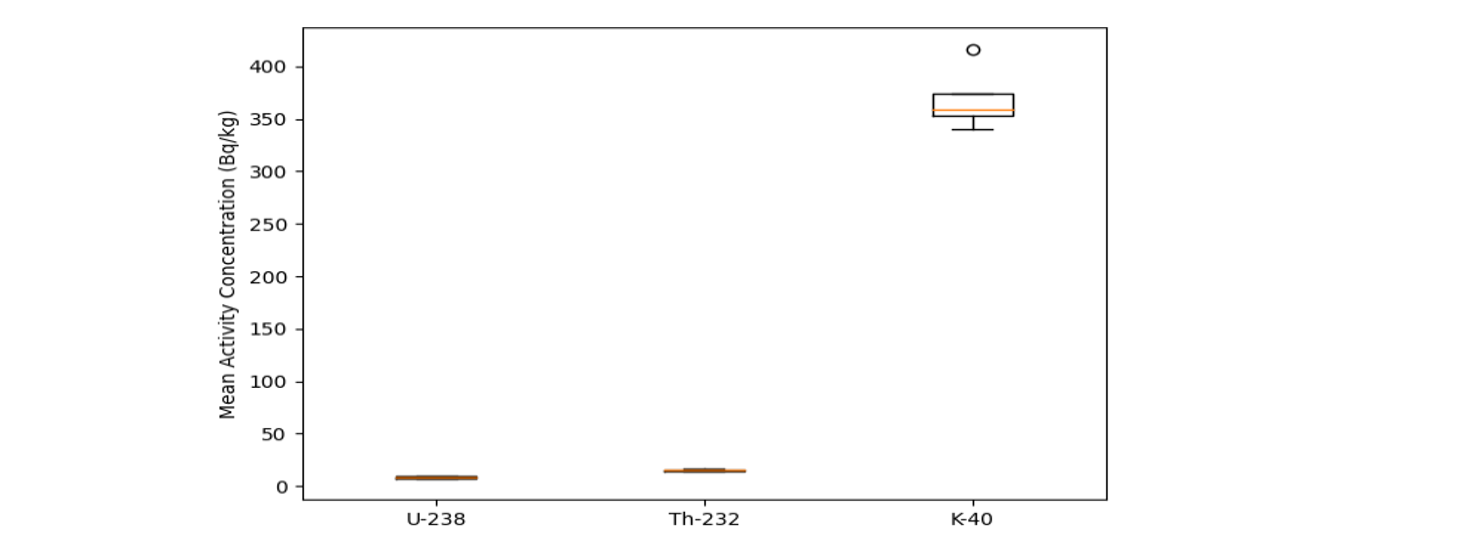
This study assessed the activity concentrations and radiological health risks associated with naturally occurring radionuclides in road dust samples obtained from road construction sites in Ijebu-Ode, Ogun State, Nigeria. Fifteen soil samples were collected from road construction sites on Ereko and Talbort Streets, Ijebu-Ode. The soil samples were air-dried, homogenised, sieved, treated and analysed using gamma spectrometry at the University of Ibadan, for the concentrations of Uranium-238, Thorium-232, and Potassium-40. Descriptive statistics, Pearson correlation, a two-way analysis of Variance (ANOVA), hierarchical clustering, and principal component analysis (PCA) were employed for statistical evaluation of the data. The mean activity concentrations of Uranium-238, thorium-232, and Potassium-40 were 8.36+-1.81, 15.17+-1.53, and 370.20+-47.44 Bq/kg. Potassium-40 experienced the highest concentration across all sampling locations. The two-way ANOVA revealed a significant difference among the radionuclide type (p<0.05), whereas spatial variation among sampling locations was not statistically significant. A strong positive correlation (r=0.976) was observed between the absorbed dose rate and radium equivalent activity. The calculated absorbed dose rate, annual effective dose equivalent, radium equivalent activity, external hazard index, internal hazard index, and excessive lifetime cancer risk were below internationally recommended safety limits. PCA and hierarchical clustering further indicated relatively homogenous radiological characteristics across the study area, with slight variations associated with primarily with potassium-40 distribution. The findings indicate that the investigated road dust samples do not pose significant radiological health hazards to construction workers or residents within the study area.
References
Addo, M. A., Darko, E. O., & Gordon, C. (2020). Heavy metal concentrations in road dust from selected major roads in Accra, Ghana and their health implications. Journal of Environmental and Public Health, 2020, 1–10.
Ademola, J. A. (2009). Assessment of natural radionuclide content of cements used in Nigeria. Radiation Protection Dosimetry, 133(3), 183–188. https://doi.org/10.1093/rpd/ncp054
Ademola, J. A. (2008). Exposure to high background radiation level in the tin mining area of Jos Plateau, Nigeria. Journal of Radiological Protection, 28(1), 93–99. https://doi.org/10.1088/0952-4746/28/1/006
Alausa, S.K. (2014). Radiological assessment of soils on the waysides of the road under construction in Ijebu-Ode, Ogun State, Southwestern Nigeria. Journal of Natural Sciences Research, 4(15),80-83.
Amato, F., Pandolfi, M., Escrig, A., Querol, X., Alastuey, A., Pey, J., Perez, N., & Hopke, P. K. (2009). Quantifying road dust resuspension in urban environment by Multilinear Engine: A comparison with PMF2. Atmospheric Environment, 43(17), 2770–2780. https://doi.org/10.1016/j.atmosenv.2009.02.039
Avwiri, G. O., Osimobi, J. C., & Agbalagba, E. O. (2012). Evaluation of radiation hazard indices and excess lifetime cancer risk due to natural radioactivity in soil profile of Udi and Ezeagu local government areas of Enugu State, Nigeria. Comprehensive Journal of Environmental and Earth Sciences, 1(1), 1–10.
Beretka, J., & Mathew, P. J. (1985). Natural radioactivity of Australian building materials, industrial wastes and by-products. Health Physics, 48(1), 87–95
Field, A. (2018). Discovering statistics using IBM SPSS statistics (5th ed.). London: Sage Publications.
International Atomic Energy Agency (IAEA). (2014). Radiation protection and safety of radiation sources: International basic safety standards (General Safety Requirements Part 3). Vienna: IAEA.
International Atomic Energy Agency (IAEA). (2003). Guidelines for radioelement mapping using gamma ray spectrometry data (IAEA-TECDOC-1363). Vienna: IAEA.
International Commission on Radiological Protection (ICRP). (2007). The 2007 recommendations of the International Commission on Radiological Protection (ICRP Publication 103). Elsevier.
Jolliffe, I. T. (2011). Principal component analysis (2nd ed.). New York: Springer.
Nigerian Meteorological Agency (NiMet). (2022). Climate data report for southwestern Nigeria. Abuja: NiMet.
Organisation for Economic Co-operation and Development (OECD). (1979). Exposure to radiation from the natural radioactivity in building materials. OECD Nuclear Energy Agency.
Rahaman, M. A. (1988). Recent advances in the study of the basement complex of Nigeria. In P. O. Oluyide et al. (Eds.), Precambrian Geology of Nigeria (pp. 11–41). Geological Survey of Nigeria.
Taskin, H., Karavus, M., Ay, P., Topuzoglu, A., Hidiroglu, S., & Karahan, G. (2009). Radionuclide concentrations in soil and lifetime cancer risk due to gamma radioactivity in Kirklareli, Turkey. Journal of Environmental Radioactivity, 100(1), 49–53. https://doi.org/10.1016/j.jenvrad.2008.10.012
United Nations Scientific Committee on the Effects of Atomic Radiation (UNSCEAR). (2008). Sources and effects of ionizing radiation. New York: United Nations.
United Nations Scientific Committee on the Effects of Atomic Radiation (UNSCEAR). (2000). Sources and effects of ionizing radiation (UNSCEAR 2000 Report to the General Assembly, with scientific annexes). New York: United Nations.
World Health Organization (WHO). (2016). Ionizing radiation, health effects and protective measures. Geneva: WHO.
Downloads
Published
Issue
Section
Categories
License
Copyright (c) 2026 Francis Oladapo, Robinson Amaju

This work is licensed under a Creative Commons Attribution 4.0 International License.


