
UNDERSTANDING THE SOLITON PHENOMENA: LEAPFROGGING THROUGH THE KORTEWEG-DE VRIES EQUATION FOR MULTI-SOLITONS SOLUTION
DOI:
https://doi.org/10.33003/fjs-2026-1006-5171Keywords:
Korteweg-de Vries Equation, Leapfrog, Multi-Solitons, Numerical StudyAbstract
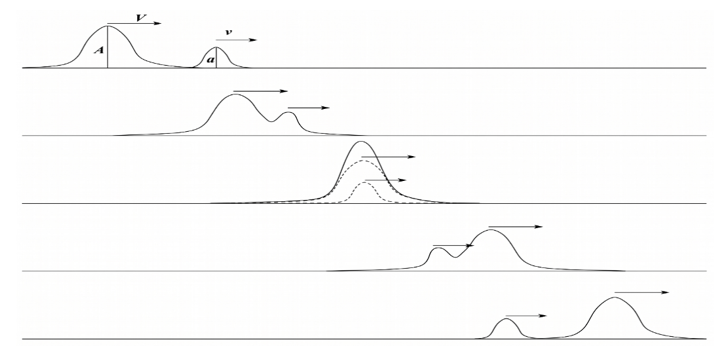
This study applies the Leapfrog algorithm to numerically obtain multi-soliton solutions of the Korteweg–de Vries (KdV) equation. The KdV equation is a classical nonlinear partial differential equation that models wave motion in dispersive media and has been widely used to describe shallow water waves, plasmas, fiber optics, Josephson junctions, and electromagnetic wave propagation. Over the years, it has become a fundamental model for understanding how nonlinearity and dispersion interact in physical systems. One of its most remarkable features is the existence of solitons; stable, localized wave packets that travel without changing shape. These waves have attracted strong interest because of their unusual ability to interact with other solitons and still retain their identity. The Leapfrog algorithm is implemented in MATLAB and Python, two common scientific computing languages. This comparison evaluates the performance, accuracy, and efficiency of these implementations. The simulation results focus on solitons, especially their collision and interaction behaviours. The analytical and numerical solutions match, although the numerical results exhibit small fluctuations in soliton profiles after collisions. However, these fluctuations do not significantly affect their core properties. This supports the existence of soliton solutions and confirms that solitons collide without altering their characteristics or identities. The findings from this study deepen our understanding of the KdV equations and their soliton solutions and provide valuable insights into the computational aspects of solving differential equations in Python and MATLAB.
References
Al‐Khaled Kamel. (2001). Sinc numerical solutions for solitons and solitary waves. Journal of Computational and Applied Mathematics, 130(1-2), 283–292. https://doi.org/10.1016/s0377-0427(99)00376-3
Alotaibi, F., & Ismail, M. S. (2020). Numerical Solution of Kortweg-de Vries Equation. Applied Mathematics, 11(04), 344–362. https://doi.org/10.4236/am.2020.114025
Borgese, G., Vena, S., Pantano, P., Pace, C., & Bilotta, E. (2015). Simulation, Modeling, and Analysis of Soliton Waves Interaction and Propagation in CNN Transmission Lines for Innovative Data Communication and Processing. Discrete Dynamics in Nature and Society, 2015, 1–13. https://doi.org/10.1155/2015/139238
Cho, H. K. (2008). INTRODUCTION TO NUMERICAL ANALYSIS. In SNO courseware (pp. 1–48). Nuclear Thermal Hydraulic Engineering Lab: Department of Nuclear Engineering, Seoul National University. https://ocw.snu.ac.kr/sites/default/files/NOTE/Lecture%2008_0.pdf
Goda, K. (1977). Numerical studies on recurrence of the Korteweg-de Vries equation. Journal of the Physical Society of Japan, 42, 1040–1046.
Greig, I. S., & Morris, J. (1976). A Hopscotch method for the Korteweg-de-Vries equation. Journal of Computational Physics, 20(1), 64–80. https://doi.org/10.1016/0021-9991(76)90102-9
Haruna, A., Olatunbosun, R. O., Ibiyemi, A. A., & Awodugba, A. O. (2018). Analysis of electromagnetic radiation for four different transmission power stations areas of Nigeria. FUDMA Journal of Sciences, 2(1), 48–53.
Helfrich, K. R., & Melville, W. K. (2006). LONG NONLINEAR INTERNAL WAVES. Annual Review of Fluid Mechanics, 38(1), 395–425. https://doi.org/10.1146/annurev.fluid.38.050304.092129
Hirota, R. (2004). The Direct Method in Soliton Theory. Cambridge University Press. https://doi.org/10.1017/cbo9780511543043
Johansen, B. R. (2008). Numerical Investigations of the Korteweg-de Vries (KdV) Equation. MSc. Thesis). School of Postgraduate Studies, Memorial University of Newfoundland, St. John’s Newfoundland-Canada. https://research.library.mun.ca/8921/
Korteweg, D. J., & de Vries, G. (1895). XLI. On the change of form of long waves advancing in a rectangular canal, and on a new type of long stationary waves. The London, Edinburgh, and Dublin Philosophical Magazine and Journal of Science, 39(240), 422–443. https://doi.org/10.1080/14786449508620739
Kumar, D., Nuruzzaman, Md., Paul, G. C., & Hoque, A. (2022). Novel localized waves and interaction solutions for a dimensionally reduced (2 + 1)-dimensional Boussinesq equation from N-soliton solutions. Nonlinear Dynamics, 107(3), 2717–2743. https://doi.org/10.1007/s11071-021-07077-9
Li, J., Xi, L., Clemens, F., & Yip, S. (2006, July 6). Solitons could power molecular electronics and artificial muscles. Phys.org; Proceedings of the National Academy of Sciences (PNAS). http://www.physorg.com/news71409967.html
María Soledad Jiménez, Poveda, G., & Carrera, C. (2016). Estudio y Simulación de la propagación de Solitones en una Fibra Óptica Monomodo. Revista Politécnica: DOAJ (DOAJ: Directory of Open Access Journals), 38(1).
Menza, L., Debussche , A., & Barton-Smith, M. (2011). Physical context and mathematical model Simulation of a stochastic model: Numerical methods for the stochastic Schödinger equation. Laboratoire de Math´ematiques - Universit´e de Reims. https://esnt.cea.fr/Images/Page/27/dimenza.pdf
O’Neill, A. I. (2009, June 2). Holland. Astroengine.com. https://astroengine.com/tag/holland/
Orapine, H. O., Ayankop-Andi, E., & Ibeh, G. J. (2020). Analytical and Numerical Computations of Multi-Solitons in the Korteweg-de Vries (KdV) Equation. Applied Mathematics, 11(07), 511–531. https://doi.org/10.4236/am.2020.117037
Osman, M. S. (2017). Analytical study of rational and double-soliton rational solutions governed by the KdV–Sawada–Kotera–Ramani equation with variable coefficients. Nonlinear Dynamics, 89(3), 2283–2289. https://doi.org/10.1007/s11071-017-3586-y
Pérez-Cota, F., Smith, R. J., Moradi, E., Marques, L., Webb, K. F., & Clark, M. (2016). High-resolution 3D imaging of living cells with sub-optical wavelength phonons. Scientific Reports, 6(1). https://doi.org/10.1038/srep39326
Rageh, T. M., Salem, E., & El-Salam F. A. (2014). Restrictive Taylor Approximation for Gardner and KdV Equations. International Journal of Advances in Applied Mathematics and Mechanics, 1(13).
Shahrill, M., Chong, M. S. F., & Mohd Nor, H. N. H. (2015). Applying Explicit Schemes to the Korteweg-de Vries Equation. Modern Applied Science, 9(4). https://doi.org/10.5539/mas.v9n4p200
Stegeman, G. I., & Mordechai Segev. (1999). Optical Spatial Solitons and Their Interactions: Universality and Diversity. Science, 286(5444), 1518–1523. https://doi.org/10.1126/science.286.5444.1518
Taylor, C. R. (2016). Finite difference coefficients calculator. MIT. https://web.media.mit.edu/~crtaylor/calculator.html
Ya, S. (2013). Introduction to Solitons (pp. 1–40). Institute of Theoretical Physics and Astronomy: University of Oldenburg and BSU Minsk. http://www.tfai.vu.lt/files/shnir/Lecture1.pdf
Zabusky, N. J., & Kruskal, M. D. (1965). Interactions of “solitons” in a collisionless plasma and the recurrence of initial states. Physics Review Letters, 15(240).
Downloads
Published
Issue
Section
Categories
License
Copyright (c) 2026 Paul Shimlumun Amon, Orapine Hycienth Ortser

This work is licensed under a Creative Commons Attribution 4.0 International License.