
A Multiple Optimizer Based Long Short-Term Memory Models for the Efficient Prediction of Solar Radiation
DOI:
https://doi.org/10.33003/fjs-2026-1011-5158Keywords:
Solar Radiation Prediction, Long Short-Term Memory, Grey Wolf Optimizer, Bayesian Optimizer, Deep Learning, Dynamic Hyperparameter TuningAbstract
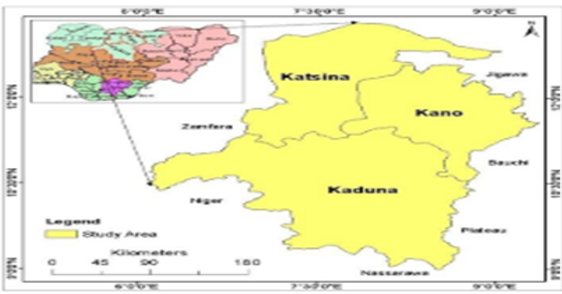
To ensure energy security and environmental sustainability, transition to renewable energy sources is required, one of the most important and sustainable renewable energy is solar energy, However, in developing predicting system, accurate solar radiation is essential for optimizing solar energy systems particularly in regions with limited ground based infrastructures including Northwest Nigeria, To address this challenge a time series dataset of daily solar radiation measurements from available meteorological parameter, several previous studies have used various methods including ARIMA, SARIMA, Machine learning and Deep leaning models with static hyperparameter optimization approach, Meanwhile optimization of forecasting systems is necessary for developing accurate energy predicting systems. Deep learning is effective in solar radiation forecasting. To evaluate the performance of deep learning method for daily solar prediction, an optimized Long Short-Term Memory (GWO-LSTM and BO-LSTM) based deep learning models were developed in the study, The optimized models were created using daily solar radiation data from Nigerian Meteorological Agency for a period of 20 years, in three states in Northwest Nigeria: Kaduna, kano and katsina, This models were evaluated using two forecasting performance metrics: R2 coefficient of determination and Root Mean Square Error (RMSE), The models results shows that both optimized models outperformed baseline LSTM model, The LSTM-BO indicates performance with training R2 = 0.8500, RMSE=0.3876 and testing of R2 = 0.8205, RMSE = 0.4309 while GWO-LSTM achieves training of R2 = 0.8358, RMSE = 0.4054 and testing of R2 = 0.8190, RMSE = 0.4340 respectively. The LSTM-BO achieves slightly better predicting accuracy than LSTM-GWO.
References
Aguiar, L. M., Pereira, B., Lauret, P., Díaz, F., & David, M. (2016). Combining solar irradiance measurements, satellite-derived data, and a numerical weather prediction model to improve intra-day solar forecasting. 97. https://doi.org/10.1016/j.renene.2016.06.018
Ahmad, T., & Zhang, D. (2020). A critical review of comparative global historical energy consumption and future demand: The story told so far. Energy Reports, 6, 1973–1991. https://doi.org/10.1016/j.egyr.2020.07.020
Bamisile, O., Oluwasanmi, A., Obiora, S., Osei-Mensah, E., Asoronye, G., & Huang, Q. (2020). Application of deep learning for solar irradiance and solar photovoltaic multi-parameter forecast. Energy Sources, Part A: Recovery, Utilization and Environmental Effects, 00(00), 1–21. https://doi.org/10.1080/15567036.2020.1801903
Bhatti, U. A., Yan, Y., Zhou, M., Ali, S., Hussain, A., Qingsong, H. U. O., Yu, Z., & Yuan, L. (2021). Time Series Analysis and Forecasting of Air Pollution Particulate Matter ( PM 2 . 5 ): An SARIMA and Factor Analysis Approach. https://doi.org/10.1109/ACCESS.2021.3060744
Bloomfield, H. C., Wainwright, C. M., & Mitchell, N. (2022). Characterizing the variability and meteorological drivers of wind power and solar power generation over Africa. June, 1–19. https://doi.org/10.1002/met.2093
Chave, J., Davies, S. J., Phillips, O. L., Lewis, S. L., Sist, P., Schepaschenko, D., Armston, J., Baker, T. R., Coomes, D., Disney, M., Duncanson, L., Hérault, B., Labrière, N., Meyer, V., Réjou-méchain, M., Scipal, K., & Saatchi, S. (2019). Ground Data are Essential for Biomass Remote Sensing. Surveys in Geophysics, 0123456789. https://doi.org/10.1007/s10712-019-09528-w
Chen, H., & Chang, X. (2021). Photovoltaic power prediction of LSTM model based on Pearson feature selection. Energy Reports, 7, 1047–1054. https://doi.org/10.1016/j.egyr.2021.09.167
Falcone, P. M. (2023). Sustainable Energy Policies in Developing Countries : A Review of Challenges and Opportunities.
Gielen, D., Boshell, F., Saygin, D., Bazilian, M. D., Wagner, N., & Gorini, R. (2019). The role of renewable energy in the global energy transformation. Energy Strategy Reviews, 24(June 2018), 38–50. https://doi.org/10.1016/j.esr.2019.01.006
Gürel, A. E., Ağbulut, Ü., & Biçen, Y. (2020). Assessment of machine learning, time series, response surface methodology and empirical models in prediction of global solar radiation. Journal of Cleaner Production, 122353. https://doi.org/10.1016/j.jclepro.2020.122353
Hewamalage, H., Bergmeir, C., & Bandara, K. (2021). Recurrent Neural Networks for Time Series Forecasting: Current status and future directions. International Journal of Forecasting, 37(1), 388–427. https://doi.org/10.1016/j.ijforecast.2020.06.008
Hossain, M. L., Shams, S. M. N., & Ullah, S. M. (2025). Time-series and deep learning approaches for renewable energy forecasting in Dhaka : a comparative study of ARIMA, SARIMA, and LSTM models.
Idogho, C., Owoicho, E., Joy, A., Onuhc, O., Harsito, C., & Omenkaf, K. (2025). Machine Learning ‐ Based Solar Photovoltaic Power Forecasting for Nigerian Regions. 1922–1934. https://doi.org/10.1002/ese3.70013
Isma’il, M., & Aliyu, S. (2023). Daily Solar Radiation Forecasting for Northwest Nigeria Using Long Short-Term Memory. International Journal of Science for Global Sustainability, 9(1), 8. https://doi.org/10.57233/ijsgs.v9i1.407
Jia, K., Yang, X., & Peng, Z. (2024). Design of an integrated network order system for main distribution network considering power dispatch efficiency.
Kumar, D. S., Yagli, G. M., Kashyap, M., & Srinivasan, D. (2020a). Solar irradiance resource and forecasting : a comprehensive review. 14, 1641–1656. https://doi.org/10.1049/iet-rpg.2019.1227
Kumar, D. S., Yagli, G. M., Kashyap, M., & Srinivasan, D. (2020b). Solar irradiance resource and forecasting: a comprehensive review. IET Renewable Power Generation, 14(10), 1641–1656. https://doi.org/10.1049/iet-rpg.2019.1227
Law, K. L. E. (2024). Deep Learning Models for Time Series Forecasting : A Review. IEEE Access, 12(July), 92306–92327. https://doi.org/10.1109/ACCESS.2024.3422528
Lindberg, M. B., Markard, J., & Andersen, A. D. (2019). Policies, actors and sustainability transition pathways: A study of the EU’s energy policy mix. Research Policy, 48(10), 1–15. https://doi.org/10.1016/j.respol.2018.09.003
Methods, C., & Trends, E. (2024). Solar Radiation Forecasting : A Systematic Meta-Review of. 1–27.
Owura, K., Opoku, R., Boahen, S., & Yaw, G. (2023). Analysis of indoor set-point temperature of split-type ACs on thermal comfort and energy savings for office buildings in hot-humid climates. 4(October 2021), 368–376. https://doi.org/10.1016/j.enbenv.2022.02.006
Rabaia, M. K. H., Abdelkareem, M. A., Sayed, E. T., Elsaid, K., Chae, K. J., Wilberforce, T., & Olabi, A. G. (2021). Environmental impacts of solar energy systems: A review. Science of the Total Environment, 754, 141989. https://doi.org/10.1016/j.scitotenv.2020.141989
Ramachandran, K. K. (2024). THE EVOLUTION OF RECURRENT NEURAL NETWORKS IN HANDLING LONG-TERM. 1(1), 1–10.
Rao, G., Huang, W., Feng, Z., & Cong, Q. (2018). LSTM with sentence representations for document-level sentiment classification. Neurocomputing, 308, 49–57. https://doi.org/10.1016/j.neucom.2018.04.045
Salisu, S., Mustafa, M. W., & Mustapha, M. (2018). Predicting Global Solar Radiation in Nigeria Using Adaptive Neuro-Fuzzy Approach. 2. https://doi.org/10.1007/978-3-319-59427-9
Salisu, S., Mustafa, M. W., Mustapha, M., & Mohammed, O. O. (2019). Solar radiation forecasting in Nigeria based on hybrid PSO-ANFIS and WT-ANFIS approach. International Journal of Electrical and Computer Engineering, 9(5), 3916–3926. https://doi.org/10.11591/ijece.v9i5.pp3916-3926
Science, D., & Analytics, A. (n.d.). Master of Science Data Science and Advanced Analytics Effective Use of Numerical Weather Predictions for Solar Energy Forecasting.
Varganova, A. V, & Khramshin, V. R. (2022). Improving Efficiency of Electric Energy System and Grid Operating Modes : Review of Optimization Techniques. 1–16.
Yoro, K. O., & Daramola, M. O. (2020). CO2 emission sources, greenhouse gases, and the global warming effect. In Advances in Carbon Capture: Methods, Technologies and Applications. Elsevier Inc. https://doi.org/10.1016/B978-0-12-819657-1.00001-3
Zhang, B., Zhang, S., & Li, W. (2019). Bearing performance degradation assessment using long short-term memory recurrent network. Computers in Industry, 106, 14–29. https://doi.org/10.1016/j.compind.2018.12.016
Downloads
Published
Issue
Section
Categories
License
Copyright (c) 2026 Abdulaziz Mohammed Usman, Yahaya Isah Shehu, Shehu Malami Sarkin -Tudu, Anas Tukur Balarabe

This work is licensed under a Creative Commons Attribution 4.0 International License.


