
Acetone Extract of Turmeric (CURCUMA LONGA) Attenuates Inflammation, Dyslipidemia, and Hepatorenal Dysfunction in Streptozotocin-Induced Type 2 Diabetic Rats
DOI:
https://doi.org/10.33003/fjs-2026-1011-5143Keywords:
Type 2 Diabetes Mellitus, Turmeric, Inflammation, Dyslipidemia, Hepatorenal Dysfunction, Insulin ResistanceAbstract
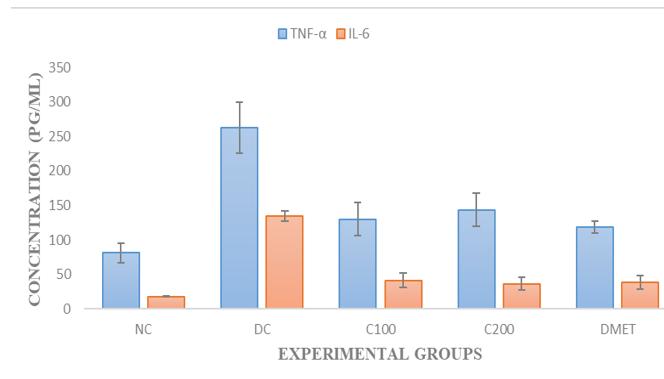
Type 2 diabetes mellitus (T2DM) is a chronic metabolic disorder associated with hyperglycemia, inflammation, dyslipidemia, and organ dysfunction. This study investigated the anti-inflammatory, hypolipidemic, and hepatorenal protective effects of acetone extract of Turmeric in streptozotocin-induced type 2 diabetic rats. Thirty male Wistar rats were randomly assigned into five groups (n = 6): normal control, diabetic control, turmeric-treated groups (100 and 200 mg/kg body weight), and metformin-treated group (500 mg/kg). Type 2 diabetes was induced using 10% fructose administration for 14 days followed by a single intraperitoneal injection of streptozotocin (50 mg/kg). Biochemical analyses were performed to evaluate inflammatory markers (TNF-α and IL-6), glucose tolerance, lipid profile, and liver and kidney function parameters. Data obtained were analyzed using multivariate analysis of variance (MANOVA) and results were considered significant at P < 0.05. Diabetic control rats showed significant elevations in fasting blood glucose, TNF-α, IL-6, total cholesterol, triglycerides, LDL-C, ALT, AST, ALP, urea, and creatinine levels, with a concomitant reduction in HDL-C and glucose clearance ability compared to the normal control group. Treatment with turmeric extract significantly ameliorated these alterations. The 100 mg/kg dose produced greater improvement in lipid profile and reduction in atherogenic indices, while the 200 mg/kg dose demonstrated stronger hepatoprotective effects through greater reductions in liver enzyme activities. These findings suggest that acetone extract of Turmeric possesses anti-inflammatory, hypoglycemic, hypolipidemic, and hepatorenal protective properties, supporting its potential as a complementary therapeutic agent in the management of T2DM and its associated complications.
References
Antar, S. A., Ashour, N. A., Sharaky, M., Khattab, M., Ashour, N. A., Zaid, R. T., Roh, E. J., Elkamhawy, A., & Al-Karmalawy, A. A. (2023). Diabetes mellitus: Classification, mediators, and complications; A gate to identify potential targets for the development of new effective treatments. Biomedicine & Pharmacotherapy, 168, 115734. https://doi.org/https://doi.org/10.1016/j.biopha.2023.115734
Ashrafizadeh, M., Zarrabi, A., Hushmandi, K., Zarrin, V., Moghadam, E. R., Hashemi, F., Makvandi, P., Samarghandian, S., Khan, H., Hashemi, F., Najafi, M., & Mirzaei, H. (2020). Toward Regulatory Effects of Curcumin on Transforming Growth Factor-Beta Across Different Diseases: A Review. Front Pharmacol, 11, 585413. https://doi.org/10.3389/fphar.2020.585413
Bhatti, J. S., Sehrawat, A., Mishra, J., Sidhu, I. S., Navik, U., Khullar, N., Kumar, S., Bhatti, G. K., & Reddy, P. H. (2022). Oxidative stress in the pathophysiology of type 2 diabetes and related complications: Current therapeutics strategies and future perspectives. Free Radical Biology and Medicine, 184, 114-134. https://doi.org/https://doi.org/10.1016/j.freeradbiomed.2022.03.019
Bako, H. Y., Ibrahim, M. A., Isah, M. S., & Ibrahim, S. (2019). Inhibition of JAK-STAT and NF-κB signalling systems could be a novel therapeutic target against insulin resistance and type 2 diabetes. Life Sci, 239, 117045. https://doi.org/10.1016/j.lfs.2019.117045
Caturano, A., D'Angelo, M., Mormone, A., Russo, V., Mollica, M. P., Salvatore, T., Galiero, R., Rinaldi, L., Vetrano, E., Marfella, R., Monda, M., Giordano, A., & Sasso, F. C. (2023). Oxidative Stress in Type 2 Diabetes: Impacts from Pathogenesis to Lifestyle Modifications. Curr Issues Mol Biol, 45(8), 6651-6666. https://doi.org/10.3390/cimb45080420
Caturano, A., Rocco, M., Tagliaferri, G., Piacevole, A., Nilo, D., Di Lorenzo, G., Iadicicco, I., Donnarumma, M., Galiero, R., Acierno, C., Sardu, C., Russo, V., Vetrano, E., Conte, C., Marfella, R., Rinaldi, L., & Sasso, F. C. (2025). Oxidative Stress and Cardiovascular Complications in Type 2 Diabetes: From Pathophysiology to Lifestyle Modifications. Antioxidants, 14(1), 72. https://www.mdpi.com/2076-3921/14/1/72
Chen, L., Chen, R., Wang, H., & Liang, F. (2015). Mechanisms Linking Inflammation to Insulin Resistance. Int J Endocrinol, 2015, 508409. https://doi.org/10.1155/2015/508409
Dabla, P. K. (2010). Renal function in diabetic nephropathy. World J Diabetes, 1(2), 48-56. https://doi.org/10.4239/wjd.v1.i2.48
Den Hartogh, D. J., Gabriel, A., & Tsiani, E. (2020). Antidiabetic Properties of Curcumin I: Evidence from In Vitro Studies. Nutrients, 12(1). https://doi.org/10.3390/nu12010118
Dilworth, L., Facey, A., & Omoruyi, F. (2021). Diabetes Mellitus and Its Metabolic Complications: The Role of Adipose Tissues. International Journal of Molecular Sciences, 22(14), 7644. https://www.mdpi.com/1422-0067/22/14/7644
El-Saadony, M. T., Yang, T., Korma, S. A., Sitohy, M., Abd El-Mageed, T. A., Selim, S., Al Jaouni, S. K., Salem, H. M., Mahmmod, Y., Soliman, S. M., Mo'men, S. A. A., Mosa, W. F. A., El-Wafai, N. A., Abou-Aly, H. E., Sitohy, B., Abd El-Hack, M. E., El-Tarabily, K. A., & Saad, A. M. (2022). Impacts of turmeric and its principal bioactive curcumin on human health: Pharmaceutical, medicinal, and food applications: A comprehensive review. Front Nutr, 9, 1040259. https://doi.org/10.3389/fnut.2022.1040259
Galicia-Garcia, U., Benito-Vicente, A., Jebari, S., Larrea-Sebal, A., Siddiqi, H., Uribe, K. B., Ostolaza, H., & Martín, C. (2020). Pathophysiology of Type 2 Diabetes Mellitus. International Journal of Molecular Sciences, 21(17), 6275. https://www.mdpi.com/1422-0067/21/17/6275
Ghorbani, Z., Hekmatdoost, A., & Mirmiran, P. (2014). Anti-hyperglycemic and insulin sensitizer effects of turmeric and its principle constituent curcumin. Int J Endocrinol Metab, 12(4), e18081. https://doi.org/10.5812/ijem.18081
González, P., Lozano, P., Ros, G., & Solano, F. (2023). Hyperglycemia and Oxidative Stress: An Integral, Updated and Critical Overview of Their Metabolic Interconnections. Int J Mol Sci, 24(11). https://doi.org/10.3390/ijms24119352
Hu, X., li, J., Fu, M., Zhao, X., & Wang, W. (2021). The JAK/STAT signaling pathway: from bench to clinic. Signal Transduction and Targeted Therapy, 6(1), 402. https://doi.org/10.1038/s41392-021-00791-1
Ipsen, D. H., Lykkesfeldt, J., & Tveden-Nyborg, P. (2018). Molecular mechanisms of hepatic lipid accumulation in non-alcoholic fatty liver disease. Cell Mol Life Sci, 75(18), 3313-3327. https://doi.org/10.1007/s00018-018-2860-6
Kang, Q., & Chen, A. (2009). Curcumin suppresses expression of low-density lipoprotein (LDL) receptor, leading to the inhibition of LDL-induced activation of hepatic stellate cells. Br J Pharmacol, 157(8), 1354-1367. https://doi.org/10.1111/j.1476-5381.2009.00261.x
Kathak, R. R., Sumon, A. H., Molla, N. H., Hasan, M., Miah, R., Tuba, H. R., Habib, A., & Ali, N. (2022). The association between elevated lipid profile and liver enzymes: a study on Bangladeshi adults. Scientific Reports, 12(1), 1711. https://doi.org/10.1038/s41598-022-05766-y
Liu, Q., Bengmark, S., & Qu, S. (2010). The role of hepatic fat accumulation in pathogenesis of non-alcoholic fatty liver disease (NAFLD). Lipids in Health and Disease, 9(1), 42. https://doi.org/10.1186/1476-511X-9-42
Liu, X., Mameza, M. G., Lee, Y. S., Eseonu, C. I., Yu, C. R., Kang Derwent, J. J., & Egwuagu, C. E. (2008). Suppressors of cytokine-signaling proteins induce insulin resistance in the retina and promote survival of retinal cells. Diabetes, 57(6), 1651-1658. https://doi.org/10.2337/db07-1761
Lumu, W., Bahendeka, S., Wesonga, R., Kibirige, D., Kasoma, R. M., & Ssendikwanawa, E. (2023). Atherogenic index of plasma and its cardiovascular risk factor correlates among patients with type 2 diabetes in Uganda. Afr Health Sci, 23(1), 515-527. https://doi.org/10.4314/ahs.v23i1.54
Mobasheri, L., Ahadi, M., Beheshti Namdar, A., Alavi, M. S., Bemidinezhad, A., Moshirian Farahi, S. M., Esmaeilizadeh, M., Nikpasand, N., Einafshar, E., & Ghorbani, A. (2023). Pathophysiology of diabetic hepatopathy and molecular mechanisms underlying the hepatoprotective effects of phytochemicals. Biomedicine & Pharmacotherapy, 167, 115502. https://doi.org/https://doi.org/10.1016/j.biopha.2023.115502
Mohamed, J., Nazratun Nafizah, A. H., Zariyantey, A. H., & Budin, S. B. (2016). Mechanisms of Diabetes-Induced Liver Damage: The role of oxidative stress and inflammation. Sultan Qaboos Univ Med J, 16(2), e132-141. https://doi.org/10.18295/squmj.2016.16.02.002
Orellana-Paucar, A. M. (2024). Turmeric Essential Oil Constituents as Potential Drug Candidates: A Comprehensive Overview of Their Individual Bioactivities. Molecules, 29(17). https://doi.org/10.3390/molecules29174210
Rahban, M., Habibi-Rezaei, M., Mazaheri, M., Saso, L., & Moosavi-Movahedi, A. A. (2020). Anti-Viral Potential and Modulation of Nrf2 by Curcumin: Pharmacological Implications. Antioxidants (Basel), 9(12). https://doi.org/10.3390/antiox9121228
Rui, L., Aguirre, V., Kim, J. K., Shulman, G. I., Lee, A., Corbould, A., Dunaif, A., & White, M. F. (2001). Insulin/IGF-1 and TNF-alpha stimulate phosphorylation of IRS-1 at inhibitory Ser307 via distinct pathways. J Clin Invest, 107(2), 181-189. https://doi.org/10.1172/jci10934
Sarapultsev, A., Gusev, E., Komelkova, M., Utepova, I., Luo, S., & Hu, D. (2023). JAK-STAT signaling in inflammation and stress-related diseases: implications for therapeutic interventions. Mol Biomed, 4(1), 40. https://doi.org/10.1186/s43556-023-00151-1
Sharifi-Rad, J., Rayess, Y. E., Rizk, A. A., Sadaka, C., Zgheib, R., Zam, W., Sestito, S., Rapposelli, S., Neffe-Skocińska, K., Zielińska, D., Salehi, B., Setzer, W. N., Dosoky, N. S., Taheri, Y., El Beyrouthy, M., Martorell, M., Ostrander, E. A., Suleria, H. A. R., Cho, W. C., Maroyi, A., & Martins, N. (2020). Turmeric and Its Major Compound Curcumin on Health: Bioactive Effects and Safety Profiles for Food, Pharmaceutical, Biotechnological and Medicinal Applications. Front Pharmacol, 11, 01021. https://doi.org/10.3389/fphar.2020.01021
Tsalamandris, S., Antonopoulos, A. S., Oikonomou, E., Papamikroulis, G. A., Vogiatzi, G., Papaioannou, S., Deftereos, S., & Tousoulis, D. (2019). The Role of Inflammation in Diabetes: Current Concepts and Future Perspectives. Eur Cardiol, 14(1), 50-59. https://doi.org/10.15420/ecr.2018.33.1
Vallon, V., & Thomson, S. C. (2012). Renal function in diabetic disease models: the tubular system in the pathophysiology of the diabetic kidney. Annu Rev Physiol, 74, 351-375. https://doi.org/10.1146/annurev-physiol-020911-153333
Wilson, R. D., & Islam, M. S. (2012). Fructose-fed streptozotocin-injected rat: an alternative model for type 2 diabetes. Pharmacol Rep, 64(1), 129-139. https://doi.org/10.1016/s1734-1140(12)70739-9
Xie, Z., Shen, G., Wang, Y., & Wu, C. (2019). Curcumin supplementation regulates lipid metabolism in broiler chickens. Poultry Science, 98(1), 422-429. https://doi.org/https://doi.org/10.3382/ps/pey315
Xuan, Y., Wu, D., Zhang, Q., Yu, Z., Yu, J., & Zhou, D. (2024). Elevated ALT/AST ratio as a marker for NAFLD risk and severity: insights from a cross-sectional analysis in the United States. Front Endocrinol (Lausanne), 15, 1457598. https://doi.org/10.3389/fendo.2024.1457598
Yang, J., Park, Y., Zhang, H., Xu, X., Laine, G. A., Dellsperger, K. C., & Zhang, C. (2009). Feed-forward signaling of TNF-alpha and NF-kappaB via IKK-beta pathway contributes to insulin resistance and coronary arteriolar dysfunction in type 2 diabetic mice. Am J Physiol Heart Circ Physiol, 296(6), H1850-1858. https://doi.org/10.1152/ajpheart.01199.2008
Zhao, X., An, X., Yang, C., Sun, W., Ji, H., & Lian, F. (2023). The crucial role and mechanism of insulin resistance in metabolic disease. Front Endocrinol (Lausanne), 14, 1149239. https://doi.org/10.3389/fendo.2023.1149239
Downloads
Published
Issue
Section
Categories
License
Copyright (c) 2026 Hauwa'u Yakubu Bako, Agboola Omolara Irene, Bilkisu Mohammed Ladan, Zainab Kasim Mohammed, Richard Auta

This work is licensed under a Creative Commons Attribution 4.0 International License.


