
Deep Learning-Based Network Intrusion Detection Using Hybrid CNN and LSTM Architecture
DOI:
https://doi.org/10.33003/fjs-2026-1013-5113Keywords:
Network Intrusion Detection System (NIDS), Deep Learning, CNN-LSTM, Cybersecurity, Network Traffic Analysis, Intrusion Detection, CICIDS2017, Artificial IntelligenceAbstract
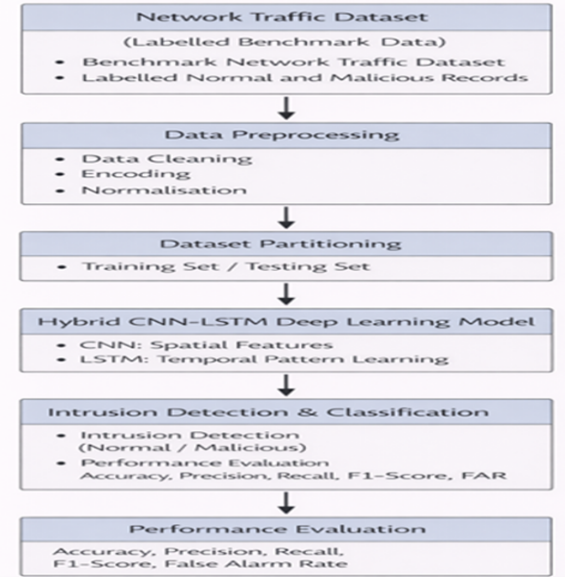
The rapid growth of digital communication technologies and interconnected network infrastructures has increased the frequency and sophistication of cyber threats. Traditional Network Intrusion Detection Systems (NIDS), which primarily depend on signature-based and rule-based approaches, often struggle to detect zero-day attacks and evolving intrusion patterns. This study presents the design and implementation of a hybrid Convolutional Neural Network-Long Short-Term Memory (CNN-LSTM) deep learning-based Network Intrusion Detection System to improve the detection accuracy and reliability of malicious network activities. The proposed system combines the feature-extraction capabilities of CNNs with the temporal sequence-learning capabilities of LSTMs to identify both spatial and sequential characteristics of network traffic. The CICIDS2017 benchmark dataset was utilised for system training and evaluation. Data preprocessing techniques such as removing missing values, feature scaling, label encoding, and Synthetic Minority Oversampling Technique (SMOTE) balancing were applied to improve data quality and class distribution. The model was implemented using Python, TensorFlow, Keras, Scikit-learn, NumPy, and Pandas within a Google Colab environment. The processed dataset was partitioned into 80% for training and 20% for testing. Experimental results demonstrated high intrusion detection performance with an accuracy of 98.48%, precision of 97.75%, recall of 99.23%, F1-score of 98.49%, and a false alarm rate of 2.28%. In addition to the deep learning model, a web-based user interface was developed to support traffic prediction, performance monitoring, and management of prediction history. The findings indicate that hybrid deep learning techniques can improve network security by enhancing intrusion detection capability while reducing false alarms.
References
Ahsan, M., Mahmud, M. A., Saha, P. K., Gupta, K. D., & Siddique, Z. (2022). Deep learning-based intrusion detection systems: A systematic review. IEEE Access, 10, 127123-127150. https://doi.org/10.1109/ACCESS.2022.3223865
Almuhanna, S., & Dardouri, S. (2025). Ensemble deep learning approaches for network intrusion detection systems. Frontiers in Artificial Intelligence, 8, 1625891. https://doi.org/10.3389/frai.2025.1625891
Buczak, A. L., & Guven, E. (2020). A survey of data mining and machine learning methods for cybersecurity intrusion detection. IEEE Communications Surveys & Tutorials, 22(2), 1153-1176. https://doi.org/10.1109/COMST.2019.2954471
Dong, X., Wang, Y., Liu, H., & Zhang, Z. (2025). Deep learning-based network intrusion detection: A systematic review. EURASIP Journal on Wireless Communications and Networking, 2025(1), 77. https://doi.org/10.1186/s13638-025-02477-6
Ferrag, M. A., Maglaras, L., Moschoyiannis, S., & Janicke, H. (2020). Deep learning for cyber security intrusion detection: Approaches, datasets, and comparative study. Journal of Information Security and Applications, 50, 102419. https://doi.org/10.1016/j.jisa.2019.102419
Goodfellow, I., Bengio, Y., & Courville, A. (2016). Deep learning. MIT Press.
Hindy, H., Brosset, D., Bayne, E., Seeam, A., Tachtatzis, C., Atkinson, R., & Bellekens, X. (2020). A taxonomy and survey of intrusion detection system design techniques, network threats and datasets. IEEE Access, 8, 104984-105021. https://doi.org/10.1109/ACCESS.2020.2999479
Kim, J., Lee, S., & Park, K. (2020). An autoencoder-based deep learning approach for network intrusion detection. Journal of Network and Computer Applications, 166, 102688.
Lashkari, A. H., Draper-Gil, G., Mamun, M. S. I., & Ghorbani, A. A. (2022). Deep learning-based intrusion detection systems for modern network traffic. Future Generation Computer Systems, 128, 1-15.
Sarhan, M., Layeghy, S., Portmann, M., & Habibi Lashkari, A. (2021). Towards a standard feature set for network intrusion detection system datasets. Computers & Security, 102, 102148.
Sharafaldin, I., Lashkari, A. H., & Ghorbani, A. A. (2018). Toward generating a new intrusion detection dataset and intrusion traffic characterisation. Proceedings of the International Conference on Information Systems Security and Privacy (ICISSP), 108-116.
Vinayakumar, R., Alazab, M., Soman, K. P., Poornachandran, P., & Venkatraman, S. (2021). Deep learning approach for an intelligent intrusion detection system. IEEE Access, 9, 41525-41550.
Yang, Y., Zheng, K., Wu, B., Yang, Y., & Wang, X. (2021). Network intrusion detection based on deep learning methods. Computers & Security, 105, 102222.
Downloads
Published
Issue
Section
Categories
License
Copyright (c) 2026 Aishat O. Jimoh-Mahmud, Abubakar Dayyabu, Abubakar Sadiq Idris, Adam Yakubu Mustapha, Maryam Ahmed Abdullahi, Rahman Diekola Azeez

This work is licensed under a Creative Commons Attribution 4.0 International License.


