
PREVALENCE OF PES PLANUS (FLAT FOOT) AMONG THE INDIGENES OF UGEP IN YAKURR LOCAL GOVERNMENT AREA, CROSS RIVER STATE, NIGERIA
DOI:
https://doi.org/10.33003/fjs-2026-1007-5098Keywords:
pes planus, flat foot, foot length, prevalence, anthropometry, Ugep, Cross River StateAbstract
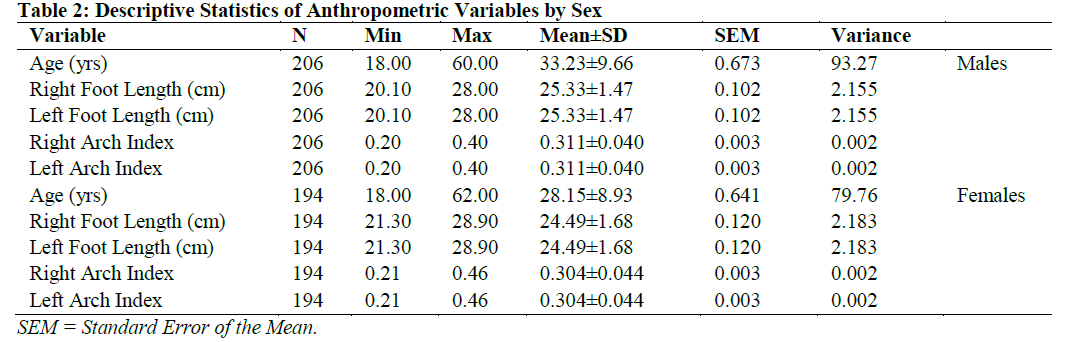
Pes planus, also called “flat foot” is a known musculoskeletal condition characterised by a collapsed medial longitudinal arch, resulting in altered gait biomechanics and postural defects. Even though its prevalence has been documented in different populations, limited data exist for indigenous Nigerian communities, particularly in Cross River State. This study aimed to explore the prevalence of pes planus among adult indigenes of Ugep, Yakurr Local Government Area, Cross River State, Nigeria, and to examine sex differences in anthropometric foot parameters. A cross-sectional study was conducted among 400 Ugep indigenes (206 males, 194 females) aged 18–62 years, selected by random sampling. Plantar footprints were obtained using the ink method. Right and left foot lengths and arch indices were measured and analysed using descriptive statistics and independent-samples t-tests. A total of 16 participants (7 males, 9 females) were identified with pes planus, giving an overall prevalence of 4.0%. Statistically significant sex differences were observed for mean age and both foot lengths, whereas no significant differences were found for right or left arch index. The prevalence of pes planus among the Ugep people is low, with females showing a slightly higher prevalence than males. These findings contribute anthropometric baseline data for this population and underscore the utility of low-cost plantar print methods in community-based foot health screening.
References
Antonuk, S. (1979). Staining process of feet studies. West African Journal, 6, 25–27.
Bahaya, B., Roa, T., & Benjamin, J. (2002). The influence of footwear on the prevalence of flatfoot. Mushin Ferrow, 16, 82–95.
Bradley, S., Jan, B., Geoffrey, J., & George, B. (2014). Foot posture as a risk factor for lower limb overuse injury: A systematic review and meta-analysis. Journal of Foot and Ankle Research, 7, 204–227.
Chang, T., & Lee, J. (2010). Flatfoot in Taiwanese school-aged children: Prevalence and risk factors. Journal of Clinical Pediatrics, 27, 101–108.
Didia, B., & Asomugha, A. (2004). The incidence of flatfoot amongst athletes in Port Harcourt. Journal of Experimental Clinical Anatomy, 3, 58–59.
Didia, B., Omu, E., & Obuoforibo, A. (1987). The use of footprint contact index II for the classification of flatfoot in a Nigerian populace. Journal of Foot and Ankle Survey, 4, 259–289.
Echi, B. (2007). Prevalence of flat foot amongst the people of southern and central senatorial district of Cross River State. International Journal of Forensic Sciences, 3(2). 157 -164.
Eluwa, M., Omini, R., & Kpela, T. (2009). The incidence of pes planus amongst Akwa Ibom students in the University of Calabar. International Journal of Forensic Sciences, 3(2).
Garcia, A., Jiménez, F., Varo, M., & Gomez, E. (1999). Flexible flatfeet in children: A real problem? Pediatrics, 103(6), e84.
Gordon, H. (2006). The workplace safety and insurance tribunal (Vol. 1, p. 5).
Hernig, E. M. (2001). Gender differences of adult foot wears. In Proceedings of the Fifth Symposium on Footwear Biomechanics (pp. 44–45). Department of Materials, ETH Zurich.
Hicks, J. H. (1995). Sample study of age and flatfoot. West African Journal, 6, 25–27.
Igbigbi, P., Pars, S., & Msamati, B. (2005). Prevalence of pes planus among indigenous Kenyans. Journal of Foot and Ankle Research, 14, 57–62.
Jones, A. L. (1998). Muscular insufficiency as a cause of flat foot. West African Journal, 6, 25–27.
Umar, I. M., Yakasai, A. M., & Rufa'i, A. A. (2010). Incidence of flatfoot among Yoruba school-aged children aged 9–14 years. Nigerian Journal of Physiotherapy, 12, 1–6.
Yamane, T. (1967). Statistics: An introductory analysis (2nd ed.). Harper and Row.
Downloads
Published
Issue
Section
Categories
License
Copyright (c) 2026 Swesme Enyioma-Alozie, Mimi-Precious E. Ubi

This work is licensed under a Creative Commons Attribution 4.0 International License.


