
PYROLYSIS OF PETROLEUM OILY SLUDGE: A SUSTAINABLE APPROACH FOR WASTE VALORISATION AND ENERGY RECOVERY
DOI:
https://doi.org/10.33003/fjs-2026-1007-5066Keywords:
Energy recovery, Petroleum oily sludge, Pyrolysis; Pyro-oil, Solid char, Waste valorisationAbstract
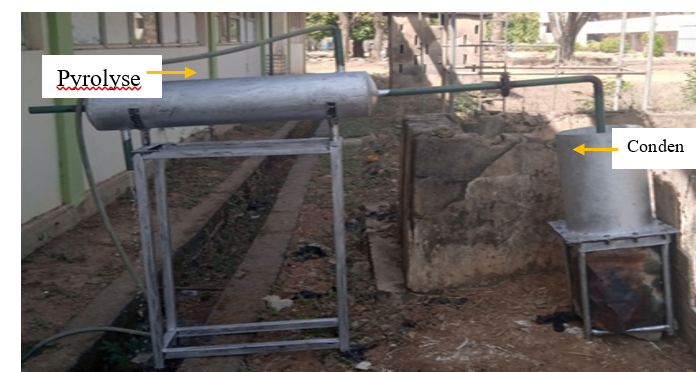
Petroleum oily sludge (POS) is a hazardous waste generated during crude oil refining, storage, and transportation, containing hydrocarbons, water, sediments, and heavy metals that pose serious environmental risks. This study investigates pyrolysis as a sustainable method for POS treatment, focusing on the effect of residence time on product yield and quality. The sludge obtained from Kaduna Refining and Petrochemical Company Limited, Nigeria, was characterised using proximate and ultimate analyses, total petroleum hydrocarbon (TPH) determination, and SEM–EDS analysis. Results showed high moisture content (70%), high carbon content (85.3%), TPH of 86%, and a high lower heating value of 47.53 MJ/kg, confirming strong suitability for thermal conversion. Pyrolysis experiments were conducted in a fixed-bed batch reactor at 450°C with residence times of 30, 45, 60, 90, and 120 minutes. Pyro-oil yield increased from 0.34 g/g at 30 minutes to a maximum of 0.87 g/g at 90 minutes before decreasing to 0.61 g/g at 120 minutes due to secondary cracking reactions. Solid char yield decreased steadily from 0.70 to 0.48 g/g with increasing residence time. The flue gas contained high methane content (57.4 wt. %), indicating strong energy recovery potential. Solid char showed carbon enrichment (92%) and significant TPH reduction to 5.3%, confirming effective hydrocarbon conversion. Pyro-oil thermal properties showed that 90 minutes provided the best balance of fuel stability and safety. The study confirms pyrolysis as an efficient waste-to-energy strategy for sustainable refinery sludge management.
References
Ali, A. M., Abu-Hassan, M. A., Ibrahim, R. R. K., & Abdulkarim, B. I. (2020). Development of a laboratory-scale thermal-arc-plasma reactor and its application in the pyrolysis of petroleum oily sludge. Frontiers in Advanced Materials Research, 2(1), 15–27. https://doi.org/10.34256/famr2012
Ali, A. M., Abu-Hassan, M. A., Ibrahim, R. R., Zaini, M. A., Abdulkarim, B. I., Hussein, A. S., Ismail, M. A. I. M., & Halim, M. A. I. M. (2017). Characterisation of petroleum sludge from refinery industry biological wastewater treatment unit. Advanced Science Letters, 23(11), 11208–11212. https://doi.org/10.1166/asl.2017.10234
Ali, A. M., Hassan, M. A. A., Ibrahim, R. R., Jalil, A. A., Nayan, N. H. M., Abdulkarim, B. I., & Sabeen, A. H. (2019). Analysis of solid residue and flue gas from thermal plasma treatment of petroleum sludge. Journal of Environmental Chemical Engineering, 7(4), Article 103207. https://doi.org/10.1016/j.jece.2019.103207
Ali, A. M., Ibrahim, H., & Jibrin, M. D. (2024). Optimisation of thermal plasma treatment of petroleum oily sludge using response surface methodology (RSM). International Journal of Innovation Research and Advanced Studies, 11(2), 45–53
Halalsheh, M., Shatanawi, K., Shawabkeh, R., Kassab, G., Mohammad, H., Adawi, M., Al-Harahsheh, M., Al-Zboon, K., & Almomani, S. (2024). Impact of temperature and residence time on sewage sludge pyrolysis for combined carbon sequestration and energy production. Heliyon, 10(7), Article e28653. https://doi.org/10.1016/j.heliyon.2024.e28653
Hasan, A. M., Kamal, R. S., Farag, R. K., & Abdel-Raouf, M. E. (2024). Petroleum sludge formation and its treatment methodologies: A review. Environmental Science and Pollution Research, 31(6), 8369–8386. https://doi.org/10.1007/s11356-023-31562-7
Hu, Y., & Chen, Z. (2025). Thermochemical conversion of sewage sludge: Progress in pyrolysis and gasification. Water, 17(12), Article 1833. https://doi.org/10.3390/w17121833
Lamido, S. I., Alhassan, A. U., & Habib, M. (2023). Design and fabrication of a fixed-bed pyrolyser for the pyrolysis of waste plastics (pure-water sachets). International Journal of Scientific Research and Engineering Development, 6(1), 654–660
Lewandowski, W. M., Ryms, M., & Kosakowski, W. (2020). Thermal biomass conversion: A review. Processes, 8(5), Article 516. https://doi.org/10.3390/pr8050516
Li, J., Sun, B., Lin, F., Tian, W., Yan, B., Song, Y., Wang, Y., Zhang, Y., & He, C. (2022). Transformation and regulation of nitrogen and sulfur during pyrolysis of oily sludge with N/S model compounds. Fuel, 324, Article 124651. https://doi.org/10.1016/j.fuel.2022.124651
Pelagalli, V., Langone, M., Matassa, S., Race, M., Tuffi, R., Papirio, S., Frunzo, L., Esposito, G., & Pirozzi, F. (2024). Pyrolysis of municipal sewage sludge: Challenges, opportunities and new valorisation routes for biochar, bio-oil, and pyrolysis gas. Environmental Science: Water Research & Technology, 10(10), 2282–2312. https://doi.org/10.1039/D4EW00318A
Shen, L., & Zhang, D. K. (2003). An experimental study of oil recovery from sewage sludge by low-temperature pyrolysis in a fluidised-bed. Fuel, 82(4), 465–472. https://doi.org/10.1016/S0016-2361(02)00320-0
Downloads
Published
Issue
Section
Categories
License
Copyright (c) 2026 Abubakar Ali, Habiba Shehu Usman, Zainab Abdulwahab

This work is licensed under a Creative Commons Attribution 4.0 International License.


