
Production and Quality Evaluation of Spiced Black Tea Blends
DOI:
https://doi.org/10.33003/fjs-2026-1011-4932Keywords:
Proximate composition, Sensory evaluation, Black tea, Doum palm, Lemon grass, Cloves, CinnamonAbstract
ABSTRACT
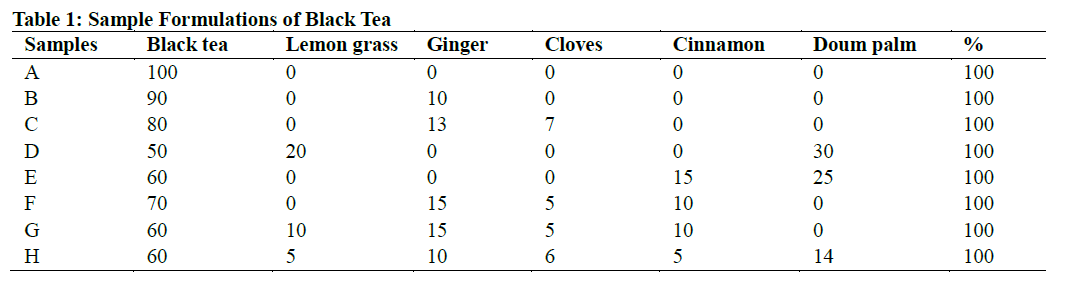
The aim of this study is to formulate a spiced black tea which is used for its health benefit and unique flavors. the spiced black tea product was produced by Doum palm, lemon grass, Ginger, Cloves and Cinnamon were blended together at the following eight different ratios: sample A (100% Black Tea), B (90% Black Tea, 10% Ginger), C (80% Black Tea, 13% Ginger ,7% Clovers), D (50% Black Tea, 20% lemon grass, 30% Doum palm), E (60% Black Tea, 15% Cinnamon, 25% Doum plam), F (70% Black Tea, 15% Ginger ,5% Cloves. 10% Cinnamon), G (60% Black Tea, 10% lemon grass, 10% Cinnamon, 15% Ginger, 5% Cloves), and H (60% Black Tea, 5% Cinnamon, 14% Doum plam, 5%, 10% Ginger, 6% Cloves,5% Lemon grass). Proximate composition content were analyzed using standard analytical methods. Sensory evaluation was carried out using 10 semi-trained panelists. the proximate composition moisture content values ranged from (8.50-6.54%), the protein content values ranged from (5.68-3.48%), crude fibre content values ranged from(17.16-4.55%) fat content values ranged from (3.58-1.41%), ash content values ranged from (7.34-5.49%), carbohydrate content values ranged from (77.93-58.72%), The Eneryg values ranged from (340.55-288.98%),From the sensory scores sample H (60% Black Tea, 5% Cinnamon, 14% Doum plam, 5%, 10% Ginger, 6% Cloves,5% Lemon grass) was most preferred in terms of taste, flavour and overall acceptance and Sample B (90% Black Tea, 10% Ginger) was the most preferred in terms of appearance.
References
Abas, F., Lajis, N. H., & Israf, D. A. (2006). Antioxidant and radical scavenging activities of the extracts of the leaves of Piper (sarmentosum). Journal of Ethnopharmacology, 107(3), 354-361.
Boriah, S. (1997). Tea processing and packaging. In Y. H. Hui (Ed.), Encyclopedia of Food Science and Technology (pp. 2511-2516). John Wiley & Sons.
Chatterjee, S., Variyar, P. S., & Sharma, A. (2014). Study on the blending of tea with spices and its effect on nutritional and sensory qualities. Journal of Food Science and Technology, 51(4), 763-771.
Eldahshan, O. A., & Singab, A. N. (2008). Phenolic compounds and antioxidant activity of doum palm (Hyphaene thebaica) fruit. Journal of Food Science, 73(4), S192-S197.
Eldahshan, O. A., & Singab, A. N. (2009). Antioxidant and anti-inflammatory activities of doum palm (Hyphaene thebaica) fruit. Journal of Ethnopharmacology, 126(2), 251-256.
Grzanna, R., Phan, P., Polotsky, A., & Gollapudi, S. (2005). Ginger—an herbal medicinal product with broad anti-inflammatory actions. Journal of Medicinal Food, 8(2), 125-132.
Katalinic, V., Milos, M., Kulisic, T., & Jukic, M. (2006). Antioxidant activity of six croatian wines. Food Chemistry, 97(3), 516-524.
Katz, D. (2013). The world of touch. In The Oxford Handbook of Cognitive Linguistics (pp. 945-958). New York, NY: Oxford University Press.
Khan, M. T. (2003). Cinnamon: A spice with potential health benefits. Journal of Ayurveda and Integrative Medicine, 4(3), 147-154.
Kikunaga, S. (2010). The effects of fragrance on emotions: Moods and physiological responses. Journal of Environmental Psychology, 30(3), 269-277.
Kuhnert, N. (2010). Unraveling the structure of black tea theaflavins. Archives of Biochemistry and Biophysics, 501(1), 37-45.
Kumar, V., Kumar, M., & Kumar, S. (2017). Phytochemical and nutritional analysis of herbal tea blends. Journal of Food Science and Technology, 54(4), 1056-1064.
Kuroda, M., Mimaki, Y., & Sashida, Y. (2000). Phenolic glycosides from the leaves of Cymbopogon citratus. Journal of Natural Products, 63(3), 355-359.
Lee, J., Lee, Y., & Kim, B. (2018). Physicochemical properties of green tea powders produced by different drying methods. Journal of Food Science, 83(5), S1448-S1456.
Loken, B. (2017). Sensory marketing: A review and agenda for future research. Journal of Consumer Psychology, 27(1), 37-53.
Luczaj, W., & Skrzydlewska, E. (2005). Antioxidant properties of tea. Journal of Food Science, 70(4), R181-R187
Naik, M. I. (2010). Essential oil of lemon grass: Its composition, pharmacological and therapeutic uses. Journal of Pharmacy Research, 3(2), 249-253.
Omotayo, O. E., Akande, B. A., & Olagunju, A. (2018). Nutritional and phytochemical analysis of doum palm (Hyphaene thebaica) fruit. Journal of Food Science and Technology, 55(4), 1230-1238.
Otten, J. J. (2010). Tea. In J. J. Otten, J. P. Hellwig, & L. D. Meyers (Eds.), Dietary Reference Intakes for Vitamin D, Calcium, and Phosphorus (pp. 405-406). National Academies Press.
Spence, C. (2015). On the psychological impact of food colour. Flavour, 4(1), 21
Teuscher, E. (2003). Medicinal spices: A handbook of culinary herbs, spices, and medicinal plants. Medpharm Scientific Publishers.
Walter, R., & Wiederecht, G. (2006). Tea. In Encyclopedia of Food Sciences and Nutrition (2nd ed., pp. 592-598). Academic Press.
Yang, C. S. (2002). Tea and health. Nutrition, 18(11-12), 977-978.
Downloads
Published
Issue
Section
Categories
License
Copyright (c) 2026 Hadiza Kubura lawan, Mas'ud Ahmad Usman, Charles Bristone Bristone, Fanna Adam Mustapha, Amina Mai-Jalo

This work is licensed under a Creative Commons Attribution 4.0 International License.


