
MOLECULAR INSIGHTS INTO THE ADSORPTION BEHAVIOUR OF QUINOLINE-BASED SCHIFF BASE CORROSION INHIBITORS ON AL (111) SURFACE: A DFT AND MONTE CARLO STUDY
DOI:
https://doi.org/10.33003/fjs-2026-1006-4907Keywords:
corrosion inhibitors, Aluminum (Al(111)) surface, Monte Carlo simulation, DFT, Adsorption behaviorAbstract
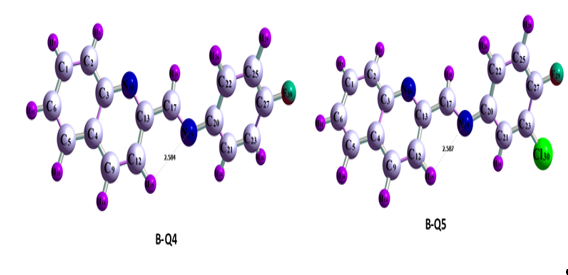
The corrosion of aluminum in acidic environments poses significant challenges for industrial applications, necessitating the development of efficient corrosion inhibitors. In this study, the inhibition potential of two quinoline-based Schiff base derivatives, (E)-N-(4-fluorophenyl)-1-(quinolin-2-yl)methanimine (B-Q4) and (E)-N-(3-chloro-4-fluorophenyl)-1-(quinolin-2-yl)methanimine (B-Q5) , on the Al(111) surface in acidic medium, was investigated using density functional theory (DFT) calculations and Monte Carlo (MC) simulations. Quantum chemical calculations reveal strong intramolecular charge transfer and significant π-electron delocalization, which enhance the electron-donating ability of both inhibitors. NBO analysis shows high stabilization energies with π→ π* interactions and NCI and QTAIM analyses show that adsorption is dominated by weak dispersive interactions, typical of physisorption. Adsorption experiments indicate that both inhibitors spontaneously react with the aluminum surface and that B-Q4 adsorbs with lower adsorption energies at the DFT level. Monte Carlo simulations also indicate strong adsorption in a simulated acidic environment, with protonated species showing enhanced interaction due to electrostatic effects. The inhibitors adopt near-parallel orientations on the Al(111) surface, maximizing surface coverage and promoting the formation of a protective barrier. Overall, the results suggest that both compounds are effective corrosion inhibitors, with B-Q4 showing slightly stronger intrinsic adsorption, while protonated B-Q5 exhibits superior performance under acidic conditions.
Downloads
Published
Issue
Section
Categories
License
Copyright (c) 2026 Abosede Adejoke Badeji, Segun D. Oladipo, Fulufhelo Tshikhudo, Gideon A. Okon

This work is licensed under a Creative Commons Attribution 4.0 International License.


