
ANTI-BACTERIAL AND ANTI Β-LACTAMASE ACTIVITIES OF EUPHORBIA HIRTA AND TRIDAX PROCUMBENS AGAINST CLINICAL ISOLATES OF Β-LACTAMASE PRODUCING SALMONELLA ENTERICA AND STAPHYLOCOCCUS AUREUS
DOI:
https://doi.org/10.33003/fjs-2026-1007-4726Keywords:
Phytochemical analysis, Staphylococcus aureus, Salmonella enterica, Antimicrobial resistance, Tridax procumbens, β-lactamase-producing bacteriaAbstract
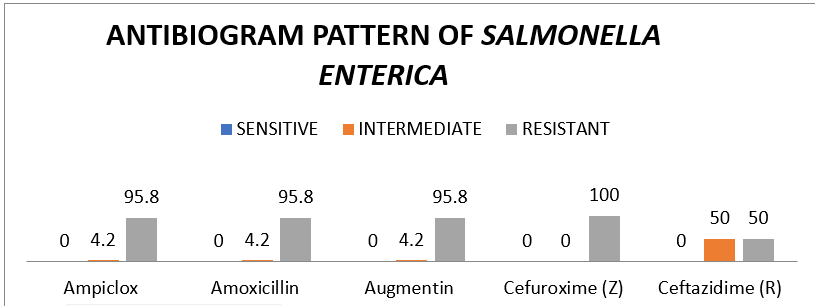
This study investigated the antibacterial and anti-β-lactamase activities of Euphorbia hirta and Tridax procumbens against clinical isolates of β-lactamase-producing Salmonella enterica and Staphylococcus aureus, addressing the growing challenge of antibiotic resistance to β-lactam antibiotics. A total of 200 clinical specimens, comprising 100 nasal swabs and 100 stool samples, were collected. From these, 24 isolates of S. enterica and 20 isolates of S. aureus were recovered and microbiologically characterized using standard biochemical tests. S. aureus was confirmed by positive catalase and coagulase reactions, while S. enterica showed motility, citrate utilization, and hydrogen sulfide production. Antibiotic susceptibility testing revealed high resistance levels to commonly used β-lactam antibiotics, with S. enterica exhibiting up to 100% resistance to cefuroxime and S. aureus showing up to 95% resistance. β-lactamase screening indicated high pre-exposure enzyme production in both organisms (83.3% and 85%, respectively). Phytochemical screening showed that E. hirta contained glycosides, tannins, saponins, and phenols, whereas T. procumbens contained mainly glycosides. Antibacterial assessment demonstrated that both plant extracts produced mild to moderate inhibitory effects at 600 mg/dL. Ethanolic extracts showed slightly higher activity (8–9 mm inhibition zones) than aqueous extracts (6–8 mm). However, post-exposure evaluation revealed limited anti-β-lactamase activity, with most isolates remaining β-lactamase-positive. In conclusion, although the extracts exhibited moderate antibacterial activity, their minimal anti-β-lactamase effect suggests that they may function better as supportive or complementary agents rather than standalone treatments. Further studies are recommended to isolate active compounds and assess synergistic interactions with existing antibiotics.
References
Adams, M. R., McClure, P. J., & Moss, M. O. (2024). Food microbiology. Royal society of
chemistry
Bergwerff, A. A., & Debast, S. B. (2021). Modernization of control of pathogenic micro-
organisms in the food-chain requires a durable role for immunoaffinity-based detection methodology—a review. Foods, 10(4), 832.
Bilash, S. M., Svintsytska, N. L., Lazarieva, K. A., Hryn, V. H., & Bilash, V. P. (2022).
Splanchnology with clinical applications. Endocrine glands.
Bush, K., & Bradford, P. A. (2020). Epidemiology of β-lactamase-producing pathogens.
Clinical microbiology reviews, 33(2), 10-1128.
Chinemerem Nwobodo, D., Ugwu, M. C., Oliseloke Anie, C., Al‐Ouqaili, M. T., Chinedu Ikem,
J.,Victor Chigozie, U., & Saki, M. (2022). Antibiotic resistance: The challenges and some emerging strategies for tackling a global menace. Journal of clinical laboratory analysis, 36(9), e24655.
Chirani, M. R., Kowsari, E., Teymourian, T., & Ramakrishna, S. (2021). Environmental impact
of increased soap consumption during COVID-19 pandemic: Biodegradable soap production and sustainable packaging. Science of the Total Environment, 796, 149013.
Dekaboruah, E., Suryavanshi, M. V., Chettri, D., & Verma, A. K. (2020). Human microbiome:
an academic update on human body site specific surveillance and its possible role. Archives of microbiology, 202, 2147-2167.
Helmreich, S. (2023). Alien ocean: Anthropological voyages in microbial seas. Univ of
California Press.
Howes, M. J. R., Quave, C. L., Collemare, J., Tatsis, E. C., Twilley, D., Lulekal, E., & Nic
Lughadha, E. (2020). Molecules from nature: Reconciling biodiversity conservation and global healthcare imperatives for sustainable use of medicinal plants and fungi. Plants, People, Planet, 2(5), 463-481.
Jacob, A. G., Tijjani, A., & Imam, I. I. (2018). Antibacterial studies of the leaves extracts of Sida
corymbosa (Malvaceae). FUDMA JOURNAL OF SCIENCES, 2(2), 169-175.
Kurittu, P., Khakipoor, B., Aarnio, M., Nykäsenoja, S., Brouwer, M., Myllyniemi, A. L. &
Heikinheimo, A. (2021). Plasmid-borne and chromosomal ESBL/AmpC genes in Escherichia coli and Klebsiella pneumoniae in global food products. Frontiers in Microbiology, 12, 592291.
Kish, L. (1965). Survey Sampling. New York: John Wiley & Sons.
Lawrence, C., & Dixey, R. (2018). Practising on principle: Joseph Lister and the germ
theories of disease. In Medical theory, surgical practice (pp. 153-215). Routledge.
Leal, H. F., Azevedo, J., Silva, G. E. O., Amorim, A. M. L., de Roma, L. R. C., Arraes, A. C. P.,
& Reis, J. N. (2019). Bloodstream infections caused by multidrug-resistant gram-negative bacteria: epidemiological, clinical and microbiological features. BMC infectious diseases, 19, 1-11.
López-Malo, A., Alzamora, S. M., Paris, M. J., Lastra-Vargas, L., Coronel, M. B., Gómez, P. L.,
& Palou, E. (2020). Naturally occurring compounds–Plant sources. Antimicrobials in food, 527-594.
Meena, M., Swapnil, P., Barupal, T., & Sharma, K. (2019). A review on infectious pathogens
and mode of transmission. J. Plant Pathol. Microbiol, 10, 472.
Moxley, R. A. (2022). Enterobacteriaceae: Escherichia. Veterinary microbiology, 56-74.
Milani, M., Curia, R., Shevlyagina, N. V., & Tatti, F. (2023). Staphylococcus aureus. In
Bacterial Degradation of Organic and Inorganic Materials: Staphylococcus aureus Meets the Nanoworld (pp. 3-20). Cham: Springer International Publishing.
Ramos, S., Silva, V., Dapkevicius, M. D. L. E., Caniça, M., Tejedor-Junco, M. T., Igrejas, G., &
Poeta, P. (2020). Escherichia coli as commensal and pathogenic bacteria among food-producing animals: Health implications of extended spectrum β-lactamase (ESBL) production. Animals, 10(12), 2239.
Raven, P. H., Gereau, R. E., Phillipson, P. B., Chatelain, C., Jenkins, C. N., & Ulloa Ulloa, C.
(2020). The distribution of biodiversity richness in the tropics. Science Advances, 6(37), eabc6228.
Sarıguzel, F. M., Silici, S., Koç, A. N., Sağıroğlu, P., & Dinç, B. (2023). Does Dry or Fresh Bee
Bread Contain Clinically Significant, and Antimicrobial Agents Resistant Microorganisms?. Journal of Agricultural Sciences, 29(2), 534-545.
Selwyn, S. (2023). The discovery of penicillin and cephalosporins. Hemodynamics and
Immune Defense: Discoveries in Pharmacology, Volume 3, 3, 283.
Tariq, S., Samad, A., Hamza, M., Ahmer, A., Muazzam, A., Ahmad, S., & Amhabj, A. M. A.
(2022). Salmonella in poultry; an overview. International Journal of Multidisciplinary Sciences and Arts, 1(1), 80-84.
Tsouklidis, N., Kumar, R., Heindl, S. E., Soni, R., & Khan, S. (2020). Understanding the fight
against resistance: Hospital-acquired methicillin-resistant Staphylococcus aureus vs. community-acquired methicillin-resistant Staphylococcus aureus. Cureus, 12(6).
Winstel, V., Schneewind, O., & Missiakas, D. (2021). Staphylococcus aureus and related
staphylococci. In Practical Handbook of Microbiology (pp. 543-566). CRC Press.
Downloads
Published
Issue
Section
Categories
License
Copyright (c) 2026 Ahmed A. Haroun, Philip Anthony Vantsawa, Abidemi Elizabeth Awujoola

This work is licensed under a Creative Commons Attribution 4.0 International License.


