
PSYCHOSOCIAL AND STRUCTURAL DETERMINANTS OF SAFE POST-HARVEST MOLD MANAGEMENT PRACTICES AMONG HOUSEHOLDS IN JIGAWA STATE, NIGERIA
DOI:
https://doi.org/10.33003/fjs-2026-1002-4664Keywords:
Behavioral intention, Food safety, Health Belief Model, Nigeria, Post-harvest management, TheoryAbstract
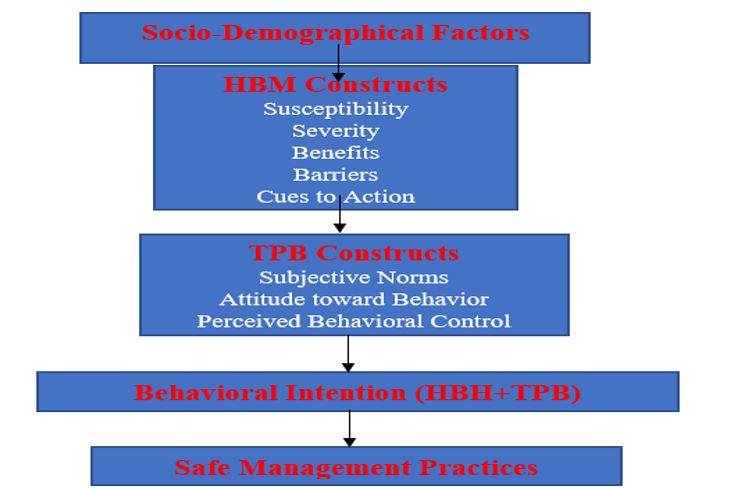
Foodborne fungal contamination of staple crops remains a persistent public health and food safety challenge in sub-Saharan Africa, particularly in settings where post-harvest handling and storage systems are inadequate. Despite increasing awareness of fungal risks in northern Nigeria, adoption of preventive household practices remains inconsistent, and the behavioral drivers of these practices are insufficiently understood. This study examined the determinants of safe mold management practices among households in Jigawa State, Nigeria, using an integrated Health Belief Model and Theory of Planned Behavior framework. A community-based cross-sectional survey was conducted among 400 households selected through multistage sampling across major agro-ecological zones. Data were analyzed using descriptive statistics, multivariate logistic regression, and Structural Equation Modeling (SEM). Behavioral intention emerged as the strongest predictor of safe practices (β = 0.58, p < 0.001; AOR = 2.10), followed by self-efficacy (β = 0.41, p < 0.001; AOR = 1.72) and perceived benefits (AOR = 1.45, p = 0.003). Perceived severity (AOR = 1.28, p = 0.041), subjective norms (AOR = 1.38, p = 0.007), education (AOR = 1.65, p = 0.019), and extension contact (AOR = 1.92, p = 0.002) were also significant positive predictors. In contrast, perceived barriers reduced the likelihood of adoption (β = −0.29; AOR = 0.66, p < 0.001). Perceived susceptibility and attitudes were not statistically significant, suggesting that risk awareness alone is insufficient to motivate behavioral change without confidence and enabling support.
References
Abbas, H. K., Weaver, M. A., Zablotowicz, R. M., & Horn, B. W. (2020). Fungal contamination of agricultural commodities in hot climates: Implications for food safety. Journal of Food Safety, 40(3), e12715. https://doi.org/10.1111/jfs.12715
Abdullahi, A., Jolly, C. M., & Rahman, S. (2022). Determinants of food safety practices among smallholder farmers in sub-Saharan Africa. Food Control, 138, 108987.
Abdullahi, A., Kabir, J., & Bello, M. (2023). Behavioral determinants of household food safety practices in northern Nigeria. Journal of Environmental Health Research, 33(2), 145–158.
Adekoya, E. A., Olatoye, M. O., & Adegbite, D. A. (2024). Extension service delivery and adoption of post-harvest food safety practices among smallholder farmers in Nigeria. Journal of Agricultural Extension, 28(1), 45–60.
Adekoya, I., Njobeh, P. B., Obadina, A. O., & Sulyok, M. (2023). Household awareness and management of mycotoxin risks in staple foods in sub-Saharan Africa. Food Control, 147, 109604. https://doi.org/10.1016/j.foodcont.2023.109604
Affognon, H., et al. (2015). Unpacking postharvest losses in sub-Saharan Africa: A meta-analysis. World Development, 66, 49–68.
Afolami, C. A., Obayelu, O. A., & Vaughan, I. O. (2023). Behavioral drivers of food safety practices among rural households in sub-Saharan Africa. Food Control, 147, 109569. https://doi.org/10.1016/j.foodcont.2023.109569
Afolayan, M. O., Alamu, O. J., & Adebayo, A. A. (2021). Household characteristics and adoption of post-harvest technologies in northern Nigeria. Journal of Rural Studies, 82, 150–159.
Ajzen, I. (2020). The theory of planned behavior: Frequently asked questions. Human Behavior and Emerging Technologies, 2(4), 314–324. https://doi.org/10.1002/hbe2.195
Armitage, C. J., & Conner, M. (2001). Efficacy of the theory of planned behavior: A meta-analytic review. British Journal of Social Psychology, 40(4), 471–499.
Atehnkeng, J., et al. (2018). Distribution and toxigenicity of Aspergillus species in West Africa. World Mycotoxin Journal, 11(3), 361–374.
Ayanwale, A. B., Ogunjimi, S. I., & Alabi, O. O. (2021). Climate variability and post-harvest losses among smallholder farmers in northern Nigeria. African Journal of Agricultural Research, 16(9), 1295–1306.
Bankole, S. A., Adebanjo, A., & Ezekiel, C. N. (2022). Post-harvest practices and mold contamination in West African food systems. African Journal of Food Science, 16(3), 85–96.
Carpenter, C. J. (2010). A meta-analysis of the effectiveness of Health Belief Model variables. Health Communication, 25(8), 661–669.
Carpenter, C. J. (2021). A meta-analysis of the effectiveness of health belief model variables in predicting behavior. Health Communication, 36(13), 1608–1619. https://doi.org/10.1080/10410236.2020.1773706
Charan, J., & Biswas, T. (2013). How to calculate sample size for different study designs in medical research. Indian Journal of Psychological Medicine, 35(2), 121–126. https://doi.org/10.4103/0253-7176.116232
Cochran, W. G. (1977). Sampling techniques (3rd ed.). John Wiley & Sons.
Darwish, W. S., et al. (2014). Mycotoxin contamination in African foods: Implications for food safety. Food Control, 43, 48–56.
Darwish, W. S., Ikenaka, Y., Nakayama, S. M. M., & Ishizuka, M. (2021). Mycotoxins and food safety challenges in developing countries. Toxins, 13(7), 476. https://doi.org/10.3390/toxins13070476
Ezekiel, C. N., Kraak, B., & Sulyok, M. (2021). Climate variability and mycotoxin risks in sub-Saharan Africa. Environmental Research, 195, 110784.
Ezekiel, C. N., Oyedele, O. A., & Sulyok, M. (2020). Fungal and mycotoxin contamination in Nigerian food chains. Food Additives & Contaminants: Part A, 37(9), 1475–1490.
FAO. (2021). The impact of food safety hazards on food security. Food and Agriculture Organization of the United Nations.
FAO. (2022). Reducing food contamination along value chains in sub-Saharan Africa. Food and Agriculture Organization of the United Nations.
Gbashi, S., Madala, N. E., de Saeger, S., & Njobeh, P. B. (2022). Mycotoxin contamination and food safety in Africa: Current challenges and mitigation strategies. Journal of Food Safety, 42(2), e12947. https://doi.org/10.1111/jfs.12947
Glanz, K., Rimer, B. K., & Viswanath, K. (2020). Health behavior: Theory, research, and practice (6th ed.). Jossey-Bass.
Glanz, K., Rimer, B. K., & Viswanath, K. (2021). Health behavior: Theory, research, and practice (5th ed.). Jossey-Bass.
Grace, D., Hoffmann, V., & Atherstone, C. (2021). Behavioral approaches to reducing aflatoxin exposure in low-income countries. Annual Review of Resource Economics, 13, 447–466. https://doi.org/10.1146/annurev-resource-101620-080019
Hell, K., et al. (2008). Aflatoxin contamination of maize in West Africa. International Journal of Food Microbiology, 122(1–2), 12–20.
Hell, K., Mutegi, C., & Fandohan, P. (2020). Aflatoxin control and prevention strategies in Africa: A review. Food Security, 12(4), 761–775.
Hoffmann, V., Moser, C. M., & Herrman, R. T. (2022). The role of barriers and incentives in adoption of food safety practices in developing countries. World Development, 152, 105783. https://doi.org/10.1016/j.worlddev.2021.105783
IARC. (2022). Aflatoxins. IARC Monographs on the Evaluation of Carcinogenic Risks to Humans. Lyon, France.
Kamala, A., Ortiz, J., Kimanya, M., et al. (2021). Knowledge and practices related to mycotoxin contamination in staple foods in Africa. Toxins, 13(6), 384.
Kothe, E. J., & Mullan, B. A. (2021). Interaction effects in the theory of planned behavior: A systematic review. Frontiers in Psychology, 12, 657871. https://doi.org/10.3389/fpsyg.2021.657871
Kumar, P., Singh, R., & Kaur, J. (2022). Socio-behavioral drivers of safe food handling practices in developing countries. Public Health Nutrition, 25(6), 1691–1702.
Kumar, S., Hellin, J., & Rola-Rubzen, M. F. (2021). Improving post-harvest management to reduce food losses and safety risks. Food Security, 13, 1095–1109. https://doi.org/10.1007/s12571-021-01189-0
Kumi, J., et al. (2021). Aflatoxin contamination and awareness among farmers in Ghana. Food Control, 123, 107768.
Lawal, B. O., Sadiq, M. S., & Yusuf, O. (2023). Gender roles and post-harvest management practices in northern Nigeria. African Journal of Agricultural Research, 18(4), 512–521.
Lemeshow, S., Hosmer, D. W., Klar, J., & Lwanga, S. K. (1990). Adequacy of sample size in health studies. World Health Organization.
Liu, Y., & Wu, F. (2010). Global burden of aflatoxin-induced hepatocellular carcinoma. Environmental Health Perspectives, 118(6), 818–824.
Matumba, L., et al. (2021). Mycotoxin exposure in sub-Saharan Africa: A review. Toxins, 13(1), 27.
McEachan, R. R. C., et al. (2011). Prospective prediction of health-related behaviors with the theory of planned behavior. Health Psychology Review, 5(2), 97–144.
Mitchell, N. J., et al. (2017). Economic burden of aflatoxin contamination. World Mycotoxin Journal, 10(1), 23–38.
Mngqawa, P., Chimonyo, M., & Mapiye, C. (2024). Integrating behavioral models to explain food safety practices among smallholder households. Food Research International, 176, 113034.
Morris, W., Henley, A., & Dowell, D. (2021). Farm diversification, social norms, and behavioral control: Evidence from rural households. Journal of Rural Studies, 86, 471–481. https://doi.org/10.1016/j.jrurstud.2021.06.012
Muhammad, S., Abdullahi, Y., & Bello, R. S. (2024). Adoption of improved grain storage technologies among rural households in north-western Nigeria. Journal of Agricultural Extension, 28(1), 67–80.
Mullan, B., Wong, C., & Kothe, E. (2022). Applying integrated behavioral models to food safety behaviors. Appetite, 168, 105708. https://doi.org/10.1016/j.appet.2021.105708
Mutegi, C. K., Hoffmann, V., & Nelson, R. J. (2021). Contribution of behavioral factors to aflatoxin risk reduction in maize systems. Food Policy, 102, 102055. https://doi.org/10.1016/j.foodpol.2021.102055
National Bureau of Statistics (NBS). (2023). Nigeria poverty and income report. Abuja: NBS.
National Bureau of Statistics. (2022). Agricultural production survey report. National Bureau of Statistics, Federal Republic of Nigeria.
Ojuri, O. T., et al. (2019). Occurrence of mycotoxins in maize and sorghum in Nigeria. Food Additives & Contaminants, 36(3), 365–374.
Ojuri, O. T., Ezekiel, C. N., & Sulyok, M. (2023). Awareness and exposure to mycotoxins in Nigerian households. Environmental Research, 216, 114567.
Oyedele, O. A., et al. (2023). Behavioral determinants of household grain storage practices in Northern Nigeria. Journal of Food Protection, 86(5), 100078.
Ricker-Gilbert, J., & Jones, M. (2023). Agricultural extension, learning, and technology adoption in Africa. Food Policy, 113, 102361. https://doi.org/10.1016/j.foodpol.2022.102361
Rimal, R. N., & Lapinski, M. K. (2021). A re-explication of social norms, ten years later. Communication Theory, 31(4), 722–746.
Rosenstock, I. M. (1974). Historical origins of the Health Belief Model. Health Education Monographs, 2(4), 328–335.
Suleiman, R. A., & Abdullahi, M. S. (2022). Post-harvest handling practices and fungal contamination of cereals in sub-Saharan Africa. Food Control, 134, 108708. https://doi.org/10.1016/j.foodcont.2021.108708.
Udomkun, P., et al. (2020). Mycotoxins in sub-Saharan Africa: Present situation, socio-economic impact, awareness, and outlook. Food Control, 113, 107153. https://doi.org/10.1016/j.foodcont.2020.107153
WHO. (2023). Food safety and mycotoxins. Geneva: WHO.
Wild, C. P., et al. (2020). Mycotoxin control in low- and middle-income countries. Annual Review of Food Science and Technology, 11, 375–398.
Wild, C. P., Miller, J. D., & Groopman, J. D. (2020). Mycotoxin control in low- and middle-income countries. IARC Scientific Publications.
World Bank. (2023). Agriculture and rural poverty in Sub-Saharan Africa. Washington, DC.
World Health Organization (WHO). (2023). Mycotoxins and food safety fact sheet. Geneva: WHO.
Downloads
Published
Issue
Section
Categories
License
Copyright (c) 2026 Aminu Hussaini ahabbabura, Ahmed Fate Ali, Suleiman Yusuf Mudi

This work is licensed under a Creative Commons Attribution 4.0 International License.


