
POTENTIAL TOXIC METALS (PTMS) POLLUTION OF UNDERGROUND WATER (WELL WATER) IN IJORA - BADIA AREA OF LAGOS STATE, SOUTHWESTERN NIGERIA
DOI:
https://doi.org/10.33003/fjs-2026-1001-4547Keywords:
Toxic, Metals, Anthropogenic, Groundwater, Environment, SignificantAbstract
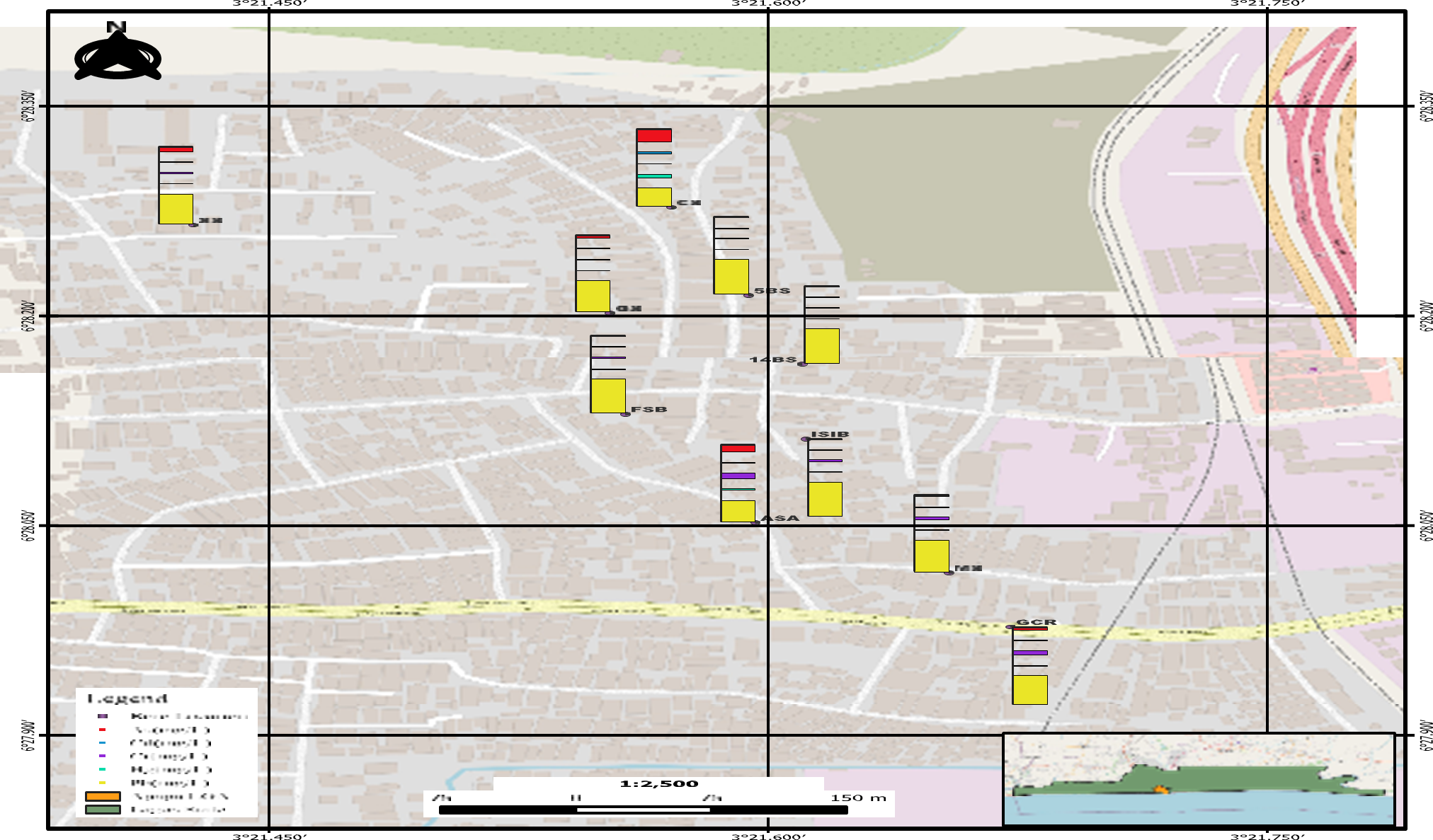
Inadequate public water supply in Ijora-Badia forces groundwater dependence, raising concerns about potentially toxic metal contamination and public health risks. This study presents Potential Toxic Metals (PTMS) Pollution of Undergroundwater(wellwater) in Ijora - Badia Area of Lagos - State, Southwestern- Nigeria. Ten well - water samples were randomly collected from ten different locations, four times per month from August 2024 to January 2025. Samples were collected using pre-washed, labeled plastic containers, digested, and analyzed for PTMs - Pb, Cd, Cr, As, and Hg using Inductively Coupled Plasma Optical Emission Spectroscopy (ICP - OES). Results showed variations in PTMS concentrations across sampling locations whose ranges included Hg - (0.0008 - 0.0139 mg/L), Pb - (0.0244 - 0.9269 mg/L), Cd - (0.0014 -0.0192 mg/L), As - (0.0035 - 0.0809 mg/L), and Cr - (0.0025 - 0.4175 mg/L). Lead-(19.0482 mg/L) recorded the highest concentration whereas mercury - (0.0513 mg/L) showed the lowest. ISIB (9.4056 mg/L; 45.6%) was the most heavily polluted site, while CS (0.0485 mg/L; 0.2%) showed minimal contamination. The distribution trend of PTMs followed the order Pb > Cr > As > Cd > Hg. Principal Component Analysis identified a single dominant component (PC1) accounting for 86.45% of the total variance, suggesting predominantly anthropogenic Sources. Heavy Metal Pollution Index (HPI), Metal Index (MI), and Pollution Index (PI) all confirm severe contamination. Correlation results (p > 0.5) further reinforced the high pollution burden. PTM levels exceeded Nigeria Industrial Standards (NIS) and WHO guidelines, rendering the groundwater unsafe for domestic use.
References
Abraham, T., Embialle, M., Self, T., Samuel, F., Here B., Mahmud A., & Ayenew N. (2021). Determination of Heavy Metal Contamination in Ground and Surface Water Sources in Jimma Town, Southwest Ethiopia. Journal of Environment pollution and Human Health, 9(2), 36 - 43.
Adano, A. J., Marcus, N. D., Magaji, J. I., & Opaluwa, O. D. (2023). Assessment of Seasonal Variation in Heavy Metal Status of a Lotic Ecosystem in Federal Capital Territory, Abuja, North Central Nigeria. Makara Journal of Science, 27(4), 264 - 272. https://doi.org/10.7454/mss.v27i4.1407.
Ajiwe, V., & Eboagu, K. (2021). Groundwater contamination and health risk assessment in urban areas. Journal of Environmental Health, 34(2), 112-125.
Ali, A. A., Kamal, B. Al-paruany., & Ansam S. A. (2025). Evaluation of Aromatic Hydrocarbons (PAHs) in some drinking - water wells in Baghdad.Iraqi Journal of Science, 66(6), 2359 - 2369.
AOAC International. (2000). Official Methods of Analysis, 17th Edition. Association of Official Analytical Chemists.
APHA. (2017). Standard Methods for the Examination of Water and Wastewater, 23rd Edition. American Public Health Association, American Water Works Association, Water Environment Federation.
Awang, S. E., Nurmaya, A., Sofatunida, T. H., & Fauzi., M. A. J. (2025). Analysis of Illegal Gold Mining (PETI) Impact on The Environment with TDS, TSS, Mercury and Cyanide Parameters in Water and Sediment of Cikaniki River. Aceh Int. J. Sci. Technol., 14(1), 74-83. doi: 10.13170/aijst.14.1.43432. Copyright: © 2025 by Aceh International Journal of Science and Technology
Badamasi, H., Hassan, U. F., Adamu, H. M., Baba, N. M., & Adamu, D. A. (2023). Heavy Metals Contamination Levels in the Vegetables Grown around Riruwai Mining Area, Kano State, Nigeria. Turkish Journal of Agriculture - Food Science and Technology, 11(6): 1032 - 1037. https://doi.org/10.24925/turjaf.v11i6.1032-1037.5663.
Behailu, T. W., Badessa, T. S., & Tewodros, B. A. (2017). Analysis of Physical and Chemical parameters in groundwater used for drinking around Konso area, Southwestern Ethiopia. J. Anal. Bioanal. Tech. 8(5), 1 - 7.
Caerio, S., Costa, M. H., Ramos, T. B., Fernandes, F., Silveira, N., Coimbra, A., & Painho, M.(2005). Assessing heavy metal contamination in Sado Estuary sediment: An index analysis approach. Ecological Indicators 5, 155 - 169.
Changfeng, Li., Zhou, K., Qin, W., Tian, C., Qi, M., Yan, X., & Han, W. (2019). A review on heavy metals contamination in soil: Effects, sources, and remediation techniques. Soil and Sediment Contamination: An International Journal, 28(4), 380 - 394. https://doi.org/10.1080/15320383.2019.1592108.
Emenike, P. C., Tenebe, I., Ogarekpe, N., Omole, D., & Nnaji, C. C. (2019). Probabilistic risk assessment and spatial distribution of potentially toxic elements in groundwater sources in Southwestern Nigeria.. Scientific Reports 9:15920 https://doi.org/10.1038/s41598-019-52325-z
Ezeajughu, V. I., & Ezeajughu, D. O. (2024). Heavy metals intoxication: The facts. World Journal of Advanced Research and Reviews, 24(3), 2916 - 2923. https://doi.org/10.30574/wjarr.2024.24.3.4018.
Faisal, B.M.R., Majumder, R. K., Uddin, M.J., & Halim, M.A. (2014). Studies on heavy metals in industrial effluent, river and groundwater of Savar industrial area, Bangladesh by principal component analysis. Int. J. Geomat Geosci 5(1), 182 - 191.
Foti, L., Dubs, F., Gignoux, J., Lata, J.-C., Lerch, T. Z., Mathieu, J., Nold, F., Nunan, N., Raynaud, X., Abbadie, L. & Barot, S. (2017). Trace element concentrations along a gradient of urban pressure in forest and lawn soils of the Paris region (France). Science of the Total Environment, 598, 938 - 948. https://doi.org/10.1016/j.scitotenv.2017.04.111
Heidari, M., Darijani, T., & Alipour, V. (2021). Heavy metal pollution of road dust in a city and its highly polluted suburb; quantitative source apportionment and source - specific ecological and health risk assessment. Chemosphere, 273, 29656.
Ika, S., & Saiful, I. (2024). Microplastics in Landfill Environments: Distribution, Characteristics, and Risks from Gampong Jawa, Indonesia. Aceh Int. J. Sci. Technol., 13(2),131-148. doi: 10.13170/aijst.13.2.42344. Copyright: © 2024 by Aceh International Journal of Science and Technology
Indri, D., Habib, S., Muhammad, F., Adi, R., & Martha, R. (2023). Simple Technology of Material Physics of Groundwater Conservation in Dealing with Climate Change in Disaster Areas of North Sumatera. Aceh Int. J. Sci. Technol., 12(2), 276 - 284.doi: 10.13170/aijst.12.2.33058. Copyright: © 2023 by Aceh International Journal of Science and Technology
Jaishankar, M., Tseten, T., Anbalagan, N., Mathew, B. B., & Beeregowda, K. N. (2018). Toxicity, mechanism, and health effects of some heavy metals. Interdisciplinary Toxicology, 7(2), 60 -72.
Men, C., Liu, R., Xu, L., Wang, Q., Guo, L., Miao, Y., & Shen, Z. (2020). Source - specific ecological risk analysis and critical source identification of heavy metals in road Dust in Beijing China, Journal of Hazard Materials, 388.
Nigerian Industrial Standard (NIS). (2007). Nigerian standard for drinking water quality. N1S - 554 - 2007.
Olusola, J. A., Aturamu, A. O., Asaolu, O., & Ogunleye, O. S. (2024). Spatial distribution and potential ecological and health risks associated with heavy metals in the Ijero - Ekiti mining site, Nigeria. Regional Sustainability, 5(1), 100110. https://doi.org/10.1016/j.regsus.2024.03.004.
Perpetual, E., Jimoh, W., Abdulrahman, A., & Shuibu, Y. (2022). Determination of Physicochemical Parameters of Water Samples in Active War Zones of Borno State, Nigeria. Nigerian Research Journal of Chemical Sciences, 10(1), 1 - 24.
Rahman, M. A., Hasnat, M. A., & Alam, M. T. (2020). Multivariate statistical analysis for assessing groundwater pollution in an urban-industrial area of Bangladesh. Environmental Advances, 2, 100018.
Satarug, S. (2022). Editorial to Special Issue Toxic Metals, Chronic Diseases and Related Cancers. Toxics 10, 125. https://doi.org/10.3390/toxics10030125.
Scott, T. M., Nystrom, E. A., & Reddy, J. E. (2019). Groundwater quality in the Delaware, Genesee, and St. Lawrence River Basins, New York, 2015. U.S. Geological Survey Open-File Report 2019 - 1005, 42:2 appendices. https://doi.org/10.3133/ofr20191005 U.S. Geological Survey, Reston, VA.
Singh, V., Kumar, A., Mishra, V., & Rai, S. N. (Eds.). (2024). Heavy Metal Contamination in the Environment: Health Impacts and Potential Remediation Approaches (1st ed.). CRC Press. https://doi.org/10.1201/9781032685793. Taylor & Fran Book.
UNICEF & WHO. (2019). Progress on household drinking water, sanitation and hygiene, 2000 - 2017: WHO/UNICEF JMP.138.
Valko, M., Jomova, K., Alomar, S. Y., Nepovimova, E., & Kuca, K. (2024). Heavy metals: toxicity and human health effects. Archives of Toxicology, 99(1), 153 -209. https://doi.org/10.1007/s00204-024-03903-2 .
WHO. (2011). Guidelines for Drinking Water Quality, 4th ed., Acceptability aspects: taste odour and appearance, Geneva Switzerland. 1-541.
WHO.(2015). Section 1: Managing the quality of drinking water sources. In: Schmoll, O., Howard, G., Chilton, G. (eds). Protecting groundwater for health. Managing the quality of drinking water. IWA Publishing for World Health Organization, Geneva.
Yusuf, A. A., Adekunle, S. A., & Ogunfowokan, A. O. (2018). Pollution index assessment of heavy metals in Nigerian groundwater systems. Environmental Science and Pollution Research, 25(12), 12345 - 12358.
Zhang, H., Li, Y., Wang, J., & Liu, Z. (2023). Anthropogenic influences on water quality parameters. Environmental Research, 72(1), 100 - 115.
Zhang, H., Yang, J., Zhang, Y., Xiao, K., Wang, Y., Si, J., Li, Y., Sun, L., Sun, J., Yi, M., Chu, X., & Li, J.(2024). Age and sex differences in the effects of short- and long-term exposure to air pollution on endothelial dysfunction. Environmental Health, 23, Article 63. https://doi.org/10.1186/s12940-024-01100-3.
Zhitkovich, A. (2016). Chromium in drinking water: Sources, toxicity, and carcinogenicity. Environmental Health Perspectives, 124(1), 55 - 63.
Downloads
Published
Issue
Section
Categories
License
Copyright (c) 2026 Chukwuwuba Chekwube Ojiodu, Adeyinka Olubunmi Eruola, Emmanuel Gbenga Olumayede, Donatus Ugochukwu Moses, Emmanuel Mmaduabuchi Ikegwu, Abiodun Waidi Ashiru

This work is licensed under a Creative Commons Attribution 4.0 International License.


