
Determination of the Iron Content of the Muscle and Organ Meats from a Cow Carcass
DOI:
https://doi.org/10.33003/fjs-2026-1011-4370Keywords:
Iron content, Cow carcass, Haem iron, Non-haem iron, Muscle meat, Organ meat, Moisture content, Crude proteinAbstract
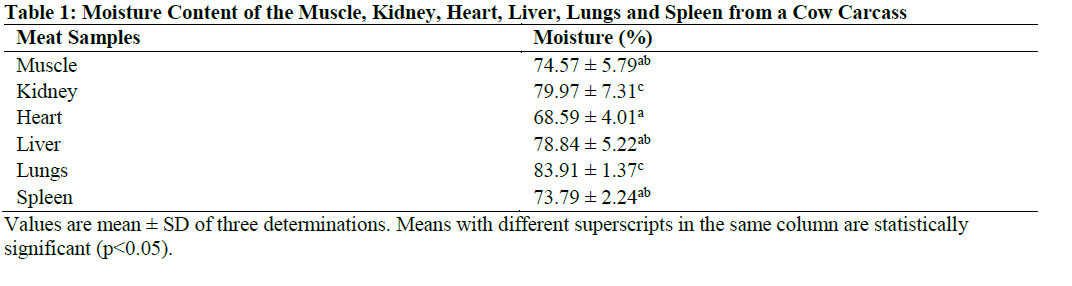
Iron is an essential micronutrient for all animal species, and its deficiency causes fatigue, poor growth, impaired cognition, and anaemia. The World Health Organization (WHO) estimates that anaemia affects approximately 30% of the global population, with iron deficiency as the primary cause. This work sought to provide data on the protein, iron and moisture content of the muscle and organ meats of a cow carcass, using atomic absorption spectrometry (AAS) to determine non-haem iron and spectrophotometry to determine haem iron. Results showed that the lungs exhibited the highest moisture content (83.91 ± 1.37 %) while the spleen had the lowest (73.79 ± 2.24 %), with a statistically significant difference (p<0.05). Muscle meat exhibited the highest crude protein (18.63 ± 1.06 %), followed by spleen (18.51 ± 0.91 %) and liver (17.26 ± 0.73 %); kidney demonstrated the lowest (13.99 ± 1.09 %), with lungs and heart showing similarly low levels (p>0.05). The spleen had the highest haem iron (247.53 ± 5.91 µg haematin/g meat) and non-haem iron (586.07 ± 22.31 mg/kg), with significant differences (p<0.05). The heart demonstrated the lowest haem iron (128.95 ± 8.10 µg haematin/g meat), closely followed by lungs (132.61 ± 4.16 µg haematin/g meat), with no significant difference (p>0.05), while the kidney had the lowest non-haem iron (117.87 ± 6.96 mg/kg), (p<0.05). Conclusively, both muscle and organ meats (liver, spleen) are rich in protein, while iron contents were higher in the organs (spleen, liver), with the spleen being significantly (p<0.05) higher.
References
Biel, W., Czerniawska-Piątkowska, E., & Kowalczyk, A. (2019). Offal chemical composition from veal, beef, and lamb maintained in organic production systems. Animals, 9(8), Article 489. https://doi.org/10.3390/ani9080489
FAO (Food and Agriculture Organization of the United Nations). (2018). Dietary assessment: A resource guide to method selection and application in low resource settings. FAO, Rome. https://www.fao.org/3/i9940en/I9940EN.pdf
Geissler, C. and Singh, M. (2011). Iron, meat and health. Nutrients, 3(3), 283–316. https://doi.org/10.3390/nu3030283
Hoffman, L. C., Laubscher, L. L., & Leisegang, K. (2013). Nutritional value of cooked offal derived from free-range rams reared in South Africa. Meat Science, 93(3), 696–702. https://doi.org/10.1016/j.meatsci.2012.11.041
Klei, T. R. L., Meinderts, S. M., van den Berg, T. K. and van Bruggen, R. (2021). From the cradle to the grave: The role of macrophages in erythropoiesis and erythrophagocytosis. Frontiers in Immunology, 8, 73. https://doi.org/10.3389/fimmu.2017.00073
Listrat, A., Lebret, B., Louveau, I., Astruc, T., Bonnet, M., Lefaucheur, L., Picard, B. and Bugeon, J. (2016). How muscle structure and composition influence meat and flesh quality. The Scientific World Journal, 2016, 3182746. https://doi.org/10.1155/2016/3182746
Lombardi-Boccia, G., Martinez-Dominguez, B. and Aguzzi, A. (2002). Total haem and non-haem iron in raw and cooked meats. Journal of Food Science, 67(5), 1738–1741. https://doi.org/10.1111/j.1365-2621.2002.tb08715.x
McAfee, A. J., McSorley, E. M., Cuskelly, G. J., Moss, B. W., Wallace, J. M. W., Bonham, M. P. and Fearon, A. M. (2010). Red meat consumption: An overview of the risks and benefits. Meat Science, 84(1), 1–13. https://doi.org/10.1016/j.meatsci.2009.08.029
Moustarah, F., and Daley, S. F. (2024). Dietary Iron(Archived). In StatPearls. StatPearls Publishing. https://pubmed.ncbi.nlm.nih.gov/31082013/
Mwangi, M. N., Mzembe, G., Moya, E. and Verhoef, H. (2021). Iron deficiency anaemia in sub-Saharan Africa: A review of current evidence and primary care recommendations for high-risk groups. The Lancet Haematology, 8(10), e732–e743. https://doi.org/10.1016/S2352-3026(21)00193-9
Pereira, P. C. (2013). Meat nutritional composition and nutritive role in the human diet. Meat Science, 93(3), 586–592. https://doi.org/10.1016/j.meatsci.2012.09.018
Ponnampalam, E. N., Hopkins, D. L., Bruce, H., Li, D., Baldi, G. and Bekhit, A. E. D. (2017). Causes and contributing factors to "dark cutting" meat: Current trends and future directions: A review. Comprehensive Reviews in Food Science and Food Safety, 16(3), 400–430. https://doi.org/10.1111/1541-4337.12258
Pretorius, B., Schönfeldt, H. C. and Hall, N. (2016). Total and haem iron content lean meat cuts and the contribution to the diet. Food Chemistry, 193, 97–101. https://doi.org/10.1016/j.foodchem.2015.02.109
Valenzuela, C., López de Romaña, D., Olivares, M., Morales, M. and Pizarro, F. (2009). Total iron and haem iron content and their distribution in beef meat and viscera. Biological Trace Element Research, 132(1–3), 103–111. https://doi.org/10.1007/s12011-009-8400-3
Van Raaij, S. E. G., Rennings, A. J., Bos, C., Engelse, M. A., Rabelink, T. J., Wetzels, J. F. M., Bikker, H., Hoenderop, J. G. J., de Baaij, J. H. F., Nijenhuis, T. and van Swelm, R. P. L. (2019). Iron handling by the human kidney: Glomerular filtration and tubular reabsorption both contribute to urinary iron excretion. American Journal of Physiology-Renal Physiology, 316(4), F606–F614. https://doi.org/10.1152/ajprenal.00425.2018
World Health Organization (WHO). (2001). Iron deficiency anaemia: Assessment, prevention and control. World Health Organization, Geneva. https://www.who.int/publications/m/item/iron-children-6to23--archived-iron-deficiency-anaemia-assessment-prevention-and-control
Downloads
Published
Issue
Section
Categories
License
Copyright (c) 2026 Ijeoma Okolo, Muhammad S. Shehu, Adeyemi O. Owolabi, Nasihatu Abubakar

This work is licensed under a Creative Commons Attribution 4.0 International License.


