
THE EFFECT OF FLOOD ON THE SOCIO-ECONOMIC ACTIVITIES ON RESIDENT OF ASABA, DELTA STATE
DOI:
https://doi.org/10.33003/Keywords:
Flooding, Urban Planning, Socio-Economic Activities, Drainage Infrastructure, Flood Risk Management, Urban Resilience, Disaster Risk Reduction, Asaba, Floodplain Encroachment, NigeriaAbstract
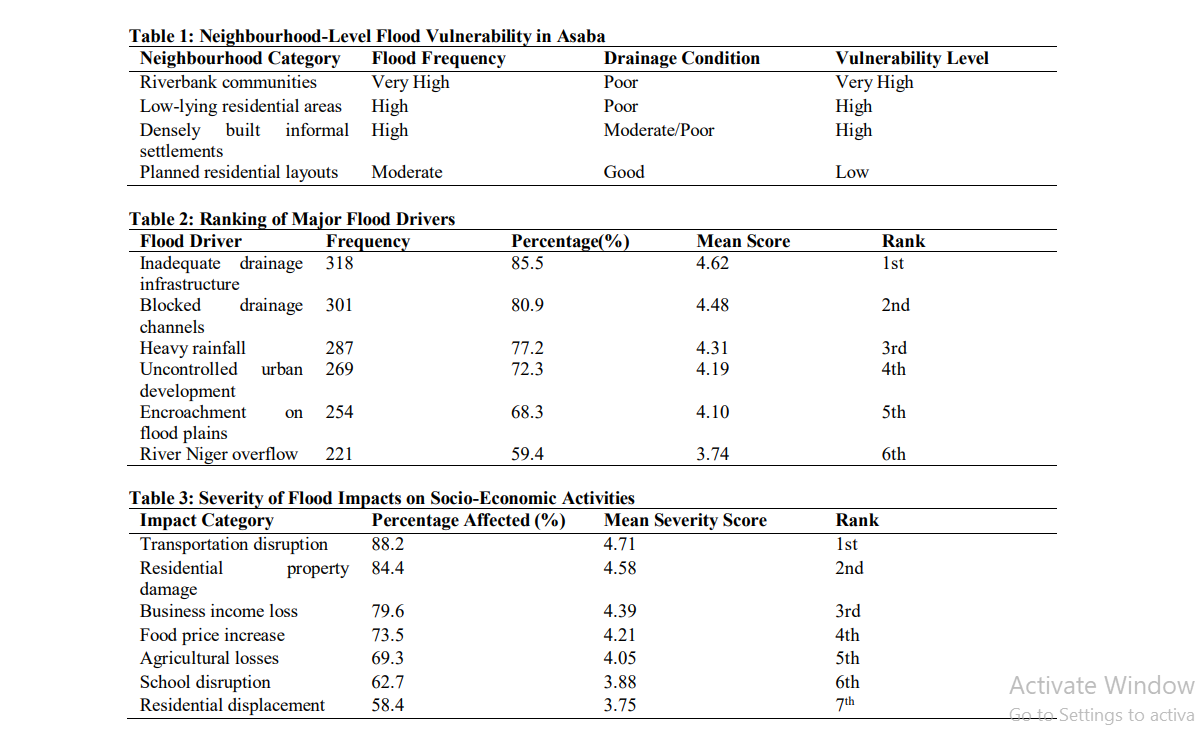
Flooding has become a recurrent environmental and urban planning challenge in Asaba, Delta State, Nigeria, with significant implications for socio-economic activities and urban sustainability. This study examined the effects of flooding on socio-economic activities in Asaba with particular emphasis on drainage deficiencies, blocked waterways, weak planning enforcement, and floodplain encroachment. A mixed-method research design was adopted using questionnaires, interviews, and field observations. A total of 400 questionnaires were distributed across flood-prone communities, while 372 valid responses were retrieved and analyzed using descriptive statistics and thematic analysis. Findings revealed that 84.1% of respondents experienced flooding annually, while 85.5% identified inadequate drainage infrastructure as the major cause of flooding. Other significant drivers included blocked drainage channels (80.9%), uncontrolled urban development (72.3%), and floodplain encroachment (68.3%). The study further showed that flooding severely disrupts transportation (88.2%), damages residential properties (84.4%), reduces business income (79.6%), affects agricultural production (69.3%), and contributes to temporary displacement and school disruption. Spatial evidence indicated that riverbank and low-lying communities were the most vulnerable due to poor drainage connectivity and weak development control. The study concludes that flooding in Asaba is not only a climatic issue but also a consequence of inadequate urban planning and infrastructure management. The study recommends prioritizing drainage rehabilitation, strengthening waste management systems, enforcing floodplain-sensitive development regulations, improving early warning compliance, and enhancing institutional coordination for effective urban flood risk management and sustainable urban resilience in Asaba.
References
Acheampong, R. A. (2019). Urban planning, climate change and flood risk management in African cities. Journal of Urban Management, 8(2), 145–156.
Cirella, G. T., & Iyalomhe, F. O. (2018). Flooding and urban planning challenges in Nigeria: Implications for sustainable development. Environmental Development, 28, 1–13.
Eleke, J. (2022). Nigeria floods: Over 600 killed and 1.3 million displaced. The Guardian Nigeria. Retrieved from https://guardian.ng
Okoye, C. O. (2019). Urban flooding and environmental management in Nigerian cities. International Journal of Environmental Studies, 76(4), 563–578.
Onuorah, A. (2022). Flood disaster and socio-economic vulnerability in Nigeria. Journal of Environmental Hazards, 21(3), 233–248.
Reuters. (2012). Nigeria floods destroy homes and displace thousands. Retrieved from https://www.reuters.com
United Nations Office for Disaster Risk Reduction (UNDRR). (2015). Sendai framework for disaster risk reduction 2015–2030. Geneva: United Nations.
World Bank. (2021). Climate risk and urban resilience in Sub-Saharan Africa. Washington, DC: World Bank.
Adelekan, I. O. (2016). Flood risk management in the coastal city of Lagos, Nigeria. Journal of Flood Risk Management, 9(3), 255–264.
Aderogba, K. A. (2012). Qualitative studies of recent floods and sustainable growth and development of cities and towns in Nigeria. International Journal of Academic Research in Economics and Management Sciences, 1(3), 1–25.
Nkwunonwo, U. C., Whitworth, M., & Baily, B. (2016). A review of the current status of flood risk management in Nigeria. Journal of Environmental Management, 173, 157–171.
Olanrewaju, C. C., Chitakira, M., Olanrewaju, O. A., & Louw, E. (2019). Impacts of flood disasters in Nigeria: A critical evaluation of health implications and management. Jàmbá: Journal of Disaster Risk Studies, 11(1), 1–9.
Oriola, E. O. (2013). Strategies for combating urban flooding in a developing nation: A case study from Ondo, Nigeria. The Environmentalist, 33(3), 247–256.
Downloads
Published
Issue
Section
Categories
License
Copyright (c) 2026 Onyinyechi Egbuna, Ewa Raymond Eyare

This work is licensed under a Creative Commons Attribution 4.0 International License.