
AN EXPLORATORY POST-OCCUPANCY ASSESSMENT OF SMART BUILDING TECHNOLOGIES IN OWNER-OCCUPIED HOUSING IN A DEVELOPING URBAN CONTEXT
DOI:
https://doi.org/10.33003/fjs-2026-1008-5280Keywords:
Smart home technologies, post-occupancy performance, retrofit adoption, energy perception, user satisfaction, smart system integrationAbstract
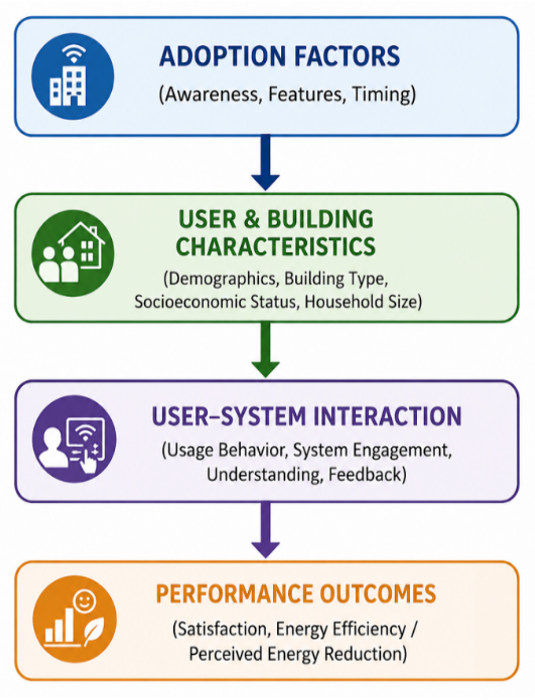
This study examined the awareness, adoption patterns, and post-occupancy performance of smart home technologies in owner-occupied residential buildings. A questionnaire survey was administered to 68 homeowners, and the data were analyzed using descriptive and inferential statistical methods, including frequency distribution, chi-square analysis, and ANOVA. The findings revealed relatively high awareness of smart home technologies, with 67.6% of respondents indicating prior knowledge of smart homes. However, awareness of specific smart features varied considerably, suggesting uneven technical understanding of integrated smart systems. Smart technology adoption was predominantly retrofit-based, with 62.0% of installations introduced after occupancy rather than during the design or construction stages. This indicates limited incorporation of smart infrastructure considerations during initial building development. User satisfaction with installed smart systems was generally high, as 82.2% of respondents reported being satisfied or very satisfied with their systems. In contrast, perceptions regarding energy reduction were more varied: only 35.0% reported significant or very significant energy savings, while 21.7% perceived no reduction in energy consumption. This divergence suggests that homeowners may value smart technologies more for convenience, security, automation, and improved occupant interaction than for demonstrable energy-efficiency outcomes. Inferential analysis revealed no statistically significant relationship between educational qualification and timing of smart technology adoption, nor between building type and perceived energy reduction. The study concludes that smart home adoption is driven more by user experience and convenience than verified energy-performance outcomes, highlighting the need for better system integration and design-stage planning. Future studies should incorporate objective post-occupancy energy data to complement perception-based assessments.
References
Adekunte, P. A., Sadiku, M. N. O., & Sadiku, J. O. (2025). Smart building. International Journal of Trend in Scientific Research and Development.
Froufe, M. M., Chinelli, C. K., Guedes, A. L. A., Haddad, A. N., Hammad, A. W. A., & Soares, C. A. P. (2020). Smart buildings: Systems and drivers. Buildings, 10(9), 153. Doi: https://doi.org/10.3390/buildings10090153
Ghansah, F. A., Owusu-Manu, D. G., Ayarkwa, J., Edwards, D. J., & Hosseini, M. R. (2021). Exploration of latent barriers inhibiting project management processes in adopting smart building technologies (SBTs) in developing countries. Construction Innovation, 21(4), 685-707. Doi: https://doi.org/10.1108/CI-07-2020-0116
Ibem, E. O., Opoko, A. P., Adeboye, A. B., & Amole, D. (2013). Performance evaluation of residential buildings in public housing estates in Ogun State, Nigeria: Users’ satisfaction perspective. Frontiers of Architectural Research, 2(2), 178–190. Doi: https://doi.org/10.1016/j.foar.2013.02.001
Indrawati, A., Yuliastri, R., & Amani, H. (2017). Indicators to measure a smart building: An Indonesian perspective. International Journal of Computer Theory and Engineering, 9(6), 406–411. Doi: https://doi.org/10.7763/IJCTE.2017.V9.1168
Jiboye, A. D. (2012). Post-occupancy evaluation of residential satisfaction in Lagos, Nigeria: Feedback for residential improvement. Frontiers of Architectural Research, 1(3), 236–243. Doi: https://doi.org/10.1016/j.foar.2012.08.001
Johnny, A. E., Effiong, A. I., & Sheik, I. (2020). Entrepreneurship development centre in Nigeria’s tertiary institutions and students’ self-employment upon graduation. American Journal of Social and Humanitarian Research, 1(4), 1–13. Doi: https://doi.org/10.31150/ajshr.v1i4.129
Kennedy, G. W., Akpan, I. M., & Kabari, A. D. (2024). Evaluation of architecture, engineering and construction professionals’ adoption of smart building practices from conceptualization to construction in Abuja, Nigeria. International Journal of Engineering and Modern Technology, 10(2), 131–146.
Li, Z., Zhang, J., Li, M., Huang, J., & Wang, X. (2020). A review of smart design based on interactive experience in building systems. Sustainability, 12(17), 6760. Doi: https://doi.org/10.3390/su12176760
Nkpiete, B. S., & Esau, J. (2021). Appraising elements of post-occupancy evaluation influencing residential satisfaction in Nigeria. Asian Journal of Social Science and Management Technology, 3(5), 55–64.
Nubi, T. G., & Adegbemile, T. (2007). Post occupancy evaluation (POE) as a tool for quality assessment of housing in Nigeria: Case study of selected LSDPC estates. The Quantity Surveyor, 54, 19–28.
Nworgu, B. G. (2015). Educational research: Basic issues and methodology (3rd ed.). Wisdom Publishers.
Olawumi, T. O., & Chan, D. W. M. (2020). Key drivers for smart and sustainable practices in the built environment. Engineering, Construction and Architectural Management, 27(6), 1257–1281. Doi: https://doi.org/10.1108/ECAM-09-2019-0463
Owusu-Manu, D. G., Ghansah, F. A., Ayarkwa, J., Edwards, D. J., & Hosseini, M. R. (2021). Factors influencing the decision to adopt smart building technology (SBT) in developing countries. African Journal of Science, Technology, Innovation and Development, 13(6), 749–759. Doi: https://doi.org/10.1080/20421338.2021.1899761
Shen, L., Zhang, Z., & Long, Z. (2017). Significant barriers to green procurement in real estate development. Resources, Conservation and Recycling, 116, 160–168. Doi: https://doi.org/10.1016/j.resconrec.2016.10.004
Downloads
Published
Issue
Section
Categories
License
Copyright (c) 2026 Precious Juliet Ugochukwu, Joseph Ojoma Edicha, Ferdinand Ozemoya Inobeme

This work is licensed under a Creative Commons Attribution 4.0 International License.


