
EVALUATION OF THE EFFECTIVENESS OF LOCAL CLAY FOR USE AS WATER-BASED DRILLING MUD (A CASE STUDY OF AMAI IN UKWUANI L.G.A, DELTA STATE)
DOI:
https://doi.org/10.33003/Keywords:
Plastic Viscosity (PV), Apparent Viscosity (AV), Yield Point, Fann viscometerAbstract
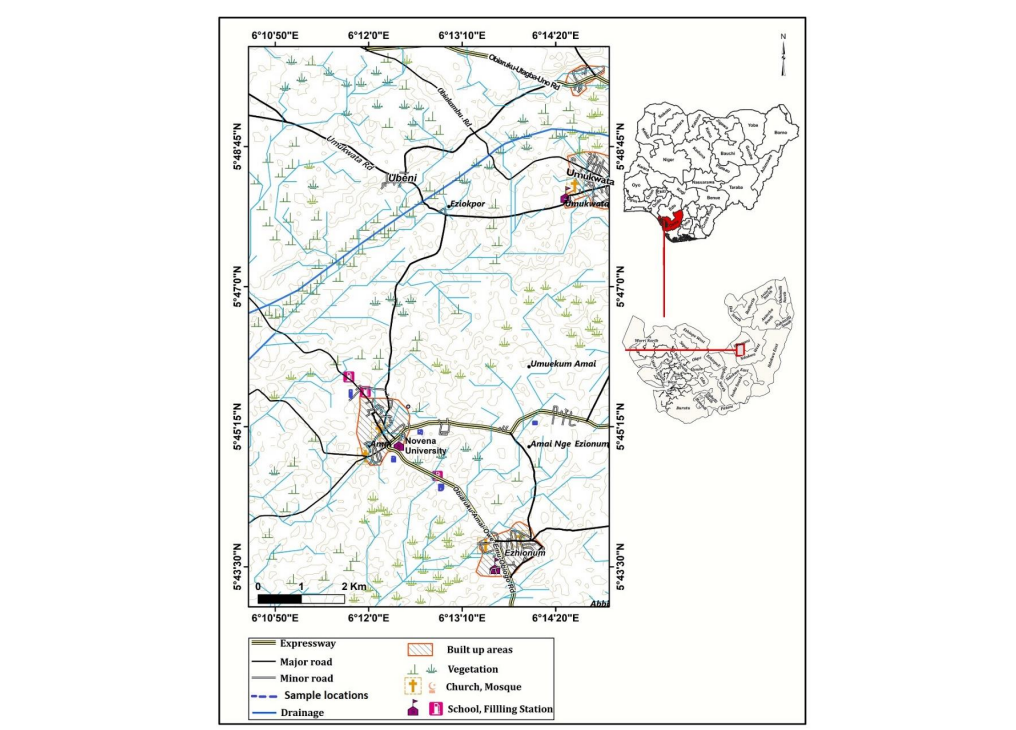
This study evaluates the effectiveness of clay deposits from Amai-Nge and Umubu communities in Ukwuani Local Government Area, Delta State, Nigeria, for application in water-based drilling mud systems as potential alternatives to imported bentonite. Clay samples were processed and formulated into drilling fluids, while rheological and filtration properties were determined according to API recommended practice (API RP-13B). Initial characterization of raw clays showed inferior performance relative to commercial bentonite, with Amai and Umubu samples exhibiting low plastic viscosity (1–2 cP), low apparent viscosity (4.5–5.0 cP), and acidic pH values of 5.77–6.14 compared with bentonite values of 8 cP, 13 cP, and pH 10.0, respectively. Following beneficiation using sodium carbonate (Na₂CO₃) and barite (BaSO₄), significant improvements were observed. Beneficiated Umubu clay demonstrated plastic viscosity of 5 cP (150% increase), apparent viscosity of 15 cP (200% increase), and yield point of 20 lb/100 ft² (233% increase), surpassing commercial bentonite by approximately 15.4% in apparent viscosity and 81.8% in yield point. pH increased from 6.14 to 10.05, achieving API-compliant alkaline conditions, while filter cake thickness (1.05 mm) remained within acceptable API limits. The Amai clay showed moderate enhancement but remained below commercial performance levels. The results demonstrate that with proper beneficiation, Umubu clay can serve as a cost-effective substitute for imported bentonite in water-based drilling fluid systems.
References
Adegoke, O. S., Oyebamiji, A. S., Edet, J. J., Osterloff, P. L., and Ulu, O. K. (2017). Cenozoic foraminifera and calcareous nannofossil biostratigraphy of the Niger Delta. Elsevier, Amsterdam, 18(3), 25-66
Aigbedion, I. (2007). Geology of clays in Nigeria. Nigerian Journal of Applied Science, 15(2), 45–58.
Amadi, A. N., (2020). Evaluation of local clay for drilling mud applications. Nigerian Journal of Engineering Research, 18(1), 33–41.
American Petroleum Institute (API), (1993), “Recommended Practice for Field Testing Water Based Drilling Fluid,” 13A, 7- 28.
Annudeep, S.D. (2012). “Rheological properties & corrosion characteristics of drilling mud additives”, Dalhousie University Halifax, Nova Scotia.
Apogu-Nwosu, T.U, Mohammed-Dabo, I.A., Ahmed, A.S., Abubakar, G., Alkali, A.S. and Ayilara, S.I. (2011) Studies on the suitability of Ubakala bentonitic clay for oil well drilling mud formulation. Br J Appl Sci Technol 1:152–171
Chinyem F.I., Abriku E.O., Ovwamuedo G.O., Salami S.A., Igili C.O., Nwugha V.N., & Osieke J.O. (2026). Hydrogeophysical Investigation of Groundwater Potential, Lithological Strata and Aquifer Vulnerability in Parts of Delta North District, Nigeria. FUDMA Journal of Sciences. 10(2); 375 – 389 DOI: https://doi.org/10.33003/fjs-2026-1002-4482
Doust, H. & Omatsola, E. (1990). Niger Delta. In: Edwards, J. D. and Santogrossi, P. A. (Eds.), Divergent /Passive Margin Basins. AAPG Memoir 48, 201-238.
Igbalajobi, A. O. (2013). Characterization of Nigerian clays for drilling mud. Journal of Mining and Geology, 49(1), 71–79.
Igili, C.O. and Ndubueze, O.V. (2024). Diagenetic Quality, Extent of Altration and Preservation of Organic Matter of Wells A and B in Niger Delta Basin, Nigeria. J. Appl. Sci. Environ. Manage. 28 (11) 3513-3518
Ogala, J. E. (2012). Geochemistry of lignite from the Ogwashi-Asaba Formation, Niger Delta Basin, southern Nigeria. Earth Sciences Research Journal, 16(2), 1–12.
Okon, A. N. and Samuel, O. D. (2014). Influence of beneficiation on drilling mud properties. Journal of Energy Studies, 5(1), 20–29. API. (2010). Recommended Practice 13B-1: Field Testing Water-Based Drilling Fluids. American Petroleum Institute.
Olatunde, A. O (2011). Performance of local clay in drilling mud formulation. SPE Nigeria Annual Conference.
Osokpor, J, Ekwere and U.J, Otele, A (2019): Paleoclimatic cycles, sea level history and sequence stratigraphic elements in Eocene– Oligocene sediments of BIMOL-1 Well Northern Niger Delta Basin, Nigeria. Journal of Applied Science and Environmental. Management 23(2): 241-248.
Reijers, T.J.A (2011): Stratigraphy and sedimentology of the Niger Delta. Geologos. 17(3): 133-162.
Reijers, T.J.A, (1996): Selected chapters in geology: sedimentary geology and sequence stratigraphy in Nigeria and three case studies and field guide, Shell Petroleum Development Company, Nigeria: 197.
Saugy, L and Eyer J.A (2003): Fifty years of exploration in the Niger Delta (West Africa). In: Halbouty, MT (Ed) Giant Oil and Gas Fields of the Decade 1990–1999. AAPG Bulletin, 78: 211-226.
Short K. C. and Stauble A. J. (1967): Outline of Geology of Nigeria. American Association of Petroleum Geology v. 51, 761-791 Traverse, A (1988): Palaeopalynology. Unwin Hyman, London. 1-600.
Tuttle, M. L. W., Charpentier R. R. and Brownfield M. E. (1999): The Niger delta Petroleum system: Niger Delta province, Nigeria, Cameroon, and Equatorial Guinea, Africa: United States Geologic Survey. United States Geologic Survey.
Downloads
Published
Issue
Section
Categories
License
Copyright (c) 2026 Chinedu Igili, John Okonkwo, Emofe Ogbimi, Felix Chinyem, Ezekiel Enebrayekedou

This work is licensed under a Creative Commons Attribution 4.0 International License.


