
PREVALENCE OF ZOONOTIC GASTROINTESTINAL HELMINTHS IN DOGS AND KNOWLEDGE OF RESIDENTS REGARDING GASTROINTESTINAL HELMINTHS IN NORTH BANK, MAKURDI
DOI:
https://doi.org/10.33003/fjs-2026-1008-5104Keywords:
Zoonotic Helminths, Gastrointestinal Helminths, Dogs, Makurdi, NigeriaAbstract
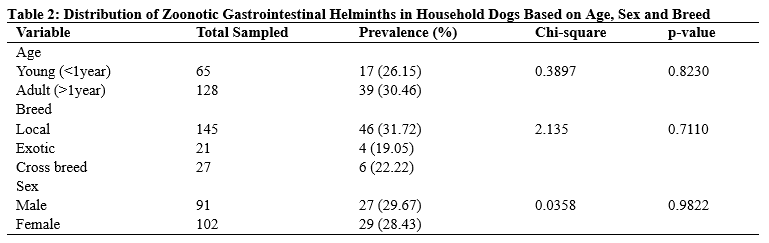
Zoonotic gastrointestinal helminths (GIH) of dogs remain an important public health concern in developing countries due to poor sanitation, inadequate veterinary care, and increasing stray dog populations. This study assessed the prevalence of GIH among 384 dogs (193 household; 191stray) using saturated sodium chloride flotation and sedimentation techniques. Additionally, 116 dog owners were surveyed using structured questionnaires to evaluate their knowledge and preventive practices related to zoonotic GIH. Data was analyzed using descriptive statistics and Chi-square tests at a significance level of p < 0.05. Overall prevalence of GIH was 30.75%, with stray dogs (32.46%) slightly exceeding household dogs (29.02%). Six genera were identified: Ancylostoma spp. (13.02%), Toxocara spp. (10.94%), Dipylidium spp. (3.39%), Strongyloides spp. (2.34%), Echinococcus spp. (0.52%), and Trichuris spp. (0.52%). Ancylostoma spp. was more prevalent among strays, whereas Toxocara spp. predominated among household dogs. While age, sex and breed showed no significant associations with infection (p > 0.05), prevalence was significantly influenced by location and month of sampling; Ujam village (χ² = 23.46, p =0.0028) and month of June (χ² = 35.70, p = 0.0001) recorded the highest rates. Questionnaire survey findings indicated moderate awareness of zoonoses, yet revealed critical gaps regarding transmission routes and preventive practices. The study demonstrates that dogs in North Bank, Makurdi are important reservoirs of zoonotic GIH, posing substantial public health risks through environmental contamination. To mitigate these risks and protect the community, an integrated approach is recommended; routine deworming, improved environmental sanitation, public health campaigns, and responsible dog ownership.
References
Abulude, O. A. (2019). Prevalence of intestinal helminth infections of stray dogs of public health significance in Lagos metropolis, Nigeria. International Annals of Science, 9(1), 24–32. Doi: https://doi.org/10.21467/ias.9.1.24-32
Ademola, O. O., Salami, O. T., & Adewale, A. A. (2021). Knowledge, attitude, and practices of dog owners regarding canine zoonoses in peri-urban communities. Journal of Preventive Medicine and Hygiene, 62(2), E415–E422. Doi: https://doi.org/10.15167/2421-4248/jpmh2021.62.2.1890
Adesoye, O. A., Olanrewaju, C. A., Ameh, U. C., Malann, Y. D., Akinleye, C. A., Akinsete, I. O., Adeniyi, K. A., & Oyeniran, O. A. (2024). Prevalence of gastrointestinal parasites of stray dogs in Suleja metropolis, Niger State, Nigeria. Sahel Journal of Life Sciences FUDMA, 2(4), 8–14. Doi: https://doi.org/10.33003/sajols-2024-0204-02
Adhikari, S., Regmi, S., & Pathak, C. (2025). Prevalence of zoonotic gastrointestinal helminths among pet dogs in Western Chitwan, Nepal. Journal of Parasitology Research, 2025. Doi: https://doi.org/10.1155/japr/9982123
Adimanyi, C., & Omudu, E. (2016). Prevalence of gastro-intestinal helminths of faeces from indoor and stray dogs in Makurdi, Nigeria. Nigerian Journal of Parasitology, 37, 23–27. Doi: https://doi.org/10.4314/njpar.v37i1.5
Akande, F. A., Obisesan, O. M., Adeniji, S. D., & Adelakun, D. O. (2022). Detection and identification of gastrointestinal parasites in dogs presented to veterinary clinics in Abeokuta, South-western Nigeria. Sokoto Journal of Veterinary Sciences, 20(1), 19–25. Doi: https://doi.org/10.4314/sokjvs.v20i1.3
Amadi, A., Obeten, P., & Chukwuemeka, B. (2021). Prevalence of helminths parasites among dogs and risk factors of zoonotic infections by dog owners in Bende Local Government Area, Abia State, Nigeria. Nigerian Journal of Parasitology. Doi: https://doi.org/10.4314/njpar.v42i2.12
Amim-Acheampong, J., Kwakye-Nuako, G., Mensah, P., & Asmah, R. H. (2016). Prevalence of helminths in dogs and owners’ awareness of zoonotic diseases in Mampong, Ashanti, Ghana. Journal of Parasitology Research, 2016, Article 4752992. Doi: https://doi.org/10.1155/2016/4752992
Amissah-Reynolds, P., Monney, I., Adowah, L., & Agyemang, S. (2016). Prevalence of helminths in dogs and owners' awareness of zoonotic diseases in Mampong, Ashanti, Ghana. Journal of Parasitology Research, 2016. Doi: https://doi.org/10.1155/2016/1715924
Awoyomi, O. J., Sanni, T. O., & Kehinde, O. O. (2022). Public health implications of canine feces management: Assessing the gap between rabies awareness and gastrointestinal parasite literacy among urban dog owners. Nigerian Veterinary Journal, 43(1), 12–25. Doi: https://doi.org/10.4314/nvj.v43i1.2
Ayinmode, A. B., Obebe, O. O., & Olayemi, E. (2016). Prevalence of potentially zoonotic gastrointestinal parasites in canine faeces in Ibadan, Nigeria. Ghana Medical Journal, 50(4), 201. Doi: https://doi.org/10.4314/gmj.v50i4.2
Bayou, K. (2005). Standard veterinary laboratory diagnostic manual: Vol. 1 – Parasitology. Ethiopian Agricultural Research Organization, National Animal Health Research Centre (NAHRC).
Beiromvand, M., Akhlaghi, L., Fattahi Massom, S. H., Meamar, A. R., Motevalian, A., Oormazdi, H., & Razmjou, E. (2013). Prevalence of zoonotic intestinal parasites in domestic and stray dogs in a rural area of Iran. Preventive Veterinary Medicine, 109(1–2), 162–167. Doi: https://doi.org/10.1016/j.prevetmed.2012.09.009
Bourgoin, G., Callait-Cardinal, M., Bouhsira, É., Polack, B., Bourdeau, P., Ariza, C., Carassou, L., Liénard, E., & Drake, J. (2022). Prevalence of major digestive and respiratory helminths in dogs and cats in France: Results of a multicenter study. Parasites & Vectors, 15. Doi: https://doi.org/10.1186/s13071-022-05368-7
Burke, T. M., & Roberson, E. L. (1985). Prenatal and lactational transmission of Toxocara canis and Ancylostoma caninum: Experimental infection of the bitch before pregnancy. International Journal for Parasitology, 15(1), 71–75. Doi: https://doi.org/10.1016/0020-7519(85)90013-1
Calvopiña, M., Cabezas-Moreno, M., Cisneros-Vásquez, E., Paredes-Betancourt, I., & Bastidas-Caldes, C. (2023). Diversity and prevalence of gastrointestinal helminths of free-roaming dogs on coastal beaches in Ecuador: Potential for zoonotic transmission. Veterinary Parasitology: Regional Studies and Reports, 40, 100859. Doi: https://doi.org/10.1016/j.vprsr.2023.100859
Chidumayo, N. (2018). Epidemiology of canine gastrointestinal helminths in sub-Saharan Africa. Parasites & Vectors, 11. Doi: https://doi.org/10.1186/s13071-018-2688-9
Dawet, A., Benjamin, C., & Yakubu, D. P. (2020). Prevalence, seasonal and geographical distribution of parasitic diseases in dogs in Plateau State Nigeria: a 30-year retrospective study. Scientific African, 9, e00511
de Waal, T., Aungier, S., Lawlor, A., Goddu, T., Jones, M., & Szlosek, D. (2022). Retrospective Survey of Dog and Cat Endoparasites in Ireland: Antigen Detection. Animals, 13(1), 137. Doi: https://doi.org/10.3390/ani13010137
Drake, J., Sweet, S., Baxendale, K., Hegarty, E., Horr, S., Friis, H., Goddu, T., Ryan, W., & Von Samson-Himmelstjerna, G. (2022). Detection of Giardia and helminths in Western Europe at local K9 (canine) sites (DOGWALKS Study). Parasites & Vectors, 15. Doi: https://doi.org/10.1186/s13071-022-05440-2.
Edo-Taiwo, O., & Akpan-Augustine, F. (2024). Prevalence of gastrointestinal parasites in different dog breeds from selected areas in Ovia North East LGA, Edo state, Nigeria. African Journal of Health, Safety and Environment, 5(2), 48–56. Doi: https://doi.org/10.52417/ajhse.v5i2.524
Esonu, D. O., Ibrahim, M. D., Otolorin, G. R., Per, M. F., & Esonu, M. C. (2019). Prevalence of gastrointestinal helminthes eggs of public health importance in house-hold dogs presented to the Veterinary Teaching Hospital Ahmadu Bello University, Zaria, Kaduna State. Nigerian Veterinary Journal, 40(3), 211. Doi: https://doi.org/10.4314/nvj.v40i3.5
Gado, D. A., Ehizibolo, D. O., Meseko, C. A., Anderson, N. E., & Lurz, P. W. W. (2023). Review of Emerging and Re-Emerging Zoonotic Pathogens of Dogs in Nigeria: Missing Link in One Health Approach. Zoonotic Diseases, 3(2), 134–161. Doi: https://doi.org/10.3390/zoonoticdis3020012
Idika, I. K., Onuorah, E. C., Obi, C. F., Umeakuana, P. U., Nwosu, C. O., Onah, D. N., & Chiejina, S. N. (2017). Prevalence of gastrointestinal helminth infections of dog in Enugu State, South Eastern Nigeria. Parasite Epidemiology and Control, 2(3), 97–104. Doi: https://doi.org/10.1016/j.parepi.2017.05.004
Ikye-Tor P. M., Kwaga J. K., Kia G. S. N., Umoh J. U. and Ikye-Tor T. J. (2020). Retrospective study of dog bites and cases of rabies virus infected dogs in slaughter houses in Makurdi, Nigeria. Sokoto Journal of Veterinary Sciences, 18: 18-26.
Jajere, S. M., Lawal, J. R., Shittu, A., Waziri, I., Goni, D. M., & Fasina, F. O. (2022). Epidemiological study of gastrointestinal helminths among dogs from Northeastern Nigeria: A potential public health concern. Parasitology Research, 121(7), 2179–2186. Doi: https://doi.org/10.1007/s00436-022-07538-z
Jones, E. H., Hinckley, A. F., Hook, S. A., Meek, J. I., Backenson, B., Kugeler, K. J., & Feldman, K. A. (2018). Pet ownership increases human risk of encountering ticks. Zoonoses and Public Health, 65(1), 74–79. Doi: https://doi.org/10.1111/zph.12429
Kamani, J., Massetti, L., Olubade, T., Balami, J. A., Samdi, K. M., Traub, R. J., Colella, V., & González-Miguel, J. (2021). Canine gastrointestinal parasites as a potential source of zoonotic infections in Nigeria: A nationwide survey. Preventive Veterinary Medicine, 192, 105385. Doi: https://doi.org/10.1016/j.prevetmed.2021.105385
Katagiri, S., & Oliveira‐Sequeira, T. C. G. (2008). Prevalence of Dog Intestinal Parasites and Risk Perception of Zoonotic Infection by Dog Owners in São Paulo State, Brazil. Zoonoses and Public Health, 55(8–10), 406–413. Doi: https://doi.org/10.1111/j.1863-2378.2008.01163.x
Khalifa, M. M., Fouad, E. A., Kamel, N. O., Auda, H. M., El-Bahy, M. M., & Ramadan, R. M. (2023). Dogs as a source for the spreading of enteric parasites including zoonotic ones in Giza Province, Egypt. Research in Veterinary Science, 161, 122–131. Doi: https://doi.org/10.1016/j.rvsc.2023.06.015
Khan, W., Nisa, N. N., Ullah, S., Ahmad, S., Mehmood, S. A., Khan, M., Ahmad, S., Ali, W., Ullah, H., & Anwar, K. (2020). Gastrointestinal helminths in dog feces surrounding suburban areas of Lower Dir district, Pakistan: A public health threat. Brazilian Journal of Biology, 80(3), 511–517. Doi: https://doi.org/10.1590/1519-6984.211956
Kim, M. K., Pyo, K. H., Hwang, Y. S., Park, K. H., Hwang, I. G., Chai, J. Y., & Shin, E. H. (2012). Effect of temperature on embryonation of Ascaris suum eggs in an environmental chamber. Parasites, Hosts and Diseases, 50(3), 239–242.
La Torre, F., Di Cesare, A., Simonato, G., Cassini, R., Traversa, D., & Di Regalbono, F. (2018). Prevalence of zoonotic helminths in Italian house dogs. Journal of infection in developing countries, 12 8, 666-672. Doi: https://doi.org/10.3855/jidc.9865.
Lawal, J. (2023). Prevalence, public health importance and risk factors associated with gastrointestinal helminths of domesticated canines (Canis familiaris) from Yobe State, Nigeria. Arid Zone Journal of Basic and Applied Research. Doi: https://doi.org/10.55639/607.151400
Miambo, R., Afonso, S., Noormahomed, E., Tamponi, C., Varcasia, A., Dessì, G., Benson, C., Bickler, S., Schooley, R., & Mukaratirwa, S. (2025). Knowledge, attitudes, and perception of dog owners on the transmission, control and prevention of cystic echinococcosis and other gastrointestinal parasites in dogs of southern provinces of Mozambique. BMC Veterinary Research, 21. Doi: https://doi.org/10.1186/s12917-025-04639-6
Millán, J., Chirife, A. D., Kalema-Zikusoka, G., Cabezón, O., Muro, J., Marco, I., Cliquet, F., León-Vizcaíno, L., Wasniewski, M., Almería, S., and Mugisha, L. (2013). Serosurvey of dogs for human, livestock, and wildlife pathogens, Uganda. Emerging infectious diseases, 19(4): 680–682.
Morales-Yanez, F. J., Sariego, I., Vincke, C., Hassanzadeh-Ghassabeh, G., Polman, K., & Muyldermans, S. (2019). An innovative approach in the detection of Toxocara canis excretory/secretory antigens using specific nanobodies. International Journal for Parasitology, 49(8), 635–645. Doi: https://doi.org/10.1016/j.ijpara.2019.03.004
Morey, D.F. (2006). Burying key evidence: the social bond between dogs and people Journal of Archaeological Science, 33: 158-175.
Morters, M. K., McKinley, T. J., Restif, O., Conlan, A. J., Cleaveland, S., Hampson, K., Whay, H. R., Damriyasa, I. M. & Wood, J. L. (2014). The demography of free-roaming dog populations and applications to disease and population control. The Journal of Applied Ecology, 51(4): 1096-1106.
Mukaratirwa, S., Singh, V. P., & Chanie, M. (2018). Epidemiology of canine gastrointestinal helminths in sub-Saharan Africa. Parasites & Vectors, 11(1), 104. Doi: https://doi.org/10.1186/s13071-018-2679-0
Nametov, A., Karmaliyev, R., Sidikhov, B., Murzabayev, K., Orynkhanov, K., Kadraliyeva, B., Yertleuova, B., Gabdullin, D., Abilova, Z., & Dushayeva, L. (2025). Stray Dogs as Reservoirs and Sources of Infectious and Parasitic Diseases in the Environment of the City of Uralsk in Western Kazakhstan. Biology, 14(6), 683. Doi: https://doi.org/10.3390/biology14060683
Nigeria (2007). Federal Republic of Nigeria Official Gazette. Notice No. 24, Volume 94. Government notice No. 21. Legal notice on the publication of the details of the breakdown of the National and State Provisional totals 2006 Census.
Odeniran, P. O., Ademola, I. O., & Alao, A. O. (2019). Choice of dog breeds, management and zoonotic awareness among dog owners in an urban community of South-western Nigeria. Journal of Public Health, 27(4), 481–489. Doi: https://doi.org/10.1007/s10389-018-0968-3
Omonijo, A. O., Omonijo, A., & Farayola, A. O. (2024). Knowledge and practices related to dog-associated zoonoses in Ekiti State, Southwestern Nigeria. Pan African Journal of Life Sciences. Doi: https://doi.org/10.36108/pajols/4202/80.0160
Paulos, D., Addis, M., Fromsa, A., & Mekibib, B. (2012). Prevalence of gastrointestinal helminths among dogs and owners’ perception about zoonotic dog parasites in Hawassa Town, Ethiopia. Journal of Public Health and Epidemiology, 4, 205–209. Doi: https://doi.org/10.5897/jphe12.022
Per F. M., Ikye-Tor P. M., Emmanuel, U. & Obinna, E. (2019). Prevalence of Zoonotic Gastrointestinal Helminth Parasites (ZGIHP) of Dogs Presented to the Small Animal Clinic of the Veterinary Teaching Hospital, University of Agriculture, Makurdi, Benue State. Scientific Research Journal. Doi: https://doi.org/10.31364/scirj/v7.i8.2019.p0819686
Sambo, M., Cleaveland, S., Ferguson, H. M., Lembo, T., Simon, C., Urassa, H., & Hampson, K. (2013). The burden of rabies in Tanzania and its impact on local communities. PLoS Neglected Tropical Diseases, 7(11), e2510. Doi: https://doi.org/10.1371/journal.pntd.0002510
Sambo, M., Cleaveland, S., Lushasi, K., Hamlin, J., Ndunguru, J., Ferguson, E., Swai, E., & Hampson, K. (2014). Dog demographics and husbandry practices related to the epidemiology and control of canine zoonoses. Global Journal of Health Science, 6(2), 114–123. Doi: https://doi.org/10.5539/gjhs.v6n2p114
Satyal, R., Manandhar, S., Dhakal, S., Mahato, B., Chaulagain, S., Ghimire, L., & Pandeya, Y. (2013). Prevalence of gastrointestinal zoonotic helminths in dogs of Kathmandu, Nepal. International Journal of Infection, 2, 91–94. Doi: https://doi.org/10.3126/ijim.v2i3.8211
Schnieder, T., Laabs, E. M., & Welz, C. (2011). Larval development of Toxocara canis in dogs. Veterinary Parasitology, 182(1), 22–34. Doi: https://doi.org/10.1016/j.vetpar.2011.07.011
Schurer, J. M., Ndao, M., Skinner, S., Irvine, J., Elmore, S. A., Epp, T., & Jenkins, E. J. (2013). Parasitic zoonoses: One Health surveillance in northern Saskatchewan. PLoS Neglected Tropical Diseases, 7(3), e2141. Doi: https://doi.org/10.1371/journal.pntd.0002141
Shahanenko, R., Rublenko, S., Shahanenko, V., Kozii, N., Avramenko, N., Antipov, A., & Goncharenk, V. (2024). The prevalence of zoonotic intestinal helminthiasis in dog. Naukovij Vìsnik Veterinarnoï Medicini, 2 (192), 88–101. Doi: https://doi.org/10.33245/2310-4902-2024-192-2-88-101
Sowemimo, O. A. (2009). The prevalence and intensity of gastrointestinal helminth parasites in dogs in Ile-Ife, Nigeria. Journal of Helminthology, 83(1), 27–31. Doi: https://doi.org/10.1017/S0022149X0807314X
Sukupayo, P., & Tamang, S. (2023). Prevalence of zoonotic gastrointestinal helminth parasite among dogs in Suryabinayak, Nepal. Veterinary Medicine International, 2023. Doi: https://doi.org/10.1155/2023/3624593
Tadesse, M., Ayana, D., Kumsa, B., & Fromsa, A. (2020). Zoonotic helminth parasites of dogs in Bishoftu Town, central Ethiopia: Prevalence, dog owners’ knowledge and control practices. Ethiopian Veterinary Journal, 24. Doi: https://doi.org/10.4314/evj.v24i1.7
Taylor, M. A., Coop, R. L., & Wall, R. L. (2016). Veterinary parasitology (4th ed.). Wiley-Blackwell
Thrusfield, M. (2007). Veterinary Epidemiology 3rd ed. London. Blackwell Science Ltd. Pp: 227-247.
Tion, M. T., Ikurior, J. S., & Or, D. (2016). The prevalence of gastrointestinal helminths (GIH) infection of dogs in Makurdi metropolis. Journal of Veterinary Advances, 6(8), 1275–1282.
Traversa, D., Frangipane di Regalbono, A., Di Cesare, A., La Torre, F., Drake, J., & Pietrobelli, M. (2014). Environmental contamination by canine geohelminths. Parasites & Vectors, 7, 67. Doi: https://doi.org/10.1186/1756-3305-7-67
Uwalaka, E. C., Sowemimo, O. A., & Falohun, O. O. (2011). Epidemiology of intestinal helminth parasites in stray dogs from markets in south-eastern Nigeria. Journal of Helminthology, 85(4), 384–388. Doi: https://doi.org/10.1017/S0022149X1000072X
World Health Organization. (1999). Laboratory diagnosis of intestinal parasitic infections. WHO Technical Report Series.
Downloads
Published
Issue
Section
Categories
License
Copyright (c) 2026 Philomena Ikye-Tor, Anokwuru Anthony Ifeanyi, Per Msugh Felix, Veronica Odinya Ameh, Terungwa Job Ikye-Tor, Ishima Lohodedoo Yakubu

This work is licensed under a Creative Commons Attribution 4.0 International License.


