
MORPHOLOGICAL TRAITS OF GRASSES AS PREDICTIVE METRICS FOR PASTURE QUALITY: A COMPREHENSIVE REVIEW
DOI:
https://doi.org/10.33003/fjs-2026-1008-5049Keywords:
Forage Quality, Animal Performance, Field Assessment, Integrating ApproachAbstract
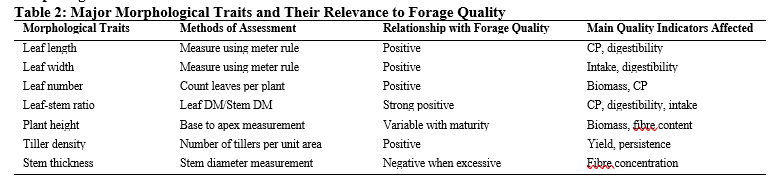
This review evaluates the suitability of morphological traits as desirable forage quality metrics in grass species. Forage evaluation is aimed at improving the performance of animal as it provides important information required for estimating the feeding requirement of the animal to meet their physiological needs. Conventional quality evaluation methods such as the Weende system of forage chemical analyses, Tilley and Terry in vitro digestibility technique, Van Soest, fibre fractionation system, near infra-red reflectance spectroscopy (NIRS), Meinke and Steingas gas production technique, and in vivo animal feeding trials provide reliable nutritive value are widely used to predict animal performance. However, these methods are often expensive, labour intensive and technically demanding, thereby limiting their applicability in resource constrained production systems. Consequently, a basic, rapid, and affordable field evaluation is needed as an alternative to ensure improved animal performance. Since morphological traits have been shown to modify the key forage nutritive attributes, hence it can be employed as a metric of forage quality. However, constraints such as lack of capacity for direct quantification of critical forage predictive parameters such as crude protein, fibre fraction and digestibility, as well as sensitivity to maturity and variability arising from agronomic practices, limit their reliability as the sole determinant of forage quality. Enhancing predictive accuracy will require integrative approaches that combine morphological traits with maturity indices and management factors. Such an approach may provide a feasible method for improving forage evaluation and contributing to better livestock productivity under field conditions.
References
Agnusdei, M. G., Di Marco, O. N., Nenning, F. R., & Aello, M. S. (2012). Leaf blade nutritional quality of Rhodes grass (Chloris gayana) as affected by leaf age and length. Crop and Pasture Science, 62(12), 1098-1105
Amuda, A., & Tubasen, P. J. (2023). Physico-Chemical Properties and In Vitro Fermentation Evaluation of Ensiled Guinea Grass (Panicum Maximum) With Different Protein Additives. International Journal of Environmental Pollution and Environmental Modelling, 6(2), 57-69.
Bell, M. J., J. Huggett, Z., Slinger, K. R., & Roos, F. (2021). Effect of pasture cover and height on nutrient concentrations in diverse swards in the UK. Grassland Science, 67(3), 267-272.
Downloads
Published
Issue
Section
Categories
License
Copyright (c) 2026 Sheriff Akintobi, Ojetayo Mujeeb, Ishaq Garba Adam

This work is licensed under a Creative Commons Attribution 4.0 International License.


