
BIOFILM FORMATON POTENTIAL OF BACTERIA RECOVERED FROM WATER TAPS AND SINKS
DOI:
https://doi.org/10.33003/fjs-2026-1008-5016Keywords:
Biofilms, Taps, Sinks, Bacterial counts, Polysaccharide matrixAbstract
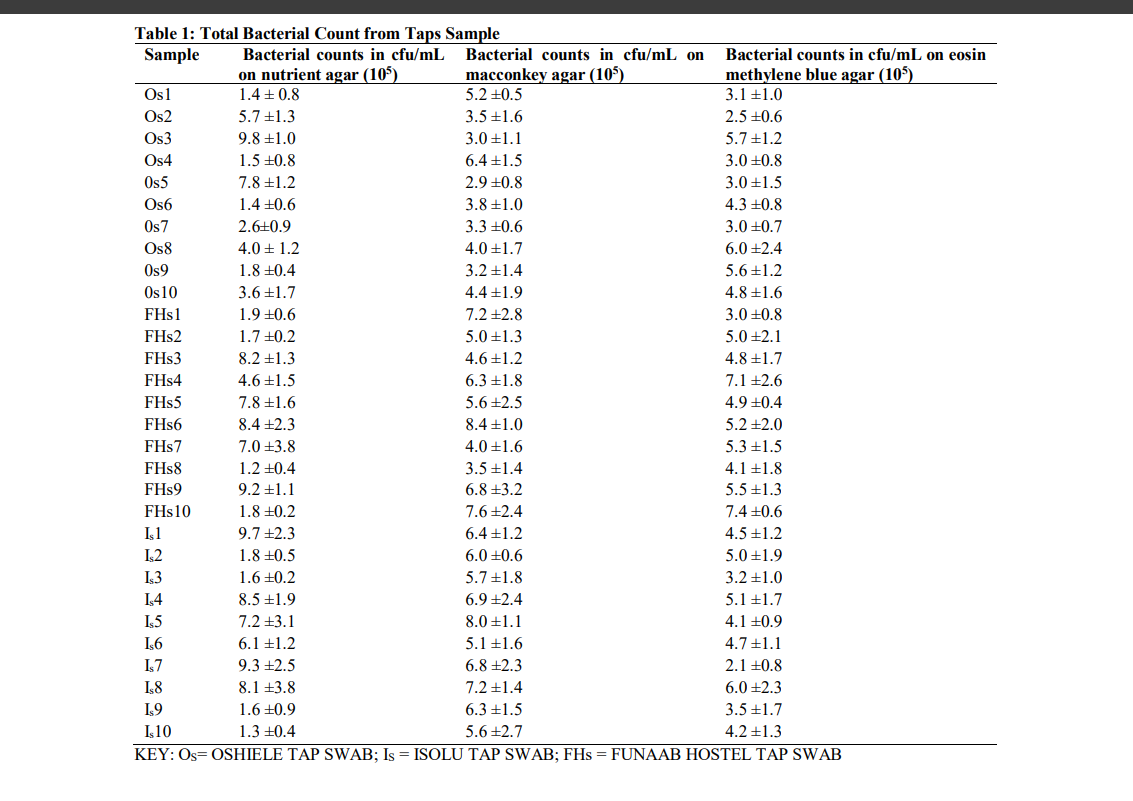
Biofilms are bacterial communities embedded in a polysaccharide matrix, resistant to antibiotics, environmental stress, biocides and could cause increase in the prevalence of diseases worldwide. This study elucidates the biofilm forming abilities of bacterial isolates from water taps and sinks. Water taps and sinks swabs samples were collected from Federal University of Agriculture, Abeokuta (FUNAAB), Isolu, Oshiele and Federal Medical Centre (FMC), Abeokuta. Isolation and identification of bacteria were carried out using standard microbiological methods and tube method was employed for biofilms assay. The isolated bacteria species include Escherichia, Klebsiella, Salmonella, Proteus, Pseudomonas and Citrobacter. The highest bacterial count of 9.8×10⁵(cfu/mL) was obtained from Oshiele tap samples while the lowest count was gotten from FMC sink samples (1.2×10⁵cfu/mL). Out of 108 bacteria isolated, 36 bacteria were biofilm formers. The isolated bacteria from FUNAAB hostel tap exhibited the highest biofilm potential followed by OSHIELE samples while FMC sink samples had highest bacteria biofilms. This study, thus, revealed that bacterial biofilm formers could be found in taps and sinks and presence of these diverse bacterial biofilms in the tap outlets and sinks could pose a serious threat to life-forms.
References
Achermann Y., Goldstein E.J., Coenye T. & Shirtliff M.E. (2014). Propionibacterium acnes: from commensal to opportunistic biofilm-associated implant pathogen. Cli. Microbiol. Rev., 27 (3), 419–440.
Ayansina A.D., Popoola O.T. & Aromolaran O. (2023). Multi drug resistant enterobacteria from biofilms in some tap water supplies in a Nigerian University. W. Journ. Biol. Pharm. Health Sci., 16(1), 89-98
Barroco C., Roma-Rodrigues C., Balasubramanian N., Guimaraes M. A.,Ferreira-Carvalho B. T., Muthukumaran J., Nunes D., Fortunato E., Martins R., Santos-Silva T., Figueiredo A., Fernandes A. R. & Santos-Sanches I. (2019). Biofilm development and computational screening for new putative inhibitors of a homolog of the regulatory protein BrpA in Streptococcus dysgalactiae subsp. Dysgalactiae. Int. Journ. Med. Microbiol., 309 (4), 169-181
Burmolle M., Thomsen T.R., Fazli M., Dige I., Christensen L., Homoe P., Tvede M., Nyvad B., Tolker-Nielsen T., Givskov M., Moser C., Kirketerp-Moller K., Johansen H.K., Hoiby N., Jensen P.O., Sorensen S.J. & Bjarnsholt T. (2010). Biofilms in chronic infections – a matter of opportunity-monospecies biofilms in multispecies infections. FEMS Immun. Med. Microbiol., 59(3), 324–336
Enogiomwan O. & Ibeh I. (2018). Forward and reverse characterization of the CTX-M genes associated with multidrug-resistant Escherichia coli isolated from pregnant mothers presenting with asymptomatic urinary tract infection in Benin City, Nigeria. Ada Sci. Microbiol., 56, 191-196
Flemming H. & Wingender J. (2010). The biofilm matrix. Nat. Rev. Microbiol., 8, 623–633.
Franco L.C., Tanner W. & Ganim C. (2020). A microbiological survey of handwashing sinks in the hospital-built environment reveals differences in patient room and health care personnel sinks. Sci. Rep., 10, 8234
Garnett J.A. & Matthew S. (2012). Interactions in bacterial biofilm development: a structural perspective. Curr. Prot. Pept. Sci., 13(8), 739–755.
Gattlena J., Ambergb C., Zinna M. & Mauclairea L. (2010). Biofilms isolated from washing machines from three continents and their tolerance to a standard detergent. Biofoul., 26(8), 873–882
Hassan A., Usman J., Kaleem F., Omair M., Khalid A. & Iqbal M. (2011). Evaluation of different detection methods of biofilm formation in the clinical isolates. Braz J Infect Dis., 15(4), 305-311
Hausner M., Packman A. & Waller S. (2012). Assessing biofilms in distribution systems. Project #4087 Denver, Colo, Water Research Foundation.
Hoiby N., Coifu O., Johansen H.K., Song Z., Moser C., Jensen P.O., Molin S., Givskov M., Tolker-Nielsen T. & Bjarnsholt T. (2011). Clinical impact of bacterial biofilms. Int Journ. Oral Sci., 3:55–65
Karim E, Dhar K. & Hossain T. (2018). Decolorization of textile reactive dyes by bacterial monoculture and consortium screened from textile dyeing effluent. Journ. Gen. Eng. Biotechnol. 16 (2), 375-380.
Kinge C., Mbewe M. & Sithebe N. (2012). Detection of bacterial pathogens in river water using multiplex-PCR, Polymerase. Dr. Patricia Hernandez-Rodriguez (Ed.), http://intechopen.com/ books/polymerase-chain-reaction/detection-of-bacterial-pathogens-in-river-water-using-multiplex-PCR.
Mangwani N., Dash H. R., Chauhan A. & Das S. (2012). Bacterial quorum sensing: functional features and potential applications in biotechnology. Journ. Mol. Microbiol Biotech., 22, 215–227.
Mathur T., Singhal S., Khan S., Padhyay D. U., Fatma T. & Rattan A. (2006). Detection of biofilm formation among the clinical isolates of staphylococci: an evaluation of three different screening methods. Ind. J. Med. Microbiol., 24 (1), 25-29.
Mirghani R., Saba T., Khaliq H.,Mitchell J., Do L., Chambi L, Diaz K., Kennedy T., Alkassab K., Huynh T., Elmi M., Martinez J., Sawan S. & Rijal G. (2022). Biofilms: formation, drug resistance and alternatives to conventional approaches. AIMS Microbiol., 8(3), 239–277
Mulamattathil S.G., Bezuidenhout C. & Mbewe M. (2014). Biofilm formation in surface and drinking water distribution systems in Mafikeng, South Africa. South Afr.Journ. Sci., 110 (12), 1-9
Nehra K., Jaglan A., Shaheen A., Yadav J., Lathwal P. & Manpreet P. (2015). Production of Poly-β-Hydroxybutyrate (PHB) by bacteria isolated from rhizospheric soils. Int. Journ. Microb. Res. Technol. 2(3): 38-48
Olsen I. (2015). Biofilm-specific antibiotic tolerance and resistance. Eur. Journ. Clin. Microbiol. Inf. Dis., 34(5), 877–886
Patil P.N., Sawant D.V. & Deshmukh R. N. (2012). Physicochemical parameters for testing of water. Int J. Environ. Sci., 3(3), 1194-1207
Rather M.A., Gupta K. & Mandal M. (2021). Microbial biofilm: formation, architecture, antibiotic resistance and control strategies. Braz J Microbiol., 52(4), 1701-1718
Downloads
Published
Issue
Section
Categories
License
Copyright (c) 2026 Seun Adebajo, Thaddeus Ariom, Williams Ike, Aderonke Akintokun

This work is licensed under a Creative Commons Attribution 4.0 International License.


