
A UNIFIED FRAMEWORK FOR GEOMETRIC-ENTROPIC INFERENCE: THE P-CPDME MODEL FOR HIGH-DIMENSIONAL DATA CLASSIFICATION
DOI:
https://doi.org/10.33003/fjs-2026-1008-4904Keywords:
Data Depth, Maximum Entropy, High-Dimensional Classification, P-CPDME, Reliability ProbabilityAbstract
.
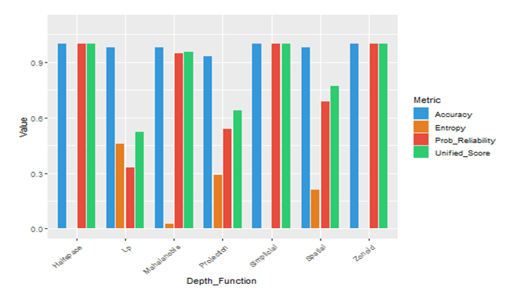
The classification of high-dimensional datasets is frequently compromised by the curse of dimensionality, a phenomenon where traditional machine learning models achieve deceptively high accuracy rates while masking profound geometric instability and predictive uncertainty. To address this critical deficiency, this research proposes the Principal Component Class Probability Distribution based on Maximum Entropy (P-CPDME) framework. By combining dimensionality conditioning with a suite of seven statistical data depth functions such as Mahalanobis, Projection, Spatial, , Halfspace, Zonoid, and Simplicial, the P-CPDME framework maps complex spatial distances into standardized, information-theoretic probability distributions. Extensive empirical evaluations were conducted across structured synthetic simulations and real-world high-dimensional datasets, including Gasoline chemometrics and Colon Cancer genomics. The results exposed a persistent Paradox. Standard Euclidean ( ) depth achieved high nominal accuracy (93.55% in Colon Cancer) but suffered from destructive entropy (0.4619), causing its probability reliability to plummet to a negligible 0.3121. In contrast, combinatorial depth function specifically, Simplicial, Zonoid, and Halfspace demonstrated supreme geometric stability, consistently maintaining values of 1.000 across all domains.
References
Donoho, D. L. (2000). High-dimensional data analysis: The curses and blessings of dimensionality. AMS Math Challenges Lecture, 1(32), 1-32.
Fan, J., & Lv, J. (2008). Sure independence screening for ultrahigh-dimensional feature space. Journal of the Royal Statistical Society: Series B (Statistical Methodology), 70(5), 849-911.
Grünwald, P. D., & Dawid, A. P. (2004). Game theory, maximum entropy, minimum discrepancy and robust Bayesian decision theory. The Annals of Statistics, 32(4), 1367-1433.
Hall, P., Marron, J. S., & Neeman, A. (2005). Geometric representation of high dimension, low sample size data. Journal of the Royal Statistical Society: Series B (Statistical Methodology), 67(3), 427-444.
Hand, D. J. (2009). Measuring classifier performance: A coherent alternative to the area under the ROC curve. Machine Learning, 77(1), 103-123.
Jaynes, E. T. (1957). Information theory and statistical mechanics. Physical Review, 106(4), 620-630.Jolliffe, I. T. (2002). Principal Component Analysis (2nd ed.). Springer-Verlag.
Li, J., Cuesta-Albertos, J. A., & Liu, R. Y. (2012). DD-classifier: Nonparametric classification based on DD-plot. Journal of the American Statistical Association, 107(498), 737-753.
Liu, R. Y. (1990). On a notion of data depth based on random simplices. The Annals of Statistics, 18(1), 405-414.
Makinde, O. S. (2022). On rank distribution classifiers for high-dimensional data. Communications in Statistics - Simulation and Computation, 51(12), 7356-7375.
Makinde, O. S., & Adewumi, A. D. (2017). A comparison of depth functions in maximal depth classification rules. Journal of Modern Applied Statistical Methods, 16(1), 388-405.
Makinde, O. S., & Fasoranbaku, O. A. (2018). On maximum depth classifiers: depth distribution approach. Journal of Applied Statistics, 45(6), 1106-1117.
Shannon, C. E. (1948). A mathematical theory of communication. The Bell System Technical Journal, 27(3), 379-423.
Tukey, J. W. (1975). Mathematics and the picturing of data. Proceedings of the International Congress of Mathematicians, 2, 523-531.
Vapnik, V. N. (1998). Statistical Learning Theory. Wiley-Interscience.
Zuo, Y., & Serfling, R. (2000). General notions of statistical depth function. The Annals of Statistics, 28(2), 461-482.
Downloads
Published
Issue
Section
Categories
License
Copyright (c) 2026 Modupe Iyabo Omotosho, Olamide Idowu Emmanuel, Akin Fasoranbaku Olusoga

This work is licensed under a Creative Commons Attribution 4.0 International License.


