
INVESTIGATION OF THE PRESERVATION TECHNIQUES FOR PERISHABLE FOOD COMMODITIES THROUGH A COMPARATIVE STUDY OF OKRA, TOMATO, AND FISH
DOI:
https://doi.org/10.33003/fjs-2026-1008-4820Keywords:
Drying, Moisture content, food preservation, kinetics, Activation energyAbstract
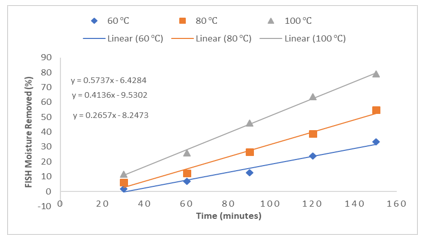
Postharvest spoilage of perishable crops such as okra (Abelmoschus esculentus), tomato (Solanum lycopersicum), and fish (Clarias gariepinus) contributes to significant food loss and reduced nutritional availability in Nigeria. This study aimed to evaluate controlled oven-drying as a preservation method for these commodities and examined changes in their nutritional composition during storage. Samples were dried at 60°C to ensure uniform heat transfer and minimize oxidative degradation. Moisture, protein, carbohydrate, and vitamin C contents were determined using standard analytical methods. Drying kinetics were assessed using first-order reaction models, and activation energy (Ea) for moisture diffusion was calculated using the Arrhenius equation. Drying significantly reduced the moisture content of all samples, improving shelf life and limiting microbial activity. Protein content increased slightly in fish (24.72–25.61%), okra (2.73–2.75%), and tomato (1.62–1.65%) due to concentration effects. Vitamin C showed substantial losses of 40–80%, confirming its thermolabile nature, while carbohydrate levels remained largely stable. Fish exhibited clear first-order drying behaviour, with rate constants of 0.0153, 0.0189, and 0.0191 min⁻¹ at 60°C, 80°C, and 100°C, respectively. The activation energy of 6.093 kJ/mol indicated moderate energy requirements and suggested moisture removal mainly through surface evaporation with limited internal diffusion. Overall, the results show that moderate drying temperatures, particularly around 60°C, can preserve key nutrients while enhancing product stability, making this method suitable for processing perishable foods in tropical environments. Higher temperatures, such as 100°C, increase moisture loss but accelerate nutrient degradation.
References
Abelti, A. L., & Teka, T. A. (2024). Intervening fish post‐harvest losses to narrow the gap between demand and supply: A review on the magnitude of fish post‐harvest losses in some Sub‐Saharan African countries. Aquaculture, Fish and Fisheries, 4(2), 1–15. Doi: https://doi.org/10.1002/aff2.168
Abraha, B., Admassu, H., Mahmud, A., Tsighe, N., Shui, X. W., & Fang, Y. (2018). Effect of processing methods on nutritional and physico-chemical composition of fish: a review. MOJ Food Processing & Technology, 6(4). Doi: https://doi.org/10.15406/mojfpt.2018.06.00191
Afolabi, T. J., Aworanti, O. A., Agarry, S. E., Agbede, O. O., Ajuebor, F., Ogunleye, O. O., Ogunkunle, O., & Laseinde, O. T. (2022). Effects of drying process parameters on the quality attributes of hot-air-dried okra and its statistical optimization. Cogent Engineering, 9(1), 1–21. Doi: https://doi.org/10.1080/23311916.2022.2122193
Ahmed, A., Mahmud, M. N., & Muniza, N. T. (2025). Post-harvest technology and food processing innovations: Prospects and challenges in Bangladesh. International Journal of Chemical Studies, 13(1), 93–103. Doi: https://doi.org/10.22271/chemi.2025.v13.i1b.12506
Ahmed, M. J., Iya, I. R., & Dogara, M. F. (2020). Proximate, Mineral and Vitamin Content of Flesh, Blanched and Dried Tomatoes (Lycopersicon esculentum). Asian Food Science Journal, 18(4), 11–18. Doi: https://doi.org/10.9734/afsj/2020/v18i430223
Ajao, T., Oyewole, O., Famakinwa, J., Oyewole, S., Abel, O., Shotonwa, A., Alao, A., Iyiola, A., Gambo, Y., & Adesina, M. (2025). Mathematical Modeling of Drying Kinetics and Analysis of Smoking Kiln Performance for Rock Fish Drying. Journal of Research in Agriculture and Food Sciences, 3(1), 1. Doi: https://doi.org/10.5455/jrafs.20250225084559
Akpabio, E. S., Akeju, K. F., & Omotoso, K. O. (2025). E-agriculture and food security in developing countries: beaming the searchlight on Nigeria. Smart Agricultural Technology, 10(October 2024), 100689. Doi: https://doi.org/10.1016/j.atech.2024.100689
Al-Dabbas, M. M., Moumneh, M., Hamad, H. J., Abughoush, M., Abuawad, B., Al-Nawasrah, B. A., Al-Jaloudi, R., & Iqbal, S. (2023). Impact of Processing and Preservation Methods and Storage on Total Phenolics, Flavonoids, and Antioxidant Activities of Okra (Abelmoschus esculentus L.). Foods, 12(19), 1–10. Doi: https://doi.org/10.3390/foods12193711
Awuchi, C. G., Chukwu, C. N., Iyiola, A. O., Noreen, S., Morya, S., Adeleye, A. O., Twinomuhwezi, H., Leicht, K., Mitaki, N. B., & Okpala, C. O. R. (2022). Bioactive Compounds and Therapeutics from Fish: Revisiting Their Suitability in Functional Foods to Enhance Human Wellbeing. BioMed Research International, 2022. Doi: https://doi.org/10.1155/2022/3661866
Badmus, U. O., Taggart, M. A., & Boyd, K. G. (2019). The effect of different drying methods on certain nutritionally important chemical constituents in edible brown seaweeds. Journal of Applied Phycology, 31(6), 3883–3897. Doi: https://doi.org/10.1007/s10811-019-01846-1
Beaulah, A., Rajadurai, K. R., Anitha, T., Rajangam, J., & Maanchi, S. (2025). Postharvest handling and value added products of tomato to enhance the profitability of farmers. Plant Science Today, 12(2). https://doi.org/10.14719/pst.5794
Bio-Stimulants Extend Shelf Life and Maintain Quality of Okra Pods. (n.d.). Retrieved May 9, 2025, from Doi: https://www.mdpi.com/2077-0472/12/10/1699
Cheng, Z., Gong, X., Jing, W., Peng, Z., & Li, J. (2018). Quality Change of Postharvest Okra at Different Storage Temperatures. Journal of Food Engineering and Technology, 7(1), 43.
Dantas, T. L., Buriti, F. C. A., & Florentino, E. R. (2021). Okra (Abelmoschus esculentus L.) as a Potential Functional Food Source of Mucilage and Bioactive Compounds with Technological Applications and Health Benefit.
Demelash Abera, B., & Alefe Adimas, M. (2024). Health benefits and health risks of contaminated fish consumption: Current research outputs, research approaches, and perspectives. Heliyon, 10(13), e33905. Doi: https://doi.org/10.1016/J.HELIYON.2024.E33905
Elkhalifa, A. E. O., Alshammari, E., Adnan, M., Alcantara, J. C., Awadelkareem, A. M., Eltoum, N. E., Mehmood, K., Panda, B. P., & Ashraf, S. A. (2021). Okra (Abelmoschus esculentus) as a potential dietary medicine with nutraceutical importance for sustainable health applications. Molecules, 26(3), 1–21. Doi: https://doi.org/10.3390/MOLECULES26030696
Giannakourou, M. C., & Taoukis, P. S. (2021). Effect of alternative preservation steps and storage on vitamin c stability in fruit and vegetable products: Critical review and kinetic modelling approaches. Foods, 10(11). Doi: https://doi.org/10.3390/foods10112630
Gidado, M. J., Gunny, A. A. N., Gopinath, S. C. B., Ali, A., Wongs-Aree, C., & Salleh, N. H. M. (2024). Challenges of postharvest water loss in fruits: Mechanisms, influencing factors, and effective control strategies – A comprehensive review. Journal of Agriculture and Food Research, 17(June), 101249. Doi: https://doi.org/10.1016/j.jafr.2024.101249
Gouda, M. H. B., & Duarte-Sierra, A. (2024). An Overview of Low-Cost Approaches for the Postharvest Storage of Fruits and Vegetables for Smallholders, Retailers, and Consumers. Horticulturae, 10(8). Doi: https://doi.org/10.3390/horticulturae10080803
Hussein, J. B., Ilesanmi, J. O. Y., Filli, K. B., & Sanusi, M. S. (2018). Effects of Drying Methods on the Chemical Properties of Okra (Abelmoschus esculentus L. Moench) Slices. Current Journal of Applied Science and Technology, 26(6), 1–10. Doi: https://doi.org/10.9734/CJAST/2018/38796
Iveren Blessing, I., & Tavershima Richard, U. (2022). Postharvest Handling Practices and Treatment Methods for Okra in Nigeria: A Review. Asian Food Science Journal, 20–33. Doi: https://doi.org/10.9734/AFSJ/2022/V21I430422
Jannah, M., Damayanthi, E., & Nasution, Z. (2025). Effect of okra mucilage addition on antioxidant properties of purple okra (Abelmoschus esculentus L. Moench) pudding. BIO Web of Conferences, 153. Doi: https://doi.org/10.1051/bioconf/202515303003
Kafui, J. A., Asiedu, S. Y., Drafor, S., & Tekpor, S. K. (2022). Effect of Some Processing and Storage Methods on the Quality of Okra (Abelmoschus esculentus). Journal of Agriculture and Ecology Research International, 23(5), 31–64. Doi: https://doi.org/10.9734/jaeri/2022/v23i530237
Komolafe, C. A., Oluwaleye, I. O., Daniel Adejumo, A. O., Waheed, M. A., & Kuye, S. I. (2018). Determination of moisture diffusivity and activation energy in the convective drying of fish. International Journal of Heat and Technology, 36(4), 1262–1267. Doi: https://doi.org/10.18280/ijht.360414
Liu, Chen, D., Zhang, Z., Li, B., El-mogy, M. M., Tian, S., & Chen, T. (2022). Solanum lycopersicum, a Model Plant for the Studies in Developmental Biology, Stress Biology and Food Science. Foods, 11(7), 2402.
Mohammed, S. M., Abdurrahman, A. A., & Attahiru, M. (2017). Proximate analysis and total lycopene content of some tomato cultivars obtained from Kano State, Nigeria. ChemSearch Journal, 8(1), 64–69.
Mramba, R. P., & Mkude, K. E. (2022). Determinants of fish catch and post-harvest fish spoilage in small-scale marine fisheries in the Bagamoyo district, Tanzania. Heliyon, 8(6), e09574. Doi: https://doi.org/10.1016/j.heliyon.2022.e09574
Nakra, S., Tripathy, S., & Srivastav, P. P. (2025). Drying as a preservation strategy for medicinal plants: Physicochemical and functional outcomes for food and human health. Phytomedicine Plus, 5(2), 100762. Doi: https://doi.org/10.1016/j.phyplu.2025.100762
Odioko, E., & Becer, Z. A. (2019). The Economic Analysis of The Nigerian Fisheries Sector: A Review Edafe. Journal of Anatolian Environmental and Animal Sciences, 2019, 156–160.
Pratama, A. W. W., Satyantini, W. H., & Kenconojati, H. (2023). Crude protein and crude fiber content of fish silage fermented with kombucha tea. IOP Conference Series: Earth and Environmental Science, 1273(1). Doi: https://doi.org/10.1088/1755-1315/1273/1/012079
Saba, A. O., Eyo, V. O., Elegbede, I. O., Fakoya, K. A., Ojewole, A. E., Dawodu, F. O., Adewale, R. A., & Amal, M. N. A. (2024). Sustaining the blue bounty: Fish food and nutrition security in Nigeria’s evolving blue economy. AIMS Agriculture and Food, 9(2), 500–530. Doi: https://doi.org/10.3934/AGRFOOD.2024029
Ummah, M. S. (2019). Review on Okra (Abelmoschus esculentus (L.) Moench) Production, Nutrition and Health Benefits. Sustainability (Switzerland), 11(1), 1–14.
Wakene, D. M., & Sharew, T. (2024). A Comprehensive Review of Tomato Post-Harvest Losses: Understanding Impacts and Contributing Factors in Ethiopia. Asian Science Bulletin, 2(4), 525–535. Doi: https://doi.org/10.3923/asb.2024.525.535
Downloads
Published
Issue
Section
Categories
License
Copyright (c) 2026 Frederick Oshomogho, Paul Anosi Idah

This work is licensed under a Creative Commons Attribution 4.0 International License.


