
APPLICATION OF WATER QUALITY INDEX (WQI) FOR THE ASSESSMENT OF EGBE RESERVOIR
DOI:
https://doi.org/10.33003/fjs-2026-1008-2697Keywords:
Water Quality Index (WQI), Egbe Reservoir, Physicochemical Parameters, E. coli, Nitrate, Phosphate, Water Quality Assessment, Southwestern NigeriaAbstract
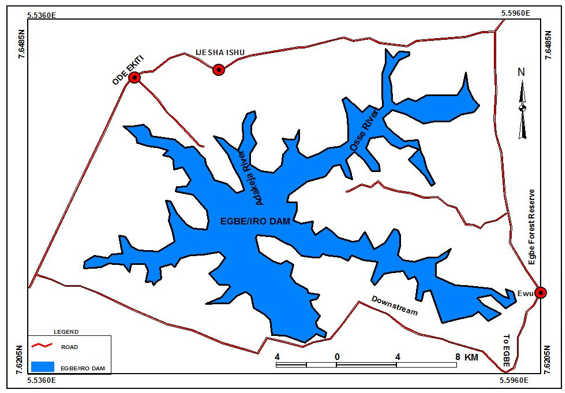
The African continent continues to face challenges in improving water accessibility, exacerbated by significant water quality issues that pose serious risks to public health, particularly through the transmission of waterborne diseases. This study aimed to evaluate the Water Quality Index (WQI) of Egbe Reservoir, a crucial source of potable water and irrigation for several local governments in Ekiti and Ondo states in Southwestern Nigeria. The assessment utilized selected physicochemical criteria, analyzed through conventional laboratory techniques. Data collected were subjected to statistical analysis using SPSS (Version 25), and the WQI was calculated based on the average of nine chosen variables, following the drinking water standards established by the World Health Organization. The physicochemical analysis of Egbe Dam revealed a generally healthy aquatic environment; however, some sampling stations exhibited signs of pollution, particularly concerning E. coli levels, phosphate (PO4) concentrations (8.33 ± 1.50 mg/L), and nitrate (NO3) concentrations (2.18 ± 1.05 mg/L), which exceeded both national and international standards. The WQI showed a weak positive correlation with temperature (0.452) and strong negative correlations with total phosphate (-0.925) and E. coli (-0.706), indicating that improved water quality is linked to lower levels of these contaminants. The overall WQI for Egbe Reservoir was 83.05, with the Ode station scoring the highest at 91.25, indicating good water quality, while the lowest score of 57.58 at Downstream still categorized as good.
References
Abdul Hameed, M. J., Abid, H. S., & Maulood, B. K. (2010). Application of water quality index for assessment of Dokan Lake ecosystem, Kurdistan Region, Iraq. Journal of Water Resource and Protection, 2(9), 792–798. Doi: https://doi.org/10.4236/jwarp.2010.29093
Adedeji, H., Idowu, T., Usman, M., & Sogbesan, O. (2019). Seasonal variations in the physico-chemical parameters of Lake Ribadu, Adamawa State, Nigeria. International Journal of Fisheries and Aquatic Studies, 7(1), 79–82.
Akinnawo, S. O. (2023). Eutrophication: Causes, consequences, physical, chemical and biological techniques for mitigation strategies. Environmental Challenges, 12, 100733. Doi: https://doi.org/10.1016/j.envc.2023.100733
Akoteyon, I., Omotayo, A., Soladoye, O., & Olaoye, H. (2011). Determination of water quality index and suitability of urban river for municipal water supply in Lagos, Nigeria. European Journal of Scientific Research, 54(2), 263–271.
American Public Health Association (APHA). (2005). Standard methods for the examination of water and wastewater (21st ed.). American Public Health Association.
Ayoade, A. A., & Izah, B. C. (2019). Physico-chemical parameters, primary productivity and phytoplankton assemblage of Dandaru Lake, Southwestern Nigeria. Studia Universitatis “Vasile Goldiș”, Seria Științele Vieții, 29(2), 91–98.
Behmel, S., Damour, M., Ludwig, R., & Rodriguez, M. J. (2016). Water quality monitoring strategies: A review and future perspectives. Science of the Total Environment, 571, 1312–1329. Doi: https://doi.org/10.1016/j.scitotenv.2016.06.235
Edward, J. B., & Ugwumba, A. A. A. (2010). Physico-chemical parameters and plankton community of Egbe Reservoir, Ekiti State, Nigeria. Research Journal of Biological Sciences, 5(5), 356–367.
Huang, J. C., Gao, J. F., & Zhang, Y. J. (2016). Eutrophication prediction using a Markov chain model: Application to lakes in the Yangtze River Basin, China. Environmental Modeling and Assessment, 21(2), 233–246. Doi: https://doi.org/10.1007/s10666-015-9485-4
John, V., Jain, P., Rahate, M., & Labhasetwar, P. (2014). Assessment of deterioration in water quality from source to household storage in semi-urban settings of developing countries. Environmental Monitoring and Assessment, 186(1), 725–734. Doi: https://doi.org/10.1007/s10661-013-3402-z
Kachroud, M., Trolard, F., Kefi, M., Jebari, S., & Bourrié, G. (2019). Water quality indices: Challenges and application limits in the literature. Water, 11(2), 361. Doi: https://doi.org/10.3390/w11020361
Obayemi, O. E., & Komolafe, O. O. (2023). Environmental assessment of Esa-Odo Reservoir based on water quality index and multivariate analysis. Sustainable Water Resources Management, 9, 135. Doi: https://doi.org/10.1007/s40899-023-00913-3
Oketola, A. A., Adekolurejo, S. M., & Osibanjo, O. (2013). Water quality assessment of River Ogun using multivariate statistical techniques. Journal of Environmental Protection, 4(5), 466–479. Doi: https://doi.org/10.4236/jep.2013.45055
Pesce, S. F., & Wunderlin, D. A. (2000). Use of water quality indices to verify the impact of Córdoba City (Argentina) on Suquía River. Water Research, 34(11), 2915–2926. Doi: https://doi.org/10.1016/S0043-1354(00)00036-1
Puri, P. J., Yenkie, M. K. N., Rana, D. B., & Meshram, S. U. (2015). Application of water quality index (WQI) for the assessment of surface water quality (Ambazari Lake). European Journal of Experimental Biology, 5(2), 37–52.
Qin, L., Lei, P., Lei, Q., Liu, H., Li, X., Zhang, H., & Lindsey, S. (2020). Evaluating the effect of dam construction on the phosphorus fractions in sediments in a reservoir of drinking water source. Environmental Monitoring and Assessment, 192, 99. Doi: https://doi.org/10.1007/s10661-019-8053-4
Ramakrishnaiah, C. R., Sadashivaiah, C., & Ranganna, G. (2009). Assessment of water quality index for the groundwater in Tumkur Taluk. E-Journal of Chemistry, 6(2), 523–530.
Romero, E., et al. (2016). Long-term water quality in the lower Seine: Lessons learned over four decades of monitoring. Environmental Science and Policy, 58, 141–154. Doi: https://doi.org/10.1016/j.envsci.2016.01.016
Rosemond, S., Duro, D., & Dubé, M. (2009). Comparative analysis of regional water quality in Canada using the Water Quality Index. Environmental Monitoring and Assessment, 156(1–4), 223–240. https://doi.org/10.1007/s10661-008-0480-6
UNICEF & World Health Organization. (2005). Meeting the MDG drinking water and sanitation target: A mid-term assessment of progress. World Health Organization.
Wang, X. P., Zhang, F., & Ding, J. L. (2017). Evaluation of water quality based on a machine learning algorithm and water quality index for the Ebinur Lake Watershed, China. Scientific Reports, 7, 12858. Doi: https://doi.org/10.1038/s41598-017-12853-y
Wojtkowska, M., & Bojanowski, D. (2018). Influence of catchment use on the degree of river water pollution by forms of phosphorus. Annual Set the Environment Protection, 20, 887–904.
World Health Organization. (2004). Guidelines for drinking-water quality (3rd ed.). World Health Organization.
World Health Organization. (2017). Guidelines for drinking-water quality (4th ed., incorporating the first addendum). World Health Organization.
Wu, Z. S., Wang, X. L., Chen, Y. W., Cai, Y. J., & Deng, J. C. (2018). Assessing river water quality using water quality index in Lake Taihu Basin, China. Science of the Total Environment, 612, 914–922. Doi: https://doi.org/10.1016/j.scitotenv.2017.08.293
Downloads
Published
Issue
Section
Categories
License
Copyright (c) 2026 Johnson Oyewumi, Adetoun Adekitan, Emmanuel Adewumi, Andrew O. Agbon, Stanley O. Agbo, Abdul O. Waidi, Omoniyi Tunde

This work is licensed under a Creative Commons Attribution 4.0 International License.


