
ASSESSMENT OF HEAVY METAL CONTAMINATION AND SEASONAL VARIATION IN RIVER GWAGWALADA, NIGERIA
DOI:
https://doi.org/10.33003/fjs-2026-1008-5076Keywords:
Heavy Metals, River Water Quality, Seasonal Variation, River Gwagwalada, Public Health RiskAbstract
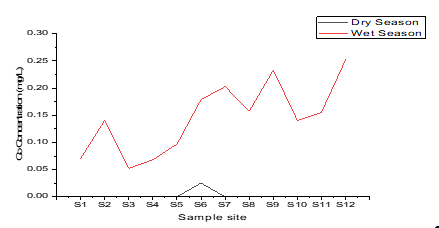
Heavy metals are among the most persistent pollutants in aquatic environments due to their toxicity, persistence, and potential for accumulation. Rivers receiving discharges from industrial, domestic, and agricultural activities are particularly vulnerable to contamination. This study investigated the concentrations and seasonal variations of seven heavy metals (Cd, Cr, Co, Fe, Mn, Ni, and Zn) in River Gwagwalada, Abuja, Nigeria. Water samples were collected from twelve sampling stations during the rainy and dry seasons and analyzed using Atomic Absorption Spectrophotometry (AAS). The mean concentrations (mg/L) were Cd (0.06), Co (0.114), Cr (0.19), Fe (1.71), Mn (0.29), Ni (1.14), and Zn (0.01). Comparison with WHO (2011) drinking-water guidelines revealed that Mn and Zn were within permissible limits, whereas Cd, Co, Cr, Fe, and Ni exceeded the recommended values. Analysis of variance (ANOVA) showed significant seasonal variations in the concentrations of Co, Cr, Fe, Mn, and Ni, while Cd and Zn exhibited no significant differences between the rainy and dry seasons. The observed spatial and seasonal variations suggest that anthropogenic activities, including agricultural practices, domestic waste disposal, sewage discharge, and urban runoff, contribute to heavy metal contamination in the river. The findings highlight the need for regular water-quality monitoring and effective pollution-control measures to support the sustainable management of River Gwagwalada.
References
Aboujassoum, H. M., & Costa, O. S. (2012). Water contamination: Cadmium in drinking water. Qatar Foundation Annual Research Forum Volume 2012 Issue 1. Qatar Foundation Annual Research Forum. https://doi.org/10.5339/qfarf.2012.EEPS11
Aderinola, O. J., Clarke, E. O., Olarinmoye, O. M., Kusemiju, V., & Anatekhai, M. A. (2009). Heavy Metals in Surface Water, Sediments, Fish and Perwinklesof Lagos Lagoon. Environ. Sci.
Adewumi, A. J., & Laniyan, T. A. (2021). Ecological and human health risks associated with metals in water from Anka Artisanal Gold Mining Area, Nigeria. Human and Ecological Risk Assessment: An International Journal, 27(2), 307–326. https://doi.org/10.1080/10807039.2019.1710694
Ag, K. (2022). Role of Rhizosphere Microbiota of Plants Growing in Heavy Metal Contaminated Environments as Ecofriendly Decontamination Bio-Tools and their Role in the Context of Human Health – A Short Review. Open Access Journal of Microbiology & Biotechnology, 7(2), 1–7. https://doi.org/10.23880/oajmb-16000220
Angon, P. B., Islam, Md. S., Kc, S., Das, A., Anjum, N., Poudel, A., & Suchi, S. A. (2024). RETRACTED: Sources, effects and present perspectives of heavy metals contamination: Soil, plants and human food chain. Heliyon, 10(7), e28357. https://doi.org/10.1016/j.heliyon.2024.e28357
Asamoah, B. D., Asare, A., Okpati, S. W., & Aidoo, P. (2021). Heavy metal levels and their ecological risks in surface soils at Sunyani magazine in the bono region of Ghana. Scientific African, 13, e00937. https://doi.org/10.1016/j.sciaf.2021.e00937
Badamosi, A. P., Olutumise, A. I., Olukoya, O. P., Adegoroye, A., & Aturamu, O. A. (2024). Socioeconomic impacts of flooding and its coping strategies in Nigeria: Evidence from Dagiri community, Gwagwalada area council of Abuja. Natural Hazards Research, 4(3), 374–386. https://doi.org/10.1016/j.nhres.2023.09.010
Boral, S., Sen, I. S., Tripathi, A., Sharma, B., & Dhar, S. (2020). Tracking Dissolved Trace and Heavy Metals in the Ganga River From Source to Sink: A Baseline to Judge Future Changes. Geochemistry, Geophysics, Geosystems, 21(10), e2020GC009203. https://doi.org/10.1029/2020GC009203
Briffa, J., Sinagra, E., & Blundell, R. (2020). Heavy metal pollution in the environment and their toxicological effects on humans. Heliyon, 6(9), e04691. https://doi.org/10.1016/j.heliyon.2020.e04691
Debnath, A., Singh, P. K., & Sharma, Y. C. (2024). Spatial distribution of heavy metals in the sediments of River Ganges, India: Occurrence, contamination, source identification, seasonal variations, mapping, and ecological risk evaluation. Marine Pollution Bulletin, 198, 115910. https://doi.org/10.1016/j.marpolbul.2023.115910
Diarra, I., & Prasad, S. (2021). The current state of heavy metal pollution in Pacific Island Countries: A review. Applied Spectroscopy Reviews, 56(1), 27–51. https://doi.org/10.1080/05704928.2020.1719130
Distribution_of_Heavy_Metals_in_the_Liver_Kidney_a (2). (n.d.).
Edokpayi, J. N., Odiyo, J. O., & Durowoju, O. S. (2017). Impact of Wastewater on Surface Water Quality in Developing Countries: A Case Study of South Africa. In H. Tutu (Ed.), Water Quality. InTech. https://doi.org/10.5772/66561
Ekpo, C. G & Haruna, I. O. (2022). Poverty and Environmental Sustainability: A Case Study of Gwagwalada Area Council, FCT, Abuja: 432-438. Volume VI(XI).
Förstner, U. (with Goldberg, E. D., Prosi, F., Lierde, J. H. van, & Wittmann, G. T. W.). (2012). Metal Pollution in the Aquatic Environment. Springer Berlin / Heidelberg.
Gezahegn, T., Dereje, M., Tefera, M., Beshaw, T., Mulu, M., Legesse, M., Kokeb, A., Lijalem, T., Fentie, T., Adugna, A., & Guadie, A. (2024). Analysis of nutrient loads, heavy metals and physicochemical properties of wastewater, wetland grass, and papaya samples: Gondar Malt factory, Ethiopia with global implication. Toxicology Reports, 12, 520–530. https://doi.org/10.1016/j.toxrep.2024.04.009
Gupta, V. K., Agarwal, S., Ahmad, R., Mirza, A., & Mittal, J. (2020). Sequestration of toxic congo red dye from aqueous solution using ecofriendly guar gum/ activated carbon nanocomposite. International Journal of Biological Macromolecules, 158, 1310–1318. https://doi.org/10.1016/j.ijbiomac.2020.05.025
Han, Q., Liu, Y., Huo, Y., Li, D., & Yang, X. (2022). Determination of Ultra-Trace Cobalt in Water Samples Using Dispersive Liquid-Liquid Microextraction Followed by Graphite Furnace Atomic Absorption Spectrometry. Molecules, 27(9), 2694. https://doi.org/10.3390/molecules27092694
Hughes, J. P., Polissar, L., & Van Belle, G. (1988). Evaluation and Synthesis of Health Effects Studies of Communities Surrounding Arsenic Producing Industries. International Journal of Epidemiology, 17(2), 407–413. https://doi.org/10.1093/ije/17.2.407
Iliya, A. Y., Ojutiku, R., Kolo, R., Arimoro, F., & Mohammed, A. (2019). Assessment of the Spatio-temporal environmental parameters of surface water in Gurara reservoir, Kaduna state, Nigeria.
Islam, M. S., Ahmed, M. K., Raknuzzaman, M., Habibullah -Al- Mamun, M., & Islam, M. K. (2015). Heavy metal pollution in surface water and sediment: A preliminary assessment of an urban river in a developing country. Ecological Indicators, 48, 282–291. https://doi.org/10.1016/j.ecolind.2014.08.016
Jamshed, Z., & VAmit, P. (2017). Review on heavy metal pollution in major lakes of India: Remediation through plants. African Journal of Environmental Science and Technology, 11(6), 255–265. https://doi.org/10.5897/AJEST2017.2299
Järup, L. (2003). Hazards of heavy metal contamination. British Medical Bulletin, 68(1), 167–182. https://doi.org/10.1093/bmb/ldg032
Kawser Ahmed, Md., Baki, M. A., Kundu, G. K., Saiful Islam, Md., Monirul Islam, Md., & Muzammel Hossain, Md. (2016). Human health risks from heavy metals in fish of Buriganga river, Bangladesh. SpringerPlus, 5(1), 1697. https://doi.org/10.1186/s40064-016-3357-0
Kouassi, D. N. F., Yao, K. M., Coulibaly, A. S., & Bi, T. J.-G. I. (2022). Trace metal concentrations, fluxes, and potential human health risks in West Africa rivers: A case study on the Bia, Tanoé, and Comoé rivers (Cote d’Ivoire). Environmental Monitoring and Assessment, 194(7), 475. https://doi.org/10.1007/s10661-022-09810-2
Ogunfowokan, A. O., Oyekunle, J. A. O., Olutona, G. O., Atoyebi, A. O., & Lawal, A. (2013). Speciation Study of Heavy Metals in Water and Sediments from Asunle River of the Obafemi Awolowo University, Ile-Ife, Nigeria. 3.
Olowojuni, O. A., Amulejoye, F. D., Ikuesan, B. B., Maulu, S., Bwalya, H., & Hasimuna, O. J. (2025). Water quality, heavy metal contamination, and ecological risk assessment in Asejire reservoir, Nigeria. Journal of Freshwater Ecology, 40(1), 2516505. https://doi.org/10.1080/02705060.2025.2516505
Pasricha, S., Mathur, V., Garg, A., Lenka, S., Verma, K., & Agarwal, S. (2021). Molecular mechanisms underlying heavy metal uptake, translocation and tolerance in hyperaccumulators-an analysis. Environmental Challenges, 4, 100197. https://doi.org/10.1016/j.envc.2021.100197
Rabee, A. M., Abd, A.-A.-H. N., Ministry of Science and Technology., Nameer, M., & Department of Biology, College of Science, University of Baghdad. (2011). Using Pollution Load Index (PLI) and Geoaccumulation Index (I-Geo) for the Assessment of Heavy Metals Pollution in Tigris River Sediment in Baghdad Region. Journal of Al-Nahrain University Science, 14(4), 108–114. https://doi.org/10.22401/JNUS.14.4.14
Rabee, A. M., Al-Fatlawy, Y. F., & Najim, A.-A.-H. (2009). Seasonal Variation and Assessment of Heavy Metals Pollution In Sediments from Selected Stations in Tigris And Euphrates Rivers, Central Iraq.
Salah, E. A. M., Zaidan, T. A., & Al-Rawi, A. S. (2012). Assessment of Heavy Metals Pollution in the Sediments of Euphrates River, Iraq. Journal of Water Resource and Protection, 04(12), 1009–1023. https://doi.org/10.4236/jwarp.2012.412117
Santhosh, K., Kamala, K., Ramasamy, P., Musthafa, M. S., Almujri, S. S., Asdaq, S. M. B., & Sivaperumal, P. (2024). Unveiling the silent threat: Heavy metal toxicity devastating impact on aquatic organisms and DNA damage. Marine Pollution Bulletin, 200, 116139. https://doi.org/10.1016/j.marpolbul.2024.116139
Shi, Y., Zhang, S., Zhou, H., Dong, Y., Liu, G., Ye, W., He, R., & Zhao, G. (2025). Recent Developments in Heavy Metals Detection: Modified Electrodes, Pretreatment Methods, Prediction Models and Algorithms. Metals, 15(1), 80. https://doi.org/10.3390/met15010080
Singh, A., Sharma, R. K., Agrawal, M., & Marshall, F. M. (2010). Health risk assessment of heavy metals via dietary intake of foodstuffs from the wastewater irrigated site of a dry tropical area of India. Food and Chemical Toxicology, 48(2), 611–619. https://doi.org/10.1016/j.fct.2009.11.041
Stephens, G. L., Slingo, J. M., Rignot, E., Reager, J. T., Hakuba, M. Z., Durack, P. J., Worden, J., & Rocca, R. (2020). Earth’s water reservoirs in a changing climate. Proceedings of the Royal Society A: Mathematical, Physical and Engineering Sciences, 476(2236), 20190458. https://doi.org/10.1098/rspa.2019.0458
Venkatesha Raju, K., Somashekar, R. K., & Prakash, K. L. (2012). Heavy metal status of sediment in river Cauvery, Karnataka. Environmental Monitoring and Assessment, 184(1), 361–373. https://doi.org/10.1007/s10661-011-1973-2
Verovšek, T., Krizman-Matasic, I., Heath, D., & Heath, E. (2020). Site- and event-specific wastewater-based epidemiology: Current status and future perspectives. Trends in Environmental Analytical Chemistry, 28, e00105. https://doi.org/10.1016/j.teac.2020.e00105
Wang, Y., Yang, Z., Shen, Z., Tang, Z., Niu, J., & Gao, F. (2011). Assessment of heavy metals in sediments from a typical catchment of the Yangtze River, China. Environmental Monitoring and Assessment, 172(1–4), 407–417. https://doi.org/10.1007/s10661-010-1343-5
World Health Organization (Ed.). (2011). Guidelines for drinking-water quality (4th ed). World Health Organization.
World Health Organization (Ed.). (2022). Guidelines for drinking-water quality (Fourth edition incorporating the first and second addenda). World Health Organization.
World Health Organization & World Health Organization (Eds.). (2006). Guidelines for drinking-water quality. First addendum to third edition, volume 1, Recommendations. World Health Organization.
Zhu, S., Xu, H., Khan, M. S., Xia, M., Wang, F., & Chen, Y. (2025). Enhanced removal of Ni2+ and Co2+ from wastewater using a novel 2-hydroxyphosphonoacetic acid modified Mg/Fe-LDH composite adsorbent. Water Research, 272, 122997. https://doi.org/10.1016/j.watres.2024.122997
Zoumis, T., Schmidt, A., Grigorova, L., & Calmano, W. (2001). Contaminants in sediments: Remobilisation and
Downloads
Published
Issue
Section
Categories
License
Copyright (c) 2026 Kamiludeen Olanrewaju, Elias Nda Amlabu, Abdullahi Mohammed Evuti, Bala Isah Abdulkarim, Abdulwasiu Abdurrahman, Stephen Yakubu

This work is licensed under a Creative Commons Attribution 4.0 International License.


