Assessment of Organic Practices’ Benefits Among Vegetable Farmers in Agricultural Development Programme Zone I, Taraba State
DOI:
https://doi.org/10.33003/fjs-2026-1022-6285Keywords:
Organic Practices, Benefits, Vegetable Farmers, Agricultural, Development, Programme Zone IAbstract
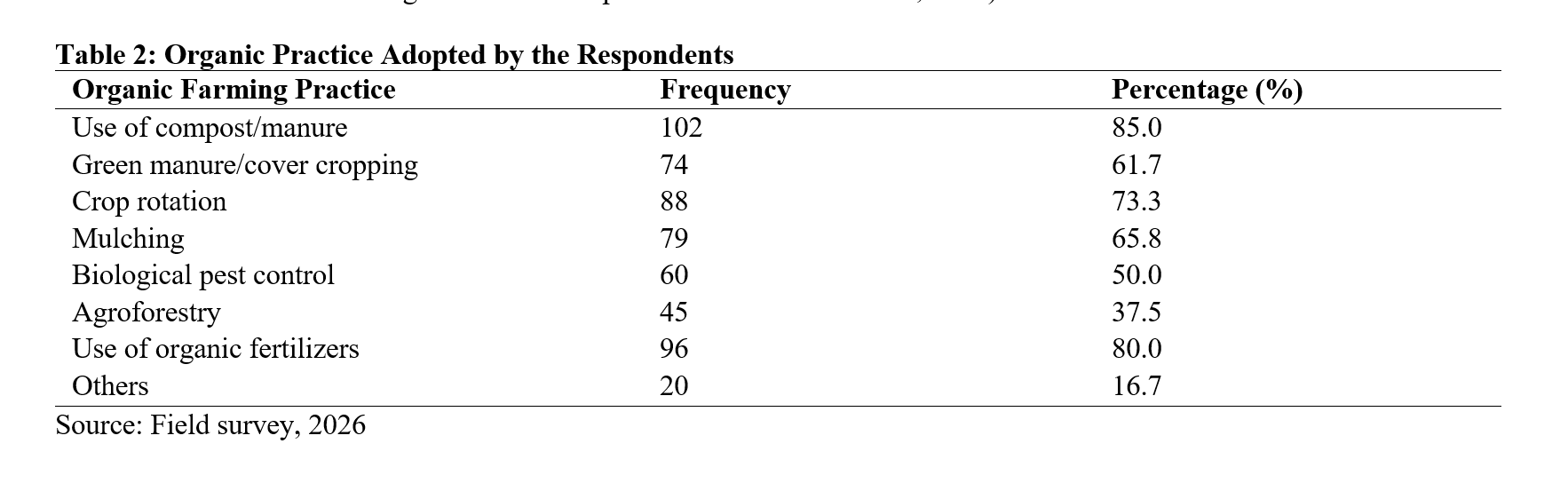
This study assessed the benefits of organic farming practices to vegetable farmers in Taraba State Agricultural Development Programme (ADP) Zone I, Nigeria. Specifically, the study determined the factors influencing adoption of organic farming practices. A multi-stage sampling technique was used to select 120 registered vegetable farmers. Primary data were obtained using structured questionnaires. Descriptive statistics and Binary logistic regression analysis were used to analyzed data. Findings revealed that the majority of respondents were male and within the active age group of 31–50 years, with an average household size of five persons and farming experience between 6–15 years. Major organic practices adopted includes compost/manure, organic fertilizers, crop rotation, and mulching. Regression results indicated that age, farming experience, farm size, income level, and perceived benefits significantly influenced the likelihood of deriving benefits from organic farming (p < 0.05). The study concluded that organic farming holds significant economic, environmental, and health benefits for vegetable farmers in Taraba State. It is therefore recommended that government agencies strengthen extension services, improve access to organic inputs, provide policy incentives, and support farmer cooperatives to promote sustainable organic farming adoption in the state.
References
Adebayo, S., & Oladele, I. O. (2014). Organic agricultural practices among small holder farmers in South Western Nigeria. In V. Pilipavicius (Ed.), Organic agriculture towards sustainability. IntechOpen. https://doi.org/10.5772/57598
Adejuyigbe, C. O., Adesodun, J. K., Harris, P. J. C., & Aiyelaagbe, I. O. O. (2012). Potential of on-farm produced compost and organic amendments in soil fertility management for organic maize production in southwestern Nigeria. Archives of Agronomy and Soil Science, 58(Suppl. 1), S170–S174. https://doi.org/10.1080/03650340.2012.696776
Central Bank of Nigeria (CBN). (2023). Annual Report and Statement of Accounts. Abuja: CBN Publications.
Eyhorn, F., Müller, A., Reganold, J. P., Frison, E., Herren, H. R., Luttikholt, L., Mueller, A., Sanders, J., Scialabba, N. E.-H., Seufert, V., & Smith, P. (2019). Sustainability in global agriculture driven by organic farming. Nature Sustainability, 2, 253–255. https://doi.org/10.1038/s41893-019-0266-6
Food and Agriculture Organization (FAO). (2022). The State of Food and Agriculture: Leveraging agricultural innovation for sustainable development. Rome: FAO.
Gomiero, T., Pimentel, D., & Paoletti, M. G. (2011). Environmental impact of different agricultural management practices: Conventional vs. organic agriculture. Critical Reviews in Plant Sciences, 30(1–2), 95–124. https://doi.org/10.1080/07352689.2011.554355
International Federation of Organic Agriculture Movements (IFOAM). (2021). Principles of organic agriculture. Bonn, Germany: IFOAM Press.
International Federation of Organic Agriculture Movements. (2021). Definition of organic agriculture. Retrieved from https://www.ifoam.bio/why-organic/organic-landmarks/definition-organicAESON Journal
Mbossoh, E. R., & Udoh, E. J. (2026). Drivers of choice and uptake of climate-smart agricultural practices among smallholder farmers in Nigeria. Discover Agriculture, 4, Article 25. https://doi.org/10.1007/s44279-026-00477-8
National Bureau of Statistics. (2024/2025). National Agricultural Sample Survey 2023: Agricultural household survey. Federal Republic of Nigeria, in collaboration with the Food and Agriculture Organization, Federal Ministry of Agriculture and Food Security, and World Bank.
National Population Commission (NPC). (2006). Population and Housing Census of the Federal Republic of Nigeria: National and State Population and Housing Tables. Abuja: NPC.
Ogungbaro, O. O., & Olaiya, K. A. (2024). Adoption drivers of organic vegetable farming practices among vegetable farmers in Oyo State, Nigeria. Agricultura Tropica et Subtropica, 57(1), 116–124. https://doi.org/10.2478/ats-2024-0012
Oluwasusi, J. O., & Akanni, Y. O. (2014). Effectiveness of extension services among food crop farmers in Ekiti State, Nigeria. Journal of Agricultural & Food Information, 15(4), 324–341. https://doi.org/10.1080/10496505.2014.952175
Reganold, J. P., & Wachter, J. M. (2016). Organic agriculture in the twenty-first century. Nature Plants, 2(2), Article 15221. https://doi.org/10.1038/nplants.2015.221
Taraba State Agricultural Development Programme (TADP). (2016). Annual Report. Jalingo: TADP.
Taraba State Government (TRSG). (2020). Taraba State Official Diary. Jalingo: Government Press.
Ukwuaba, I. C., Nze, C. B., Mukaila, R., Ukwuaba, S. I., Ume, C. O., Omeje, E. E., Onah, O. G., Onyekwe, C. N., & Umeh, O. J. (2025). Small-scale farmers’ uptake of eco-friendly vegetable production practices in Enugu State, Nigeria. Journal of Agricultural Extension.
Ume, C. (2023). The role of improved market access for small-scale organic farming transition: Implications for food security. Journal of Cleaner Production, 387, Article 135889. https://doi.org/10.1016/j.jclepro.2023.135889
Ume, C. O., Onah, O. G., Okpukpara, B. C., Chukwuma-Ume, N., Charles, U. I., Omeje, E. E., Chiemela, C. J., Chituru, I. J., & Orazulike, O. (2023). Factors influencing smallholder adoption of organic agriculture in Southeast geopolitical region of Nigeria. Frontiers in Sustainable Food Systems, 7, Article 1173043. https://doi.org/10.3389/fsufs.2023.1173043
Ume, C., & Bahta, Y. T. (2024). Policy support strategies for organic farming extensification in Nigeria. Organic Agriculture, 14, 323–344. https://doi.org/10.1007/s13165-024-00467-4
United Nations Development Programme (UNDP). (2021). Human Development Report 2021/2022: Sustainability and Equity. New York: UNDP.
World Bank. (2020). World Development Report: Agriculture for Development. Washington, DC: World Bank Publications
Downloads
Published
Issue
Section
Categories
License
Copyright (c) 2026 Muhammed Sahabi Abubakar, Zhintswen Ashumate Adi, Joshua Kafari

This work is licensed under a Creative Commons Attribution 4.0 International License.