
Assessment of Multidimensional Poverty Among Farming Households in Southern Taraba, Taraba State, Nigeria
DOI:
https://doi.org/10.33003/fjs-2026-1022-6276Keywords:
Assessment, Farming Households, Multidimensional Poverty, Southern TarabaAbstract
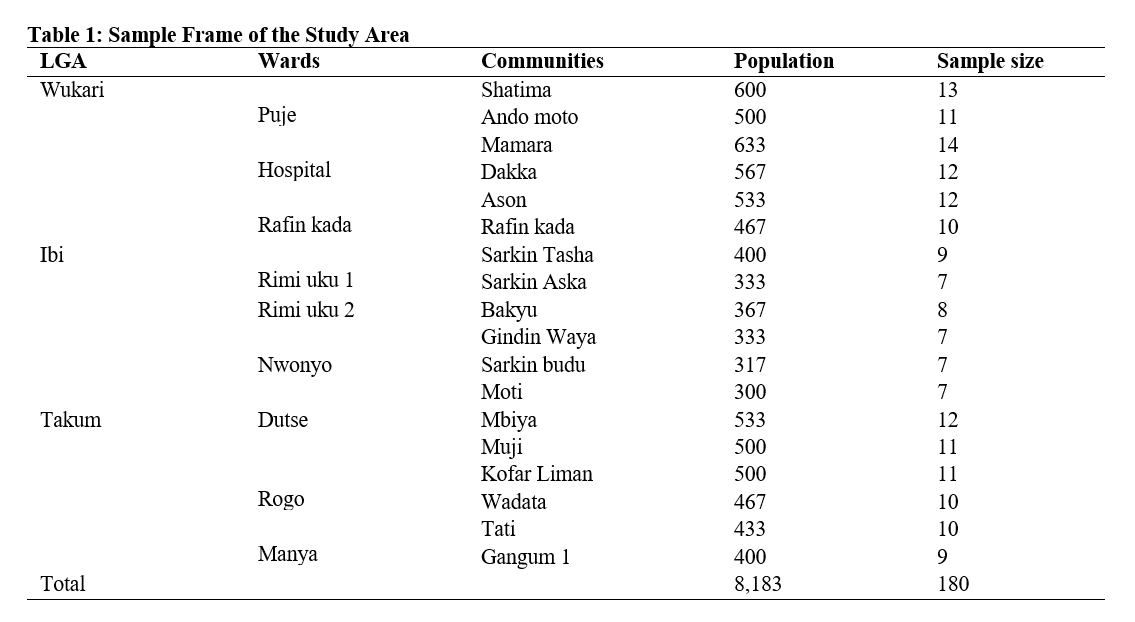
This study assessed multidimensional poverty and among farming households in Southern Taraba, Taraba State, Nigeria. A multistage sampling procedure was used to select 180 farming households, and data were collected using structured questionnaires. Data were analysed using descriptive statistics, deprivation scores, the Multidimensional Poverty Index (MPI), and a multiple regression model. The results showed that 54% of respondents were male, with a mean age of 40 years and an average e household size of six members. About 93% had formal education, the average farm size was 3 hectares, and farming was the primary occupation for 45% of respondents. Furthermore, 68% were married, 54% lacked access to credit, 62% were not members of farmers' associations, and 58% engaged in business as an additional source of income. The deprivation analysis revealed that the standard of living and health dimensions contributed most to multidimensional poverty. The Global MPI indicated that Wukari recorded the highest population share of poor households (40%) among the selected local government areas, while Shatima had the highest share (7.2%) among the sampled communities. The study concluded that multidimensional poverty is widespread among farming households in Southern Taraba and poses a challenge to improved livelihoods, peace, and stability. It recommends promoting farmers' participation in cooperative societies and implementing gender-responsive agricultural and poverty reduction programs.
References
Ajiboye, A., Amao, A. O., Oluwatusin, F. M. and Farayola C. O. (2020). Analysis of Poverty Status among Small Holder Arable Farm Households in Southwestern Nigeria. International Journal of Agriculture and Earth Science, 6 (2): 71-77.
Adeleke, R., Alabede, O., Joel, M., and Ashibuogwu, E. (2023). Exploring the geographical variations and influencing factors of poverty in Nigeria. Regional Science Policy & Practice, 15(6), 1182-1198.
Alaye, A., 2024. Comparative Assessment of Poverty Trends and Socioeconomic Inequality in Nigerian States. NIU Journal of Social Sciences, 10(2), pp.33-48.
Beatriz, F. (2016). Economic growth and poverty reduction in rapidly changing world. European Commission. European Economic Briefs 019.
Chen, K. M., Leu, C. H. and Wang, T. M. (2019). Measurement and Determinants of Multidimensional Poverty: Evidence from Taiwan. Social Indicators Research, 145: 459-478.
Dauda, R. S. (2017). Poverty and economic growth in Nigeria: Issues and policies. Journal of poverty, 21(1), 61-79.
Khan, M., Saboor, A., Rizwan, M. and Ahmad, T. (2020). An Empirical Analysis of Monetary and Multidimensional Poverty: Evidence from a Household Survey in Pakistan. Asia Pacific Journal of Social Work and Development, 30(2): 106-121.
Le, H. (2015). Multidimensional Poverty: Evidence from Vietnam. Economic Bulletin, 35(4), 2820–2831.
Michael, A., Tashikalma, A. K., Maurice, D. C., & Tafida, A. B. (2019). Analysis of multidimensional poverty in rural Adamawa State, Nigeria. Journal of Agribusiness and Rural Development, 3(53), 233–241. https://doi.org/10.17306/J.JARD.2019.01211
National Bureau of Statistics (NBS) (2017). Data Monitor. Abuja, Nigeria: NBS. Retrieved from www.nbs.gov.ng
NPC. 2006. National Population Census Report. Abuja: NPC. p. 18.
Onwuemele, A. (2015). Escalating Poverty in Nigeria: Appraising Institutional Frameworks for Poverty Reduction in Nigeria. International Journal of Economic Development Research and Investment, 6(1), 1–21.
Oxford Poverty and Human Development Initiative (OPHI). (2018). OPHI Country Briefing for Nigeria, June 2017. Oxford Department of International Development, Queen Elizabeth House. Oxford: University of Oxford.
Oyekale, T. O., Aboaba, K. A., Adewuyi, S. A. and Dada, D. A. (2019). Multidimensional Poverty among Rural Households in Ogun State, Nigeria. Journal of Agribusiness.
Thulo, R. B., & Mpundu, M. (2025). Multi-dimensional Poverty in South Africa; A narrative review of literature through a seven-lens approach. International Journal of Advanced Business Studies, 4(5), 67-119.
Udoh, A. J. (2025). Poultry Farming Policy and Poverty Reduction: An Assessment of the Dakkada Programme in Akwa Ibom State (2015–2023). IRASS Journal of Economics and Business Management, 2(2), 31-45.
United State Agency for International Development (2017). Nigeria Development Abuja, Nigeria. World Poverty Clock (2018). Nigeria Poverty Index. Retrieved from: https://www.worldpoverty.io/index
Downloads
Published
Issue
Section
Categories
License
Copyright (c) 2026 Molikah Olabisi Olayiwola, Godiya Bulus, Maryanne Odufa Egbeadumah

This work is licensed under a Creative Commons Attribution 4.0 International License.