
A Vector Autoregression (VAR) Model of the Dynamic Interrelationships Between Gross Domestic Product and Selected Demographic Variables in Nigeria
DOI:
https://doi.org/10.33003/fjs-2026-1019-6199Keywords:
VAR, ADF, Lag Length, Granger Causality, Demographic Variables, GDPAbstract
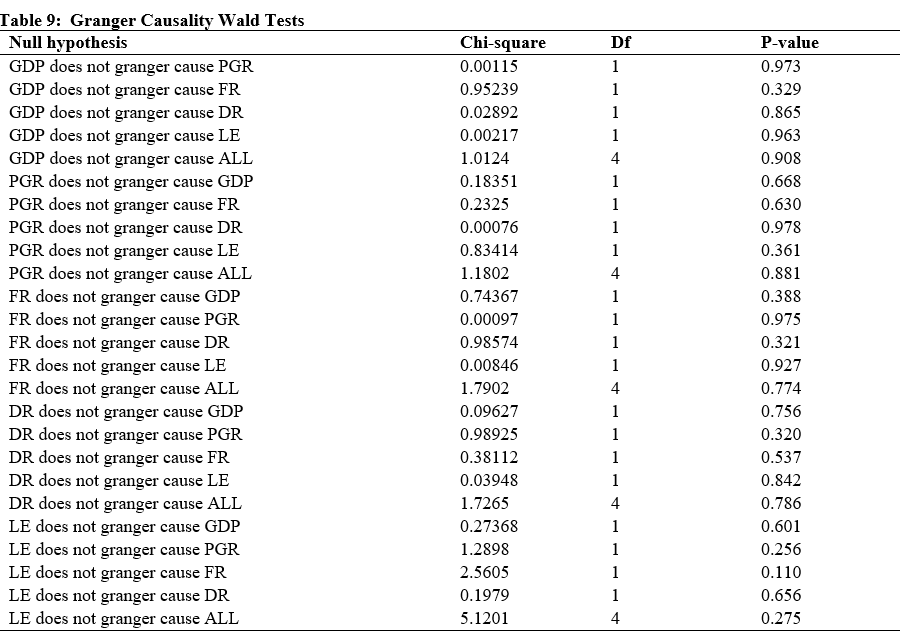
This paper examined the dynamic interrelationship between gross domestic product and selected demographic variables in Nigeria using a vector autoregression (VAR) model to capture the temporal interactions among the variables employing annual time series secondary data covering the period 1995-2025 (30 years). Augmented dickey-fuller unit-root test was employed to test the stationary of the variables. Descriptive statistics was also employed to examine the distributional properties of the variables. The optimal lag selection criteria were used to determine the optimal lag of the study variables. The Granger causality analysis was employed to determine the causal relationship among the study variables. The results revealed that GDP and demographic variables showed dynamic interactions over time. The Granger causality analysis showed limited evidence that past values of the demographic variables simultaneously improve the estimation of GDP. The study concludes that demographic change alone cannot be enough to generate gross domestic product in Nigeria. We recommend that demographic factor should be considered alongside other economic factors when evaluating economic performance in Nigeria.
References
Akaike, H. (1974). A new look at the statistical model identification. IEEE Transactions on Automatic Control, 19(6), 716-723.
Akinlo, A. E. and Salisu, A. A. (2019). Demographic transition and economic growth in Nigeria. Journal of Demographic Studies, 24(1), 33-50.
Barro, R. J. (2017). Determinants of economic growth in panel of countries. Annals of Economics and Finance. 4, 231-274.
Aniah-Betiang, E. I. (2025). A panel vector error correction model of the impact of demographic variables on human development in Nigeria. Joseph Sarwuan Tarka University, Makurdi.
Bătrancea, L., Rathnaswamy, M. M. and Bătrancea, I. (2021). A panel data analysis of economic growth determinants in 34 African countries. Journal of Risk and Financial Management, 14(6), 1-15.
Cancado, L.P. (2025). Economic growth: panel data evidence from Latin America, Ohio University, 285-292.
Dewan, E. and Hussein, S. (2020). Determinants of economic growth (panel data approach). Reserve Bank of Fiji, 35(2), 63-73.
Dickey, D. A., and Fuller, W. A. (1979). Distribution of the estimators for autoregressive time series with a unit root. Journal of the American Statistical Association, 74(366), 427-431.
Enders, W. (2015). Applied econometric time series (4th edition). Willey.
Granger, C. W. J. (1969). Investigating causal relations by econometric models and cross spectral methods. Econometrica, 37(2), 424-438.
Hamilton, J. D. (1994). Time series analysis. Princeton University Press.
Hannan, E. J., and Quinn, B. G. (1979). The determination of the order of an autoregression. Journal of the Royal Statistical Society: Series B (Methodological), 41(2), 190-195.
Lenka, S. K. and Sharma, P., (2024). FDI as a main determinant of economic growth: A panel data analysis. Annual Research Journal of Symbiosis Centre for Management Studies, Pune, 1, 84-97.
Lutkepohl, H. (2005). New introduction to multiple time series analysis. Springer.
Maduka, A. C., Maidiche, C. and Ekesiobi, C. (2018). Healthcare expenditure, health outcomes and economic growth nexus in Nigeria. A Toda-Yamamoto causality approach. Unified Journal of Economics and International Finance. 2(1), 1-10.
Manyeki, K.B. and Balazs, K. (2020). Income inequality and economic growth: An empirical analysis of Kenya. Udvari B (Ed) 2020: Proceedings of the 4th central European PhD. workshop technology technological change and development. University of Szeged, Doctoral School in Economics Szeged, 338-356.
Ndambiri, H.K., Ritho C., Ng’ang’a S.I., Kubowon, P.C., Mairura F.C., Nyangweso, P.M., Muiruri, E.M., and Cherotwo, F.H., (2022). Determinants of economic growth in sub Saharan Africa: A panel data approach. International Journal of Economics and Management Sciences, 2(2), 18-24.
Olayemi, O. O. and Oyelami, T. O. (2021). Demographic dividend and economic growth in West Africa: Threshold effect analysis. West African Journal of Monetary and Economic Integration, 21(1), 75-99
Omosanya, O. and Lawal, A. A., (2020). Determinants of economic growth in sub-Saharan African countries: panel data approach. Royal Statistical Society Nigeria Local Group Annual Conference Proceedings, 3(2), 56-68.
Samsuddin, M. A. and Amar, S. (2020). Determinants of economic growth in developing countries of G20 members. Advances in Economics, Business and Management Research. 152, 177-183.
Schwarz, G. (1978). Estimating the dimension of a model. The Annals of Statistics, 6(2), 461-464.
Sher, A., Amjad, A. and Amjad, A. (2017): The impact of population growth on economic development in Pakistan. Middle-East Journal of Scientific Research, 18(4), 483-491
Sims, C. A. (1980). Macroeconomics and reality. Econometrica, 48(1), 1-48.
Upreti, P. (2019). Factors affecting economic growth in developing countries. Major Themes in Economics, 17(1), 37-54.
Wahyudi, S. T., and Jantan, M. D., (2022). The determinants of economic growth in ASEAN 4 countries: an application of Solow-Swan and Mankiew-Romer-Weil models. China-USA Business Review, 4(11), 462-473.
Yusuf, S. A. and Abdullahi, A. A. (2020). Demographic transition and economic growth in Nigeria: A VECM approach. Nigerian Journal of Economic and Social Studies, 62(2), 205-228.
Downloads
Published
Issue
Section
Categories
License
Copyright (c) 2026 2Elizabeth Ishagba, Aniah- Betiang, Clement Vakang Tari, Mohammed Hamza, Gyegwe Fanyam, Salisu Isah

This work is licensed under a Creative Commons Attribution 4.0 International License.