In Silico Evaluation of Curcuma longa Curcuminoids as Dual (COX-2) / (5-LOX) Inhibitors
DOI:
https://doi.org/10.33003/fjs-2026-1020-6195Keywords:
Curcumin; Curcuma longa, Molecular docking, Dual COX-2/5-LOX inhibition, Anti-inflammatory, In silicoAbstract
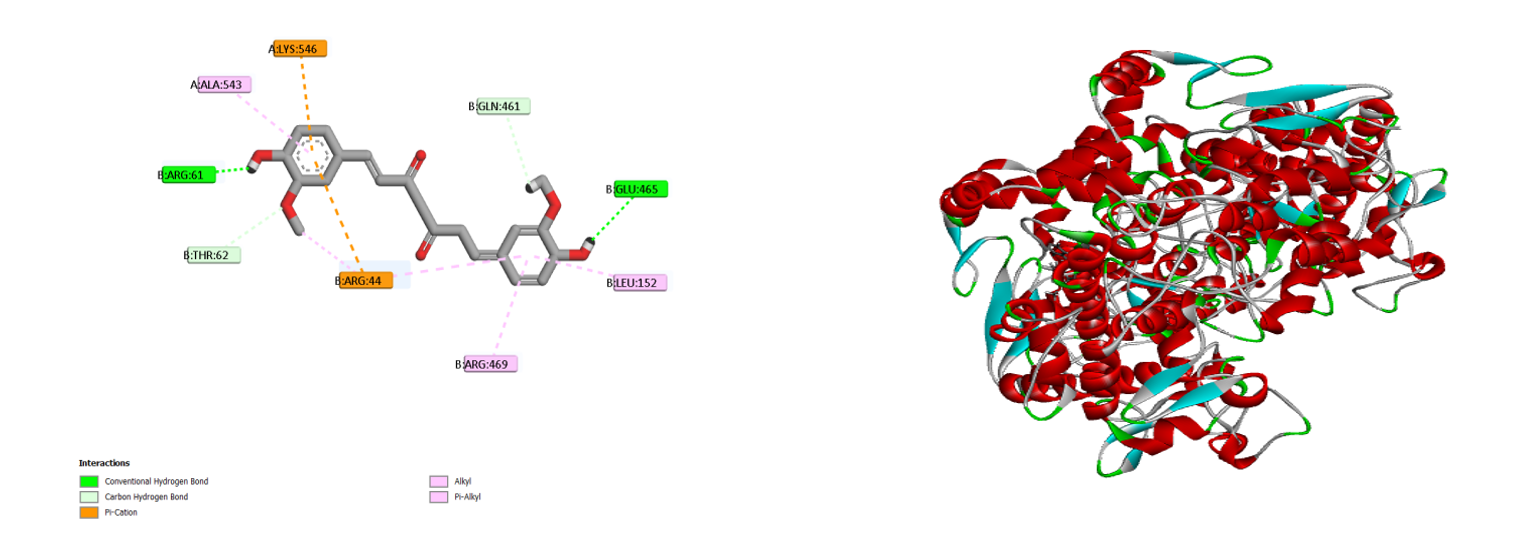
Inflammation is a major contributor to chronic diseases, including diabetes, cancer, and cardiovascular disorders, and is regulated by the arachidonic acid cascade through cyclooxygenase-2 (COX-2) and 5-lipoxygenase (5-LOX). Conventional anti-inflammatory drugs, such as nonsteroidal anti-inflammatory drugs (NSAIDs) and selective COX-2 inhibitors, are associated with gastrointestinal, cardiovascular, and renal toxicities. Moreover, selective COX-2 inhibition may induce the "arachidonic acid shunt," increasing leukotriene production via the 5-LOX pathway. Consequently, simultaneous inhibition of COX-2 and 5-LOX represents a promising therapeutic strategy. This study employed in silico methods to evaluate the dual inhibitory potential of curcumin, demethoxycurcumin (DMC), and bis-demethoxycurcumin (BDMC) from Curcuma longa against COX-2 (PDB: 5F19) and 5-LOX (PDB: 7TTK), using celecoxib, ibuprofen, licofelone, and zileuton as reference drugs. Molecular docking was performed using Molegro Virtual Docker following protocol validation (RMSD < 2.0 Å), while binding interactions and pharmacokinetic properties were analysed using Discovery Studio, SwissADME, and pkCSM. Curcumin demonstrated the strongest dual inhibitory activity, with MolDock scores of −133.272 kcal/mol for COX-2 comparable to celecoxib (-138.129 kcal/mol), −143.172 kcal/mol for 5-LOX superior to zileuton (-88.474 kcal/mol), and formed hydrogen bonding, electrostatic, and hydrophobic interactions with ARG-61, GLU-465, GLN-437, and ARG-438 residues. Bis-demethoxycurcumin also exhibited favourable dual binding affinity (−127.373 and −122.126 kcal/mol for COX-2 and 5-LOX). All three curcuminoids complied with Lipinski's Rule of Five, showed good gastrointestinal absorption, and were predicted to be non-mutagenic and non-hepatotoxic, although CYP3A4 inhibition warrants further investigation.
References
Agboola, O. E., Agboola, S. S., Fadugba, A. E., Adegbuyi, A. T., & Odeghe, O. B. (2025). Computational analysis of Curcuma longa L compounds: Unraveling molecular interactions and drug-like properties for novel therapeutic applications. Next Research, 2(2), 100283. https://doi.org/10.1016/j.nexres.2025.100283.
Alabi, M. A., Adebara, D. S., Jamiu, H. A., Ayuba, A. K., Alli, A., Oluokun, R. A., & Ajani, E. (2026). Acanthus montanus phytochemicals as potential multi-target therapeutics for uterine fibroids: An integrated GC-MS, network pharmacology, and molecular dynamics study. FUDMA Journal of Sciences, 10(18), 181–195. https://doi.org/10.33003/fjs-2026-1018-5562
Alessandri, A. L., Sousa, L., Lucas, C. D., Rossi, A., Pinho, V., & Teixeira, M. (2013). Resolution of inflammation: mechanisms and opportunity for drug development. Pharmacology & therapeutics, 139 2, 189-212 . https://doi.org/10.1016/j.pharmthera.2013.04.006.
Alhyari, D., Qinna, N., Sheldrake, H. M., Kantamneni, S., Ghanem, B. Y., & Paluch, K. (2025). Antioxidant, Anti-Inflammatory, and Oral Bioavailability of Novel Sulfonamide Derivatives of Gallic Acid. Antioxidants, 14 . https://doi.org/10.3390/antiox14040374.
Bošković, J., Dobričić, V., Mihajlović, M., Kotur-Stevuljević, J., & Čudina, O. (2023). Synthesis, evaluation of enzyme inhibition and redox properties of potential dual COX-2 and 5-LOX inhibitors. Pharmaceuticals, 16(4), 549. https://doi.org/10.3390/ph16040549.
Carson, S., Ousmanou, A., & Hoyler, S. L. (2025). Emerging significance of P-glycoprotein in understanding drug disposition and drug interactions in psychopharmacology. Psychopharmacology bulletin, 36 (1), 67-81 . https://doi.org/10.64719/pb.4231.
Cheng, X., Kong, D., Li, Y., Bian, G., & Li, D. (2022). Screening of dual targeted inhibitors of 5-lipoxygenase and cyclooxygenase-2 from Oroxylum indicum by off-line two-dimensional liquid chromatography coupled with mass spectrometry. Industrial Crops and Products, 186, 115243. https://doi.org/10.1016/j.indcrop.2022.115243.
Chung, H., Kim, D. H., Lee, E., Chung, K., Chung, S., Lee, B., Seo, A. Y., Chung, J., Jung, Y.-S., Im, E., Lee, J., Kim, N., Choi, Y. J., Im, D., & Yu, B. (2019). Redefining Chronic Inflammation in Aging and Age-Related Diseases: Proposal of the Seno inflammation Concept. Aging and Disease, 10, 367 - 382. https://doi.org/10.14336/ad.2018.0324
Coumau, C., & Csajka, C. (2025). A Systematic Review and Classification of the Effects of P-glycoprotein Inhibitors and Inducers in Humans, Using Digoxin, Fexofenadine, and Dabigatran as Probe Drugs. Clinical Pharmacokinetics, 64, 849 - 863. https://doi.org/10.1007/s40262-025-01514-3.
Daina, A., Michielin, O., & Zoete, V. (2017). SwissADME: A free web tool to evaluate pharmacokinetics, drug-likeness and medicinal chemistry friendliness of small molecules. Scientific Reports, 7, 42717. https://doi.org/10.1038/srep42717.
Ekoro, I. A., & Odeja, O. O. (2026). Molecular docking and theoretical toxicity assessment of bioactive constituents of leaf and root bark essential oils from Spondia dulcis. FUDMA Journal of Sciences, 10(3), 119–129. https://doi.org/10.33003/fjs-2026-1003-4601
Elgohary, M. K., Abd El Hadi, S. R., Abo-Ashour, M. F., Abo-El Fetoh, M. E., Afify, H., Abdel-Aziz, H. A., & Abou-Seri, S. M. (2023). Fragment merging approach for the design of thiazole/thiazolidine clubbed pyrazoline derivatives as anti-inflammatory agents: Synthesis, biopharmacological evaluation and molecular modeling studies. Bioorganic Chemistry, 139, 106724. https://doi.org/10.1016/j.bioorg.2023.106724.
Er-rajy M, El fadili M, Zarougui S, Mujwar S, Aloui M, Zerrouk M, Hammouti B, Rhazi L, Sabbahi R, Alanazi MM, Azzaoui K, Salghi R and Elhallaoui M (2025) Design and evaluation of novel triazole derivatives as potential anti-gout inhibitors: a comprehensive molecular modeling study. Front. Chem. 13, 1518777. https://doi.org/10.3389/fchem.2025.1518777.
Feehan, K. T., & Gilroy, D. (2019). Is Resolution the End of Inflammation? Trends in molecular medicine, 25 (3), 198-214 . https://doi.org/10.1016/j.molmed.2019.01.006.
Gadnayak, A., Dehury, B., Nayak, A., Jena, S., & Sahoo, A. (2022). Insights into 5-lipoxygenase inhibition by active principles derived from essential oils of Curcuma species: Molecular docking, ADMET analysis and molecular dynamics. PLoS ONE, 17(8), e0271956. https://doi.org/10.1371/journal.pone.0271956.
Hu, S., Liang, L., Peng, X., Zhang, W., Li, W., Deng, J., Zhong, F., Lin, Q., Zhou, P., He, J., Luo, F., & Mwaikono, K. S. (2026). Natural sources and bioactive mechanisms of anti-inflammatory peptides: from digestive metabolism to bioavailability enhancement strategies.. Food chemistry, 506, 148069 . https://doi.org/10.1016/j.foodchem.2026.148069.
Ibrahim, S. O., Ayipo, Y. O., Lukman, H. Y., Abubakar, F. A., Na'Allah, A., Katibi-Abdullahi, R. A., Zubair, M. F., & Atolani, O. (2025). De novo in silico screening of natural products for antidiabetic drug discovery: ADMET profiling, molecular docking, and molecular dynamics simulations. In silico pharmacology, 13(1), 29. https://doi.org/10.1007/s40203-025-00320-w.
Idris, M. H. M., Amin, S. N. M., Nyokat, N., Khong, H. Y., Selvaraj, M., Zakaria, Z. A., Shaameri, Z., Hamzah, A. S., Teh, L. K., & Salleh, M. Z. (2022). Flavonoids as dual inhibitors of cyclooxygenase-2 (COX-2) and 5-lipoxygenase (5-LOX): Molecular docking and in-vitro studies. Beni-Suef University Journal of Basic and Applied Sciences, 11(1). https://doi.org/10.1186/s43088-022-00296-y.
Lan, Z., Yang, R., Wang, H., Xue, X., Sun, Y., Wang, S., Zhang, Y., & Meng, J. (2024). Rapid identifying of COX-2 inhibitors from turmeric (Curcuma longa) by bioaffinity ultrafiltration coupled with UPLC-QExactive-Orbitrap-MS and zebrafish-based in-vivo validation. Bioorganic Chemistry, 147, 107357. https://doi.org/10.1016/j.bioorg.2024.107357.
Mari van de Vyver (2023) Immunology of chronic low-grade inflammation: relationship with metabolic function. J Endocrinol , 257 (1), e220271. https://doi.org/10.1530/JOE-22-0271.
Mbadiko, C., Bongo, G., Matondo, A., Kilembe, J., & Nzundu, J. P. (2024). In silico analysis of the anti-inflammatory activity of curcuminoids and/or curcumin metabolites on Cox-1 and Cox-2. Research Square (Preprint). https://doi.org/10.21203/rs.3.rs-4930657.
Mohan, M., Hussain, M. A., Khan, F. A., & Anindya, R. (2021). Symmetrical and un-symmetrical curcumin analogues as selective COX-1 and COX-2 inhibitor. European Journal of Pharmaceutical Sciences, 160, 105743. https://doi.org/10.1016/j.ejps.2021.105743.
Nathan, C., & Ding, A. (2010). Non-resolving inflammation. Cell, 140(6), 871-82 . https://doi.org/10.1016/j.cell.2010.02.029.
Nathaniel, J., Ifediorah, S., & Tukur, M. I. (2026). Molecular characterization and evaluation of bioactive compounds from selected medicinal plant extracts against mastitis-causing pathogens among dairy cattle in Minna, Niger State, Nigeria. FUDMA Journal of Sciences, 10(17), 409–415. https://doi.org/10.33003/fjs-2026-1017-6110
Nguyen, T.-T.-L., Duong, V.-A., & Maeng, H. (2021). Pharmaceutical Formulations with P-Glycoprotein Inhibitory Effect as Promising Approaches for Enhancing Oral Drug Absorption and Bioavailability. Pharmaceutics, 13. https://doi.org/10.3390/pharmaceutics13071103.
Noti, V., Pontiki, E., & Hadjipavlou-Litina, D. (2023). Development of novel pyrrole derivatives and their cinnamic hybrids as dual COX-2/LOX inhibitors. Molecules, 28(24), 7958. https://doi.org/10.3390/molecules28247958.
Okoh, E.U. & Aiwonegbe, A.E. (2026). Screening of antimicrobial phytochemicals from Allium sativum against bacterial and fungal drug targets: Insights from molecular docking and ADMET analysis. Mediterranean Journal of Medical Research. 3(3), 289-300. https://doi.org/10.5281/zenodo.22816383.
Parvin, M. S., Shakib, M. S. I., Hossain, M. S., & Sinthi, A. T. (2025). Computational profiling of anti-inflammatory phytochemicals targeting 5-LOX and COX-2 pathways: PASS prediction, molecular docking and ADMET analysis. Chemico-Biological Interactions, 406, 111402. https://doi.org/10.1016/j.cbi.2025.111402.
Pires, D. E. V., Blundell, T. L., & Ascher, D. B. (2015). pkCSM: Predicting small-molecule pharmacokinetic and toxicity properties using graph-based signatures. Journal of Medicinal Chemistry, 58(9), 4066–4072. https://doi.org/10.1021/acs.jmedchem.5b00104.
Rafiyan, M., Sadeghmousavi, S., Akbarzadeh, M., & Rezaei, N. (2023). Experimental animal models of chronic inflammation. Current Research in Immunology, 4. https://doi.org/10.1016/j.crimmu.2023.100063.
Rudrapal, M., Eltayeb, W. A., Rakshit, G., El-Arabey, A. A., & Khan, J. (2023). Dual synergistic inhibition of COX and LOX by potential chemicals from Indian daily spices investigated through detailed computational studies. Scientific Reports, 13(1), 7747. https://doi.org/10.1038/s41598-023-35161-0.
Saha, S. (2024). The ethnomedicinal profiles and pharmacological properties of phytochemicals from Curcuma longa Linn. – A decade update. Chemistry Select, 9(47), e202402443. https://doi.org/10.1002/slct.202402443.
Singh, A., Soni, U., Varadwaj, P. K., & Misra, K. (2025). Anti-inflammatory effect of curcumin in an accelerated senescence model of Wistar rat: An in vivo and in silico study. Journal of Biomolecular Structure and Dynamics, 43(3), 1234–1248. https://doi.org/10.1080/07391102.2023.2291832.
Soliman, A. M., Soliman, M., Shah, S. S. H., Baig, H., Gouda, N., Alenezi, B., Alenezy, A., Hegazy, A. M. S., Jan, M., & Eltom, E. (2025). Molecular dynamics of inflammation resolution: therapeutic implications. Frontiers in Cell and Developmental Biology, 13. https://doi.org/10.3389/fcell.2025.1600149.
Thomsen, R., & Christensen, M. H. (2006). MolDock: A new technique for high-accuracy molecular docking. Journal of Medicinal Chemistry, 49(11), 3315–3321. https://doi.org/10.1021/jm051197e.
Vyshnevska, L., Severina, H. I., Prokopenko, Y., & Shmalko, A. (2022). Molecular docking investigation of anti-inflammatory herbal compounds as potential LOX-5 and COX-2 inhibitors. Pharmacia, 69(3), 733–744. https://doi.org/10.3897/pharmacia.69.e89400.
Wang, Y., Shang, Y., Tang, F., Qiu, K., Wei, X., & Wang, Z. (2023). Self-Double-Emulsifying Drug Delivery System Enteric-Coated Capsules: A Novel Approach to Improve Oral Bioavailability and Anti-inflammatory Activity of Panax notoginseng Saponins. AAPS PharmSciTech, 24, 1-15. https://doi.org/10.1208/s12249-023-02549-0.
Downloads
Published
Issue
Section
Categories
License
Copyright (c) 2026 Sarah Oseakhumen Egbele, Anthony Egbeyanebhonlen Aiwonegbe

This work is licensed under a Creative Commons Attribution 4.0 International License.