
Artificial Intelligence in Environmental Research: Applications, Challenges and Future Directions A Narrative Review
DOI:
https://doi.org/10.33003/fjs-2026-1019-6188Keywords:
Artificial intelligence, Machine learning, Deep learning, Environmental monitoring, Climate change, Biodiversity conservation, Remote sensing, SustainabilityAbstract
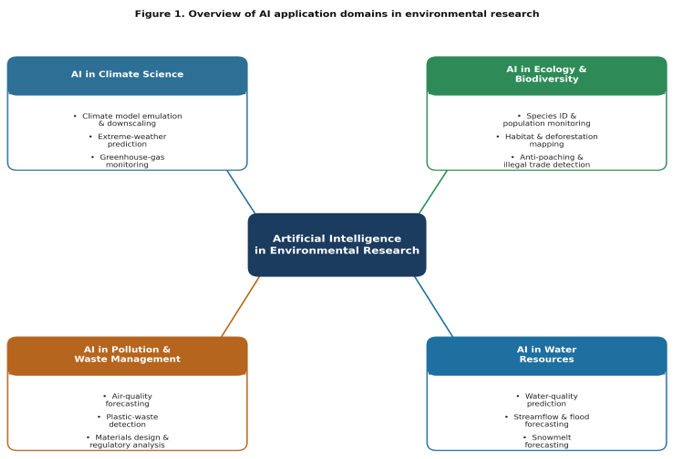
Climate change, biodiversity loss, and pollution are producing environmental data whose volume, velocity, and complexity increasingly surpass the capabilities of conventional analytical methods. Artificial intelligence (AI), particularly machine learning (ML) and deep learning (DL), is being rapidly adopted to analyse these data; however, evidence regarding its performance remains dispersed across disciplines. This narrative review synthesises peer-reviewed literature identified through structured searches of Scopus, Web of Science, and Google Scholar (1997–2026), selected according to explicit inclusion criteria and organized thematically. The review examines AI applications in four domains: climate science (model emulation, downscaling, precipitation nowcasting, and methane detection); ecology and biodiversity conservation (species identification, habitat mapping, and wildlife-trade surveillance); pollution and waste management (air-quality forecasting, plastic detection, and materials design); and water resources (water-quality, streamflow, and flood forecasting). Across these domains, the most robust evidence is found in data-rich settings where AI models have been benchmarked against established physical or statistical methods. Conversely, many other applications, particularly in the Global South, remain at the proof-of-concept or simulation stage. Persistent limitations include scarce and spatially biased training data, limited interpretability, weak transferability between regions, and the energy and carbon costs associated with training large models. Additionally, concerns regarding equity, privacy, and human rights are emerging. This review concludes that AI is most valuable as a complement to, rather than a replacement for, process-based understanding and field observation. It identifies local data infrastructure, independent validation, interpretable and energy-efficient models, and equitable research partnerships as key priorities.
References
AghaKouchak, A., Farahmand, A., Melton, F. S., Teixeira, J., Anderson, M. C., Wardlow, B. D., & Hain, C. R. (2015). Remote sensing of drought: Progress, challenges and opportunities. Reviews of Geophysics, 53(2), 452–480. https://doi.org/10.1002/2014RG000456
Ahumada, J. A., Fegraus, E., Birch, T., Flores, N., Kays, R., O’Brien, T. G., ... & Dancer, A. (2020). Wildlife insights: A platform to maximize the potential of camera trap and other passive sensor wildlife data for the planet. Environmental Conservation, 47(1), 1-6.
Alotaibi, E., & Nassif, N. (2024). Artificial intelligence in environmental monitoring: In-depth analysis. Discover Artificial Intelligence, 4, Article 84. https://doi.org/10.1007/s44163-024-00198-1
Ball-Damerow, J. E., Brenskelle, L., Barve, N., Soltis, P. S., Sierwald, P., Bieler, R., LaFrance, R., Ariño, A. H., & Guralnick, R. P. (2019). Research applications of primary biodiversity databases in the digital age. PLOS ONE, 14(9), Article e0215794. https://doi.org/10.1371/journal.pone.0215794
Belis, C. A., Favez, O., Mircea, M., Diapouli, E., Manousakas, M.-I., Vratolis, S., Gilardoni, S., Paglione, M., Decesari, S., Mocnik, G., Mooibroek, D., Salvador, P., Takahama, S., Vecchi, R., & Paatero, P. (2019). European guide on air pollution source apportionment with receptor models: Revised version 2019 (EUR 29816 EN). Publications Office of the European Union. https://doi.org/10.2760/439106
Biermann, L., Clewley, D., Martinez-Vicente, V., & Topouzelis, K. (2020). Finding plastic patches in coastal waters using optical satellite data. Scientific Reports, 10(1), Article 5364. https://doi.org/10.1038/s41598-020-62298-z
Chan, H. W. H., & Lo, N. P. K. (2025). A study on human rights impact with the advancement of artificial intelligence. Journal of Posthumanism, 5(issue), 1114–1153. https://doi.org/[DOI]
Chen, R., Zhang, W., & Wang, X. (2020). Machine learning in tropical cyclone forecast modeling: A review. Atmosphere, 11(7), Article 676. https://doi.org/10.3390/atmos11070676
Chen, Z., Yuan, J., Liu, J., Zhang, D., Guo, H., Wu, P., & Zhuang, S. (2026). Artificial intelligence-aided new paradigm of environmental research. Artificial Intelligence & Environment, 1(1), 23-32.
Croce, A., Ugo, F., Roveta, A., Bertolina, C., Rinaudo, C., Maconi, A., & Bertolotti, M. (2025). Strengths and weaknesses of artificial intelligence in exploring asbestos history and regulations across countries. Geosciences, 15(10), Article 395. https://doi.org/10.3390/geosciences15100395
Dangiwa, A., & Ndawayo, B. A. (2026). Geospatial Analysis and Quadratic Regression Modelling of Soil Chemical Properties and Exchangeable Sodium in Aridisols of Sahel Savannah for Sustainable Soil Management. FUDMA Journal of Sciences, 10(18), 1-9.
Devisri, P., & Manjula, S. (2026). A New Era of Environmental Protection: The AI Revolution. In Smart Forestry 5.0 for Powered AI Sustainable Environment and Climate (pp. 129-145). Cham: Springer Nature Switzerland.
Di Minin, E., Fink, C., Tenkanen, H., & Hiippala, T. (2018). Machine learning for tracking illegal wildlife trade on social media. Nature Ecology & Evolution, 2(3), 406–407. https://doi.org/10.1038/s41559-018-0466-x
Fournier, C., Fernandez-Fernandez, R., Cirés, S., López-Orozco, J. A., Besada-Portas, E., & Quesada, A. (2024). LSTM networks provide efficient cyanobacterial blooms forecasting even with incomplete spatio-temporal data. Water Research, 267, Article 122553. https://doi.org/10.1016/j.watres.2024.122553
Gu, Y., Zhang, H., Xu, Z., Ren, R., Kong, X., Wang, Y., ... & Zhang, J. (2025). Design and application of electrocatalyst based on machine learning. Interdisciplinary Materials, 4(3), 456-479.
Guo, Z., Huang, L., Yan, J., Zhang, H., Jia, X., Li, M., & Li, H. (2025). Artificial intelligence technology in environmental research and health: Development and prospects. Environment international, 109788.
Hampton, S. E., Strasser, C. A., Tewksbury, J. J., Gram, W. K., Budden, A. E., Batcheller, A. L., Duke, C. S., & Porter, J. H. (2013). Big data and the future of ecology. Frontiers in Ecology and the Environment, 11(3), 156–162. https://doi.org/10.1890/120103
Hansen, M. C., Potapov, P. V., Moore, R., Hancher, M., Turubanova, S. A., Tyukavina, A., Thau, D., Stehman, S. V., Goetz, S. J., Loveland, T. R., Kommareddy, A., Egorov, A., Chini, L., Justice, C. O., & Townshend, J. R. G. (2013). High-resolution global maps of 21st-century forest cover change. Science, 342(6160), 850–853. https://doi.org/10.1126/science.1244693
Hochreiter, S., & Schmidhuber, J. (1997). Long short-term memory. Neural Computation, 9(8), 1735–1780. https://doi.org/10.1162/neco.1997.9.8.1735
Hrytsulyak, H., & Yevnika, R. (2025). Environmental chemistry: An in-depth analysis of the scientific discipline. In Latest theories and technologies for the development of scientific research: Proceedings of the XXIV International Scientific and Practical Conference (p. 45). European Conference. https://eu-conf.com/
Intergovernmental Panel on Climate Change. (2022). Climate change 2022: Impacts, adaptation and vulnerability. Contribution of Working Group II to the Sixth Assessment Report of the Intergovernmental Panel on Climate Change. Cambridge University Press. https://doi.org/10.1017/9781009325844
Intergovernmental Science-Policy Platform on Biodiversity and Ecosystem Services. (2019). Summary for policymakers of the global assessment report on biodiversity and ecosystem services. IPBES Secretariat. https://doi.org/10.5281/zenodo.3553579
Irakulis-Loitxate, I., Guanter, L., Liu, Y. N., Varon, D. J., Maasakkers, J. D., Zhang, Y., ... & Jacob, D. J. (2021). Satellite-based survey of extreme methane emissions in the Permian basin. Science Advances, 7(27), eabf4507.
Islam, F. S. (2025). The role of artificial intelligence in environmental monitoring for sustainable development and future perspectives. Journal of Global Ecology and Environment, 21(2), 164-179.
Islam, F. S. (2025a). Artificial intelligence-driven smart waste-to-energy networks for climate-resilient circular resource management in vulnerable megacities. International Journal of Environment and Climate Change, 15(7), 381-415.
Islam, F. S. (2025b). A comprehensive analysis of air pollution in Dhaka City, Bangladesh, and the application of artificial intelligence and machine learning for enhanced management and forecasting. International Journal of Applied and Natural Sciences, 3(1), 131-167.
Jadhav, B., Kulkarni, A., Khang, A., Kulkarni, P., & Kulkarni, S. (2025). Beyond the horizon: Exploring the future of artificial intelligence (ai) powered sustainable mobility in public transportation system. In Driving green transportation system through artificial intelligence and automation: Approaches, technologies and applications (pp. 397-409). Cham: Springer Nature Switzerland.
Kratzert, F., Klotz, D., Brenner, C., Schulz, K., & Herrnegger, M. (2018). Rainfall–runoff modelling using Long Short-Term Memory (LSTM) networks. Hydrology and Earth System Sciences, 22(11), 6005–6022. https://doi.org/10.5194/hess-22-6005-2018
Krizhevsky, A., Sutskever, I., & Hinton, G. E. (2012). ImageNet classification with deep convolutional neural networks. In F. Pereira, C. J. C. Burges, L. Bottou, & K. Q. Weinberger (Eds.), Advances in neural information processing systems (Vol. 25, pp. 1097–1105). Curran Associates.
LeCun, Y., Bengio, Y., & Hinton, G. (2015). Deep learning. Nature, 521(7553), 436–444. https://doi.org/10.1038/nature14539
Li, J., Knapp, D. E., Fabina, N. S., Kennedy, E. V., Larsen, K., Lyons, M. B., ... & Asner, G. P. (2020). A global coral reef probability map generated using convolutional neural networks. Coral Reefs, 39(6), 1805-1815.
Malik, A., Sharma, S., Batra, I., Sharma, C., Kaswan, M. S., & Garza-Reyes, J. A. (2024). Industrial revolution and environmental sustainability: an analytical interpretation of research constituents in Industry 4.0. International Journal of Lean Six Sigma, 15(1), 22-49.
Nearing, G., Cohen, D., Dube, V., Gauch, M., Gilon, O., Harrigan, S., ... & Matias, Y. (2024). Global prediction of extreme floods in ungauged watersheds. Nature, 627(8004), 559-563.
ODUMO, N., & Epelle, B. C. (2026). Comparative Review of Intelligent Flood Monitoring and Risk Assessment Systems: An IoT–Random Forest Perspective. FUDMA Journal of Sciences, 10(16), 509-515.
Raissi, M., Perdikaris, P., & Karniadakis, G. E. (2019). Physics-informed neural networks: A deep learning framework for solving forward and inverse problems involving nonlinear partial differential equations. Journal of Computational Physics, 378, 686–707. https://doi.org/10.1016/j.jcp.2018.10.045
Ravuri, S., Lenc, K., Willson, M., Kangin, D., Lam, R., Mirowski, P., ... & Mohamed, S. (2021). Skilful precipitation nowcasting using deep generative models of radar. Nature, 597(7878), 672-677.
Rawat, K. S., & Yadav, M. (2025). Decoding the intellectual landscape and evolving research paradigm of artificial intelligence in environmental sustainability. IEEE Internet of Things Journal, 12(21), 44343-44366.
Rolnick, D., Donti, P. L., Kaack, L. H., Kochanski, K., Lacoste, A., Sankaran, K., ... & Bengio, Y. (2022). Tackling climate change with machine learning. ACM computing surveys (CSUR), 55(2), 1-96.
Rudin, C. (2019). Stop explaining black box machine learning models for high stakes decisions and use interpretable models instead. Nature machine intelligence, 1(5), 206-215.
Schuit, B. J., Maasakkers, J. D., Bijl, P., Mahapatra, G., Van den Berg, A. W., Pandey, S., ... & Aben, I. (2023). Automated detection and monitoring of methane super-emitters using satellite data. Atmospheric Chemistry and Physics Discussions, 2023, 1-47.
Sethi, S. S., Jones, N. S., Fulcher, B. D., Picinali, L., Clink, D. J., Klinck, H., Orme, C. D. L., Wrege, P. H., & Ewers, R. M. (2020). Characterizing soundscapes across diverse ecosystems using a universal acoustic feature set. Proceedings of the National Academy of Sciences, 117(29), 17049–17055. https://doi.org/10.1073/pnas.2004702117
Sønderby, C. K., Espeholt, L., Heek, J., Dehghani, M., Oliver, A., Salimans, T., Agrawal, S., Hickey, J., & Kalchbrenner, N. (2020). MetNet: A neural weather model for precipitation forecasting (arXiv:2003.12140). arXiv. https://doi.org/10.48550/arXiv.2003.12140
Sourek, M. (2025). Artificial intelligence in architecture and the built environment: The revolution yet to come. CRC Press.
Strubell, E., Ganesh, A., & McCallum, A. (2019). Energy and policy considerations for deep learning in NLP. In Proceedings of the 57th Annual Meeting of the Association for Computational Linguistics (pp. 3645–3650). Association for Computational Linguistics. https://doi.org/10.18653/v1/P19-1355
Torney, C. J., Lloyd‐Jones, D. J., Chevallier, M., Moyer, D. C., Maliti, H. T., Mwita, M., ... & Hopcraft, G. C. (2019). A comparison of deep learning and citizen science techniques for counting wildlife in aerial survey images. Methods in Ecology and Evolution, 10(6), 779-787.
Vandal, T., Kodra, E., Ganguly, S., Michaelis, A., Nemani, R., & Ganguly, A. R. (2017). DeepSD: Generating high resolution climate change projections through single image super-resolution. In Proceedings of the 23rd ACM SIGKDD International Conference on Knowledge Discovery and Data Mining (pp. 1663–1672). Association for Computing Machinery. https://doi.org/10.1145/3097983.3098004
Watson‐Parris, D., Rao, Y., Olivié, D., Seland, Ø., Nowack, P., Camps‐Valls, G., ... & Roesch, C. (2022). ClimateBench v1. 0: A benchmark for data‐driven climate projections. Journal of Advances in Modeling Earth Systems, 14(10), e2021MS002954.
Weiss, K., Khoshgoftaar, T. M., & Wang, D. (2016). A survey of transfer learning. Journal of Big Data, 3(1), Article 9. https://doi.org/10.1186/s40537-016-0043-6
World Health Organization. (2021). WHO global air quality guidelines: Particulate matter (PM2.5 and PM10), ozone, nitrogen dioxide, sulfur dioxide and carbon monoxide. https://iris.who.int/handle/10665/345329
Downloads
Published
Issue
Section
Categories
License
Copyright (c) 2026 Aliyu Abubakar Shehu, Abdullahi Adamu

This work is licensed under a Creative Commons Attribution 4.0 International License.


