
Antioxidant and Cholinesterase Inhibitory Activities of Zinc Oxide Nanoparticles Biosynthesized from Neem Leaf Extract
DOI:
https://doi.org/10.33003/fjs-2026-1019-6185Keywords:
Green synthesis, Zinc oxide nanoparticles, Azadirachta indica, Antioxidant, Cholinesterase inhibition, NeuroprotectionAbstract
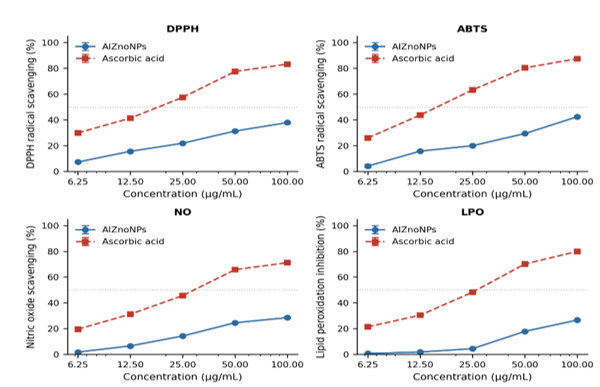
Green metal oxide nanoparticles has emerged as bioactive nanomaterials with broad therapeutic potential. In this study, zinc oxide nanoparticles biosynthesised using Azadirachta indica (neem) leaf extract (AIZnoNPs) were evaluated for their in vitro antioxidant capacity and cholinesterase inhibitory activity. X-ray diffraction analysis of AlZnONPs revealed a hexagonal wurtzite crystal structure and an average crystallite size of 16.8 nm. Dynamic Light Scattering results showed a gradual decrease in particle size of highly monodisperse particles with a polydispersity index of less than 0.3. The surface area of smaller particles was found to be relatively high from the Brunauer- Emmett- Teller analysis. The complete preparation and characterization report of AlZnONPs is currently under review and not detailed here. Antioxidant activity was assessed using DPPH, ABTS, ferric reducing antioxidant power (FRAP), nitric oxide (NO) scavenging, lipid peroxidation (LPO) inhibition, iron chelation, and copper chelation assays, while neuroprotective potential was evaluated through inhibition of acetylcholinesterase (AChE) and butyrylcholinesterase (BChE). The nanoparticles demonstrated concentration-dependent activity across all assays. The strongest antioxidant responses were recorded for ABTS (IC₅₀ = 210.21 µg/mL), DPPH (IC₅₀ = 290.96 µg/mL), and copper chelation (IC₅₀ = 168.76 µg/mL), while FRAP analysis revealed a dose-dependent increase in reducing power (absorbance =0.6099 ± 0.005 at 100 µg/mL). Enzyme inhibition assays showed notable AChE inhibitory activity(IC₅₀ = 245.70 µg/mL) compared to BChE (IC₅₀ = 1160.85 µg/mL). All activities were significantly lower than reference standards, indicating moderate but measurable bioactivity attributable to the phytochemical composition of A. indica extract and the nanoscale properties of the particles.
References
Akinsipo, O., Osinubi, A., & Adebayo, B. (2026). GREEN SYNTHESIS AND CHARACTERIZATION OF ZINC OXIDE NANOPARTICLES USING Euphorbia laterifloraLEAF EXTRACT: EVALUATION OF ANTIMICROBIAL AND ANTIOXIDANT ACTIVITIES. FUDMA JOURNAL OF SCIENCES, 10(2), 45–54. https://doi.org/10.33003/fjs-2026-1002-4456
Akinsipo (Oyelaja), O. B., Osinubi, A. D., Badeji, A. A., Ogunade, T. J., Idowu, A. D., Afolayan, O. J., Ajiwe, I. A., & Ameen, A. O. (2024). Green synthesized silver nanoparticles and their biomedical applications: a review. Scientia Africana, 23(3), 11–24. https://doi.org/10.4314/sa.v23i3.2
Alzohairy, M. A. (2016). Therapeutics Role of Azadirachta indica (Neem) and Their Active Constituents in Diseases Prevention and Treatment. Evidence-Based Complementary and Alternative Medicine : ECAM, 2016, 7382506. https://doi.org/10.1155/2016/7382506
Ansari, W. A., Srivastava, K., Nasibullah, M., & Khan, M. F. (2025). Reactive oxygen species (ROS): sources, generation, disease pathophysiology, and antioxidants. Discover Chemistry 2025 2:1, 2(1), 191-. https://doi.org/10.1007/S44371-025-00275-Z
Aseen, A. H., Gowthami, V., & Jyolsna, P. (2025). Green synthesis of NiO/ZnO nanocomposite using Vitex negundo leaf extract for antibacterial and anti-inflammatory activities. Journal of Integrated Science and Technology, 13(3). https://doi.org/10.62110/SCIENCEIN.JIST.2025.V13.1056
Asiri, Y. A., & Mostafa, G. A. E. (2023). Donepezil. Profiles of Drug Substances, Excipients and Related Methodology, 35, 117–150. https://doi.org/10.1016/S1871-5125(10)35003-5
Benzie, I. F. F., & Strain, J. J. (1996). The ferric reducing ability of plasma (FRAP) as a measure of “antioxidant power”: The FRAP assay. Analytical Biochemistry, 239(1), 70–76. https://doi.org/10.1006/abio.1996.0292
Blois, M. S. (1958). Antioxidant Determinations by the Use of a Stable Free Radical. Nature 1958 181:4617, 181(4617), 1199–1200. https://doi.org/10.1038/1811199a0
Brahim Mahamat, O., Asraoui, F., Farihi, A., Bouhrim, M., Boussaoudi, I., El Ismaili, S., Herqash, R. N., Shahat, A. A., Otchom, B. B., & Saoud, Y. (2025). Phytochemical analysis and antioxidant activity of Azadirachta indica A. Juss from the Republic of Chad: In vitro and in silico studies. Open Chemistry, 23(1). https://doi.org/10.1515/CHEM-2025-0178/XML
Chen, Z. R., Huang, J. B., Yang, S. L., & Hong, F. F. (2022). Role of Cholinergic Signaling in Alzheimer’s Disease. Molecules, 27(6), 1816. https://doi.org/10.3390/MOLECULES27061816
Cichon, N., Grabowska, W., Gorniak, L., Stela, M., Harmata, P., Ceremuga, M., & Bijak, M. (2024). Mechanistic and Therapeutic Insights into Flavonoid-Based Inhibition of Acetylcholinesterase: Implications for Neurodegenerative Diseases. Nutrients 2025, Vol. 17, Page 78, 17(1), 78. https://doi.org/10.3390/NU17010078
Cong, C., Cong, H., Yao, Y., Bai, Y., & Xu, L. (2025). Copper homeostasis and cuproptosis in Alzheimer’s disease (Review). International Journal of Molecular Medicine, 56(5), 172. https://doi.org/10.3892/IJMM.2025.5613
Dinis, T. C. P., Madeira, V. M. C., & Almeida, L. M. (1994). Action of phenolic derivatives (acetaminophen, salicylate, and 5-aminosalicylate) as inhibitors of membrane lipid peroxidation and as peroxyl radical scavengers. Archives of Biochemistry and Biophysics, 315(1), 161–169. https://doi.org/10.1006/abbi.1994.1485
Donmez, S. (2025). Phyto-Mediated Synthesis of Zinc Oxide Nanoparticles Using Black Chokeberry Fruit (Aronia melanocarpa L.) Extracts for Promising Antioxidant, Antibacterial, Antidiabetic, and Photocatalytic Activities. Journal of Cluster Science 2025 36:4, 36(4), 119-. https://doi.org/10.1007/S10876-025-02830-1
Ellman, G. L., Courtney, K. D., Andres, V., & Featherstone, R. M. (1961). A new and rapid colorimetric determination of acetylcholinesterase activity. Biochemical Pharmacology, 7(2). https://doi.org/10.1016/0006-2952(61)90145-9
Fayed, B., & Reda, A. E. (2026). Zinc meets metal: are Zn-based bimetallic nanoparticles the future of biological nanomedicine? Discover Applied Sciences 2026 8:4, 8(4), 436-. https://doi.org/10.1007/S42452-026-08236-6
Gyamfi, M., Yonamine, M., Vascular, Y. A.-G. P. T., & 1999, undefined. (n.d.). Free-radical scavenging action of medicinal herbs from Ghana: Thonningia sanguinea on experimentally-induced liver injuries. ElsevierMA Gyamfi, M Yonamine, Y AniyaGeneral Pharmacology: The Vascular System, 1999•Elsevier. Retrieved July 2, 2026, from https://www.sciencedirect.com/science/article/pii/S0306362398002389
Hussain, K., Lone, S. M., Masoodi, K. Z., & Balkhi, S. M. (2024). Antioxidants. Techniques for Biochemical Analysis, 211–214. https://doi.org/10.1016/B978-0-443-15914-5.00025-9
Islas, J. F., Acosta, E., G-Buentello, Z., Delgado-Gallegos, J. L., Moreno-Treviño, M. G., Escalante, B., & Moreno-Cuevas, J. E. (2020). An overview of Neem (Azadirachta indica) and its potential impact on health. Journal of Functional Foods, 74. https://doi.org/10.1016/J.JFF.2020.104171
Jiang, Y., Kang, Y., Liu, J., Yin, S., Huang, Z., & Shao, L. (2022). Nanomaterials alleviating redox stress in neurological diseases: mechanisms and applications. Journal of Nanobiotechnology 2022 20:1, 20(1), 265-. https://doi.org/10.1186/S12951-022-01434-5
Jomova, K., Raptova, R., Alomar, S. Y., Alwasel, S. H., Nepovimova, E., Kuca, K., & Valko, M. (2023). Reactive oxygen species, toxicity, oxidative stress, and antioxidants: chronic diseases and aging. Archives of Toxicology, 97(10), 2499. https://doi.org/10.1007/S00204-023-03562-9
Kamarajan, G., Anburaj, D. B., Porkalai, V., Muthuvel, A., & Nedunchezhian, G. (2022). Green synthesis of ZnO nanoparticles using Acalypha indica leaf extract and their photocatalyst degradation and antibacterial activity. Journal of the Indian Chemical Society, 99(10), 100695. https://doi.org/10.1016/J.JICS.2022.100695
Lakey-Beitia, J., Burillo, A. M., La Penna, G., Hegde, M. L., & Rao, K. S. (2021). Polyphenols as Potential Metal Chelation Compounds against Alzheimer’s Disease. Journal of Alzheimer’s Disease, 82(s1), S335–S357. https://doi.org/10.3233/JAD-200185 WEBSITE:WEBSITE:SAGE;WGROUP:STRING:PUBLICATION
Marcocci, L., Maguire, J. J., Droy-Lefaix, M. T., & Packer, L. (1994). The nitric oxide-scavenging properties of Ginkgo biloba extract EGb 761. Biochemical and Biophysical Research Communications, 201(2), 748–755. https://doi.org/10.1006/bbrc.1994.1764
Masternak, J., Zienkiewicz‐machnik, M., Łakomska, I., Hodorowicz, M., Kazimierczuk, K., Nosek, M., Majkowska‐młynarczyk, A., Wietrzyk, J., & Barszcz, B. (2021). Synthesis and structure of novel copper(Ii) complexes with n,o‐ or n,n‐donors as radical scavengers and a functional model of the active sites in metalloenzymes. International Journal of Molecular Sciences, 22(14), 7286. https://doi.org/10.3390/IJMS22147286/S1
Mohammed, A. M., Mohammed, M., Oleiwi, J. K., Ihmedee, F. H., Adam, T., Betar, B. O., & Gopinath, S. C. B. (2025). Comprehensive review on zinc oxide nanoparticle production and the associated antibacterial mechanisms and therapeutic potential. Nano Trends, 11, 100145. https://doi.org/10.1016/J.NWNANO.2025.100145
Murali, M., Kalegowda, N., Gowtham, H. G., Ansari, M. A., Alomary, M. N., Alghamdi, S., Shilpa, N., Singh, S. B., Thriveni, M. C., Aiyaz, M., Angaswamy, N., Lakshmidevi, N., Adil, S. F., Hatshan, M. R., & Amruthesh, K. N. (2021). Plant-Mediated Zinc Oxide Nanoparticles: Advances in the New Millennium towards Understanding Their Therapeutic Role in Biomedical Applications. Pharmaceutics 2021, Vol. 13, Page 1662, 13(10), 1662. https://doi.org/10.3390/PHARMACEUTICS13101662
Ohkawa, H., Ohishi, N., & Yagi, K. (1979). Assay for lipid peroxides in animal tissues by thiobarbituric acid reaction. Analytical Biochemistry, 95(2), 351–358. https://doi.org/10.1016/0003-2697(79)90738-3
Oluwaniyi, O. O., & Oyewo, B. T. (2025). Green Synthesis of Zinc Oxide Nanoparticles via Dennettia tripetala Extracts: Optimization, Characterization, and Biological Activity Evaluation. Nano Select, 6(5), e202400110. https://doi.org/10.1002/NANO.202400110
Petrov, W., Dawid´ Dawid´slebioda, D., Kozí Nska, R., Kukla, K., Petrov, P., Sroka, M., Tesyna, J., Pu´zniak, G. P., Kudlí Nski, M., Rejda, T., Skowron, I., & Chłopa´schłopa´s-Konowałek, A. (2026). Analysis of the Efficacy of Acetylcholinesterase Inhibitors in the Treatment of Alzheimer’s Disease, Literature Review. International Journal of Molecular Sciences 2026, Vol. 27, Page 5733, 27(13), 5733. https://doi.org/10.3390/IJMS27135733
Rananaware, P., Singh, S., & Brahmkhatri, V. P. (2025). Scavenging of reactive oxygen and nitrogen species using nanoparticles and their applications in disease management. RSC Advances, 15(56), 47955. https://doi.org/10.1039/D5RA05248C
Re, R., Pellegrini, N., Proteggente, A., Pannala, A., Yang, M., & Rice-Evans, C. (1999). Antioxidant activity applying an improved ABTS radical cation decolorization assay. Free Radical Biology and Medicine, 26(9–10), 1231–1237. https://doi.org/10.1016/S0891-5849(98)00315-3
Repetto, M., Semprine, J., & Boveris, A. (2012). Lipid Peroxidation: Chemical Mechanism, Biological Implications and Analytical Determination. Lipid Peroxidation. https://doi.org/10.5772/45943
Samrot, A. V., Ram Singh, S. P., Deenadhayalan, R., Rajesh, V. V., Padmanaban, S., & Radhakrishnan, K. (2022). Nanoparticles, a Double-Edged Sword with Oxidant as Well as Antioxidant Properties—A Review. Oxygen 2022, Vol. 2, Pages 591-604, 2(4), 591–604. https://doi.org/10.3390/OXYGEN2040039
Yu, D., Park, J., Kim, T., Choi, C., Yuk, S. A., & Kim, H. (2026). Nanotechnology-Enabled Delivery of Phytochemicals: From Formulation Strategies to Therapeutic Translation. Journal of Phytomedicine 2026, Vol. 1, Page 4, 1(1), 4. https://doi.org/10.3390/JPHYTOMED1010004
Downloads
Published
Issue
Section
Categories
License
Copyright (c) 2026 Oyesolape Basirat Akinsipo, Francis Olumide Oladapo, Adetoro Ajibike Osanyibi, Fatimoh Titilope Arole, Oluwaseun Adenike Orugun

This work is licensed under a Creative Commons Attribution 4.0 International License.


