
Assessment of Radon - 222 Activity Concentration and Associated Effective Doses in Groundwater Sources in BIU, Borno State, Nigeria
DOI:
https://doi.org/10.33003/fjs-2026-1019-6162Keywords:
Radon, Well, Borehole, Water, Biu, USEPA, WHOAbstract
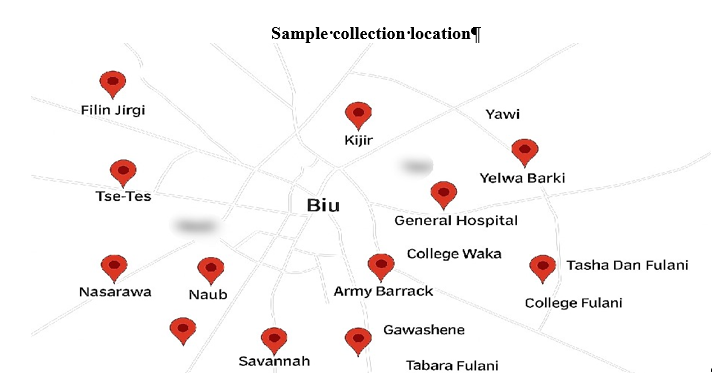
This research titled “Assessment of Radon - 222 Activity Concentration and Associated Effective doses in Groundwater Sources in Biu, Borno State, Nigeria” Were carried out in Biu due it geological nature that contains sedimentary rock basement and the good number of population attracted from near by villages due to insurgence. This studies investigates the concentration of Radon-222 Activity in groundwater sources used for domestic purposes. Fifteen (15) water samples were collected from wells and boreholes across selected locations within Biu Metropolis . The percentage of borehole to well water sample collected is at the ratio of (70 to 30 )%. The samples were analyzed using a Liquid Scintillation Counter (Tri-Carb-LSA1000) at the Centre for Energy Research and Training (CERT), Ahmadu Bello University, Zaria. It was observed in table 2,. Well water recorded a higher concentration of 22.45 Bq/L than borehole water 13.59 Bq/L The highest value (22.5 Bq/L) occurred in Yawi, while the lowest (10 Bq/L) was found in Tasha Dan Fulani. The overall average concentration is found to be 14.77 Bq/L,which exceeds the USEPA (11.1 Bq/L) and WHO (10 Bq/L) permissible limits of the international safety limits.The overall Annual effective dose due to inhalation of Radon in the water sources is found to be less than the permissible limit of 100μSvy-1 set by WHO. Also, the overall AED due to ingestion of Radon is found to be higher than the WHO permissible limit of 100 μSvy-1 for adults and less than the permissible limit of 200 μSvy-1 for children
References
Adulkadir, W. A., A. Bello., A Yakubu., S.T. Sununu., A. Usman., and M. Sulieman., (2021). Investigation of Radon Concentration in Drinking Water in Some Selected Areas of Sokoto, Nigeria. International Journal of Scientific Research, 9(6): 86-91.
Bem, H., Plota, U., Staniszewska, M., Bem, E. M., &Mazurek, D. (2014). Radon (222Rn) in
underground drinking water supplies of the southern Greater Poland region. Journal of Radioanalytical and Nuclear Chemistry, 299, 1307–1312.
Cho, J. S. (2004). Radon concentration in groundwater in Busan measured with a liquid scintillation counter. Journal of Environmental Radioactivity, 75, 105–112.
David, B. M., Robkin, A., & David, R. S. (1989). Indoor radon and its hazard (2nd ed.). University of Washington Press.
Duggal, V., Mehra, R., & Rani, A. (2013). Determination of 222Rn level in groundwater using a RAD7 detector in the Bathinda district of Punjab, India. Radiation Protection Dosimetry, 156, 239–245.
Garba, N. N., Rabi'u, N., Yusuf, A. M., &Isma'ila, A. (2008). Radon: Its consequences and measurement in our living environs. Journal of Research in Physical Sciences, 4(4), 23–25.
Garba, N.N., Rabi'u, N. Dewu B.B.M., (2012). Preliminary studies on 222Rn concentration in groundwater from Zaria, Nigeria, Journal Physical. Science. 23(1) 57–64.
Garba N. N. Rabi’u, N., Dewu, B. B. M., Sadiq, U., and Yamusa, Y. A., (2013). Radon assessment in groundwater sources from Zaria and environs, Nigeria. International Journal of Physical Sciences, 8(42): 1983–1983.
Jibril, M. K., Garba, N. N., Nasiru, R., and Ibrahim, N., (2021). Assessment of Radon Concentrations in Water Sources from Sabon Gari Local Government Area, Kaduna State, Nigeria. FUDMA Journal of Sciences (FJS), 5(1), 25-260
Irene, Opoku-Nitim., Owiredu, Gynampo., and Aba, Bentil. Andam., (2019). Risk Assessment of Radon in Some Bottled Water on the Ghanaian Market. Environmental Research community,
Jauro D., Ngari, A. Z., Teru P. B. and Yaram, A. T (2024) Radon-222 Concentration and Health Implication in Borehole Water of Ngumari Costain, Jere, Local Government, Borno State. Nigerian Journal of Physics (NJP),33(3), 134-141 DOI: 4https://doi.org/10.62292/njp.v33i3.2024.280
Kendel, G. M., & Smith, T. J. (2002). Dose to organs and tissues from radon and its decay products. Journal of Radiological Protection, 22, 389–406.
Krishna, Pal .Singh., Subhash, Chandra., Mukesh, Prasad., Abhishek, Joshi., Ganesh Prasad., and R. C. Ramola., (2023). Estimation of radiation dose due to ingestion of radon in water samples of Garhwal Himalaya, India. Journal of Radioanalytical and Nuclear Chemistry, springer. https://doi.org/10.1007/s10967-023-09002-3
Oni, O. M., Yusuff, I. M., Adagunodo, T. A., (2019). Measurement of Radon-222 Concentration in Soil-Gas of Ogbomoso Southwestern Nigeria using RAD7. International Journal of History and Scientific Studies Research, (IJHSSR) https://doi.org/10.1088/1742- 6596/1299/1/012
Rilwan, U., Yahaya, I., Musa, M., Galadima, O.O., Waida, J., and Idris, M. M., (2022). Investigation of Radon-222 in Water from Loko Town in Nasarawa, Nasarawa State, Nigeria. Journal of Oncology and Cancer Screening,
Salik, Nazir., Shakeel, Simnani., B. K. Sahoo., Rosaline Mishra., Tanu Sharma., Sajad, Masood., (2020). Monitoring geothermal springs and groundwater of Pir Panjal, Jammu, and Kashmir, for radon contamination. Journal of Radioanalytical and Nuclear Chemistry Springer, https://doi.org/10.1007/s10967- 020-07451-8.
Shilpa, G. M., Anandaram, B. N., &Mohankumari, T. L. (2017). Measurement of 222Rn concentration in drinking water in Karnataka. Journal of Research and Applied Science, 10(3), 262–268.
Somlai, K. (2007). 222Rn concentration of water in Balaton Highland and southern Hungary. Radiation Measurement, 42, 491–494.
Sura, Al-Harahsheh., and Mohummad, Al-Dalabeeh., (2020). Measurement of Radon Levels in the Groundwater of Al-Rusaifah City in Zarqa Governorate Using Liquid Scintillation Counter. Jordan Journal of Earth and Environmental Sciences (JJEES) 11(2): 98- 102.
Suresh, S. Rangaswamy, D. R., Srinivasa E., and Sannappa, J., (2020). Measurement of radon concentration in drinking water and natural radioactivity in soil and their radiological hazards. Journal of radiation research and applied sciences, 13(1). 12–26 https://doi.org/10.1080/16878507.2019.1693175.
Umma, Abdullahi., Asuku, A., Umar, A., Ahmed, Y. A., Adam, U. S., Abdulmalik, N. F., Yunusa, M. H. and Abubakar, A. R.., (2020). Assessment of Radon Concentration and Associated Health Implications in Ground Water and Soil Around Riruwai Mine Site, Kano State, Nigeria and its Environs. FUDMA Journal of Sciences (FJS), 4(3). 242–246.
United States Environmental Protection Agency USEPA, (2017). Radon in Drinking Water: Health Risk Reduction and Cost Analysis. World Health Organization WHO, (2008). Guidelines for drinking water quality, 3rd edition: Volume 1; Recommendation incorporating the first and second addenda, Geneva. Switzerland
United Nations Scientific Committee on the Effects of Atomic Radiation, UNSCEAR, (2000). Sources, Effects, and Risks of Ionizing Radiation. Report to the General Assembly.
WHO. (2016). Radon and health. http://www.who.int/mediacentre/factsheets/fs291/en/
Xinwei, L. (2006). Analysis of radon concentration in drinking water in Bagi (China). Radiation Protection Dosimetry, 121(2), 158–167
Downloads
Published
Issue
Section
Categories
License
Copyright (c) 2026 Adamu Z. Ngari, Oyono S. Job, James H. Kanus, Andrew Abel, Haruna S. Ahmed

This work is licensed under a Creative Commons Attribution 4.0 International License.


