
Assessing the Efficiency of Automated Land Administration: A Study of the Kano Geographic Information System (KANGIS), Nigeria
DOI:
https://doi.org/10.33003/fjs-2026-1019-6160Keywords:
Land Information System, KANGIS, land administration, service delivery, ICT infrastructure, land-use applications, Geographic Information SystemAbstract
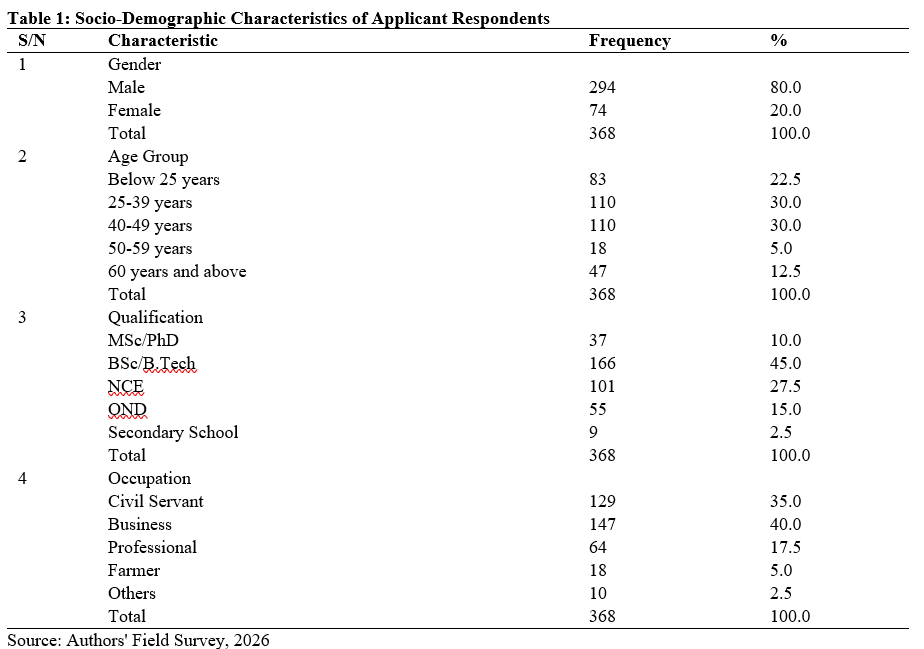
This study assessed the efficiency of the automated land administration system implemented by the Kano Geographic Information System (KANGIS) in Kano Metropolis, Nigeria, from the perspective of land applicants. A quantitative research design was adopted, using a structured questionnaire administered to 368 of 14,403 registered applicants, alongside secondary data from official KANGIS records (2014-2025). Primary data were analysed using descriptive statistics, while secondary data were analysed using 3-month and 12-month moving average trend analysis. KANGIS significantly improved land administration services, with strong ratings for transparency (Mean = 1.33), record accuracy (Mean = 1.35), and reduced processing time (Mean = 1.63), although site inspection (Mean = 2.55) and final approval (Mean = 2.66) received only moderate ratings. Technical infrastructure (Mean = 1.54), staff training (Mean = 1.58), network connectivity (Mean = 1.60), and clarity of user guidance (Mean = 2.72) were identified as significant constraints. Trend analysis of 14,388 applications processed between 2014 and 2025 revealed substantial fluctuations, declining by 67.2% between 2014 and 2018, collapsing by 62.4% in 2024, and rebounding by 378.3% in 2025, coinciding with the state-wide Certificate of Occupancy recertification exercise launched in late 2024. The study concludes that while KANGIS has substantially modernised land administration and demonstrated capacity for recovery, its full potential remains constrained by infrastructural deficiencies, human capacity gaps, and procedural bottlenecks. Sustained investment in technical infrastructure, staff training, network connectivity, and user support is recommended to stabilise service delivery and restore public confidence in land administration services in Kano State.
References
Abab, S. A., Wakjira, F. S., & Negash, T. T. (2021). Determinants of the land registration information system operational success: Empirical evidence from Ethiopia. Land, 10(12), 1394. https://doi.org/10.3390/land10121394
Adeniyi, P. O. (2018). Land information systems and sustainable land administration in Nigeria. Nigerian Journal of Surveying and Geoinformatics, 3(1), 12-24.
Aholou, C. C. (2024). Cadastres and land management in Africa: Discussions on their sustainability and lessons through a semisystematic review. Journal of Infrastructure Policy and Development, 8(14), Article 9327. https://doi.org/10.24294/jipd9327
Aluko, B. T., & Amidu, A. (2006). Urban low income settlements, land deregulation and sustainable development in Nigeria [Paper presentation]. 5th FIG Regional Conference, Accra, Ghana.
Ameyaw, D. P., & de Vries, W. T. (2021). Toward smart land management: Land acquisition and the associated challenges in Ghana. A look into a blockchain digital land registry for prospects. Land, 10(3), Article 239. https://doi.org/10.3390/land10030239
Daily Trust. (2025, February 15). GIS: Disputes over land titles persist despite computerisation. Daily Trust. https://dailytrust.com/gis-disputes-over-land-titles-persist-despite-computerisation/
Democracy in Africa. (2024, July 26). Digital democracy? Offline challenges to electronic land registries. https://democracyinafrica.org/digital-democracy-offline-challenges-to-electronic-land-registries/
Ekebuike, A. N., & Igbokwe, E. C. (2024). Assessment of problems and prospects of land management digitisation in Nigeria: The role of cloud computing in Anambra State [Preprint]. ResearchGate.
Kabigi, B., de Vries, W. T., & Kelvin, H. (2021). A neo-institutional analysis of alternative land registration systems in Tanzania: The cases of Babati and Iringa districts. Land Use Policy, 105, Article 105396.
Kano State Geographic Information System (KANGIS). (2026). About KANGIS: Mandate and core functions. Kano State Ministry of Land and Physical Planning. https://kangis.gov.ng/
Ntongani, E. E. (2023). Landowners' perception on the implementation of Integrated Land Management Information System (ILMIS) in Kinondoni Municipality, Dar es Salaam. African Journal of Law and Public Policy, 2(1), 1-16.
Papaskiri, T., Burov, M., Ananicheva, E., Shevchuk, A., & Popova, E. (2021). Information and technological support of digital land management. IOP Conference Series: Earth and Environmental Science, 867, Article 012174. https://doi.org/10.1088/1755-1315/867/1/012174
Saunders, M., Lewis, P., & Thornhill, A. (2019). Research methods for business students (8th ed.). Pearson Education.
Williamson, I., Enemark, S., Wallace, J., & Rajabifard, A. (2010). Land administration for sustainable development. ESRI Press.
Yamane, T. (1967). Statistics: An introductory analysis (2nd ed.). Harper and Row.
Downloads
Published
Issue
Section
Categories
License
Copyright (c) 2026 Dahiru Suleiman, Baballe Mukhtar Isyaku, Aisha Mahmood Baba, Umar Alhassan Khalil, Mukhtar Muhammad

This work is licensed under a Creative Commons Attribution 4.0 International License.


