
Interpretable Machine Learning for Credit Risk Decision Support: Balancing Interpretability and Predictive Performance
DOI:
https://doi.org/10.33003/fjs-2026-1020-6143Keywords:
Explainable AI, Interpretable Machine Learning, Institutional Decision Support, Credit Risk, Model Comparison, Scikit-LearnAbstract
With the growing prevalence of machine learning in making institutional decisions, there is a need for careful balancing of predictive accuracy and interpretability of such models. In this research work, the performance and interpretability of three machine learning models in helping institutions make decisions were investigated, particularly the issue of credit risk assessment. In this process, the German Credit Data dataset, which is open source (N = 1,000), was used and subjected to 5-
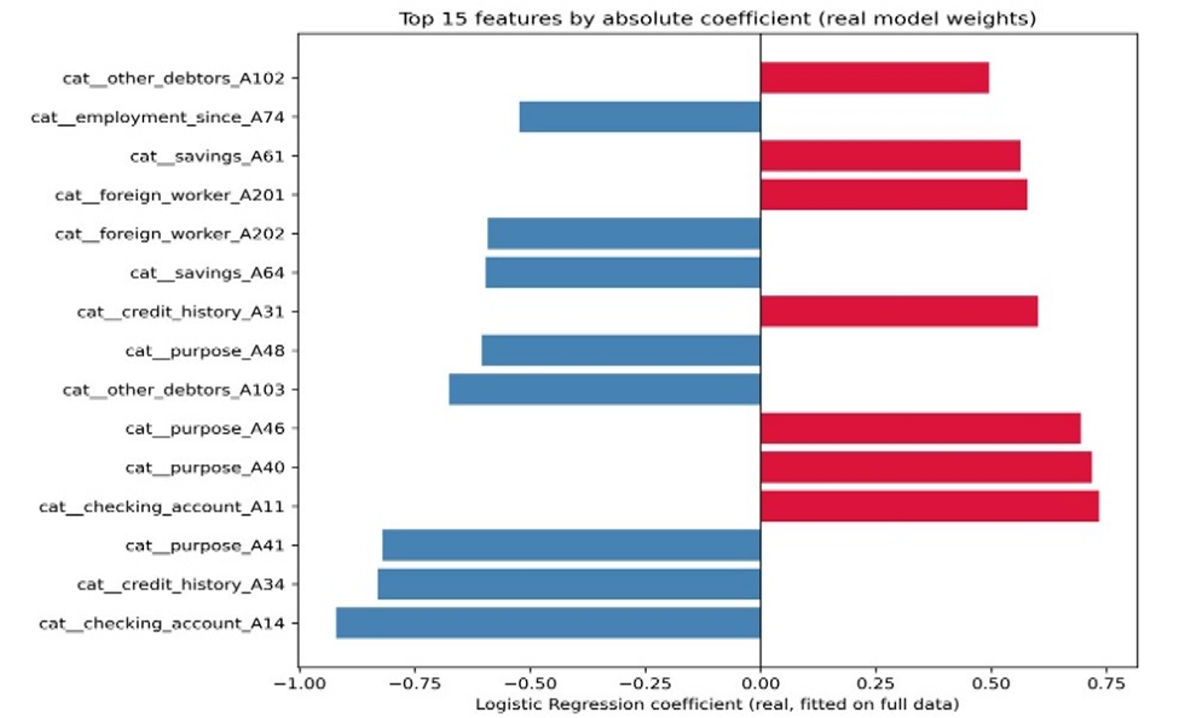
Fold Cross-Validation. The results show that while Random Forest attained the highest accuracy (76.3%), Logistic Regression had the highest discriminating power (AUC: 0.79), just marginally better than the complex ensemble approach (AUC: 0.78). It also has the added advantage of better interpretability due to clear coefficient and decision rule visualization. This clearly shows that inherently interpretable models serve as a very good alternative to the complex ensemble approach in decision-making within organizations, without falling prey to the “black-box” problem, and in some cases even performing better in discriminatory power.
However, the study notes relatively low minority-class recall (36.3–46.3%), highlighting a practical limitation. Conclusions are based on a benchmark dataset and the specified model configurations.
References
Al-Sammerraie, A. H. K. (2025). Between human trust and algorithmic prediction: Designing intelligent systems using XAI and modern big data platforms. Central Asian Journal of Mathematical Theory and Computer Sciences, 6(4), 747-757. https://cajmtcs.casjournal.org/index.php/CAJMTCS/article/view/806
Ayari, H., Guetari, R., & Kraïem, N. (2026). Machine learning powered financial credit scoring: A systematic literature review. Artificial Intelligence Review, 59(1), 13. https://doi.org/10.1007/s10462-025-11416-2
Nallakaruppan, M. K., Chaturvedi, A., & Sharma, R. (2024). Credit risk assessment and financial decision support using explainable AI. Risks, 12(10), 164. https://doi.org/10.3390/risks12100164
Machado, M. R., Chen, D. T., & Osterrieder, J. R. (2025). An analytical approach to credit risk assessment using machine learning models. Decision Analytics Journal, 16, 100605. https://doi.org/10.1016/j.dajour.2025.100605
De Lange, P. E., Kozodoi, N., & Lessmann, S. (2022). Explainable AI for credit assessment in banks. European Journal of Operational Research, 299(2), 582-597. https://doi.org/10.1016/j.ejor.2021.07.025
Černevičienė, J., & Kabašinskas, T. (2024). Explainable artificial intelligence (XAI) in finance: A systematic literature review. Artificial Intelligence Review, 57(8), 245. https://doi.org/10.1007/s10462-024-10854-8
Sterling, J., & Chen, L. (2026). A comparative analysis of explainable AI techniques in consumer credit scoring. Journal of Financial Services Research, 69(2), 145-168. https://doi.org/10.1007/s10693-026-09387-4
Rao, A., Patel, S., & Kumar, V. (2025). Enhancing credit scoring models with explainable AI: An ensemble approach. Journal of Banking and Financial Data Science, 9(11), 1-11. https://doi.org/10.2139/ssrn.5190418
Mishra, S., & Gupta, R. (2025). LightGBM with ADASYN and SHAP vs. XGBoost for credit scoring: A comparative study. International Journal of Machine Learning and Cybernetics, 16(3), 892-907. https://doi.org/10.1007/s13042-025-00389-2
Aboulmaouda, R., Elhadj, B., & Benali, M. (2026). Credit risk scoring in the age of AI: A systematic review of accuracy, stability, and interpretability. Journal of Financial Transformation, 52, 78-95. https://doi.org/10.2139/ssrn.6585058
Carvalho, D. V., Pereira, E. M., & Cardoso, J. S. (2019). Machine learning interpretability: A survey on methods and metrics. Electronics, 8(8), 832. https://doi.org/10.3390/electronics8080832
Rudin, C. (2019). Stop explaining black box machine learning models for high stakes decisions and use interpretable models instead. Nature Machine Intelligence, 1(5), 206-215. https://doi.org/10.1038/s42256-019-0048-x
Hofmann, H. (1994). Statlog (German Credit Data) Data Set. UCI Machine Learning Repository. https://doi.org/10.24432/C5NC77
Downloads
Published
Issue
Section
Categories
License
Copyright (c) 2026 Mohaned Zkaria Salem

This work is licensed under a Creative Commons Attribution 4.0 International License.